Demeter's Harvest Myth Meaning & Symbolism
A mother's grief for her abducted daughter brings the world to winter, forging a sacred cycle of loss, descent, and cyclical return.
The Tale of Demeter's Harvest
Hear now the story that holds the turning of the world in its heart, the tale of the green-giving mother and the stolen light.
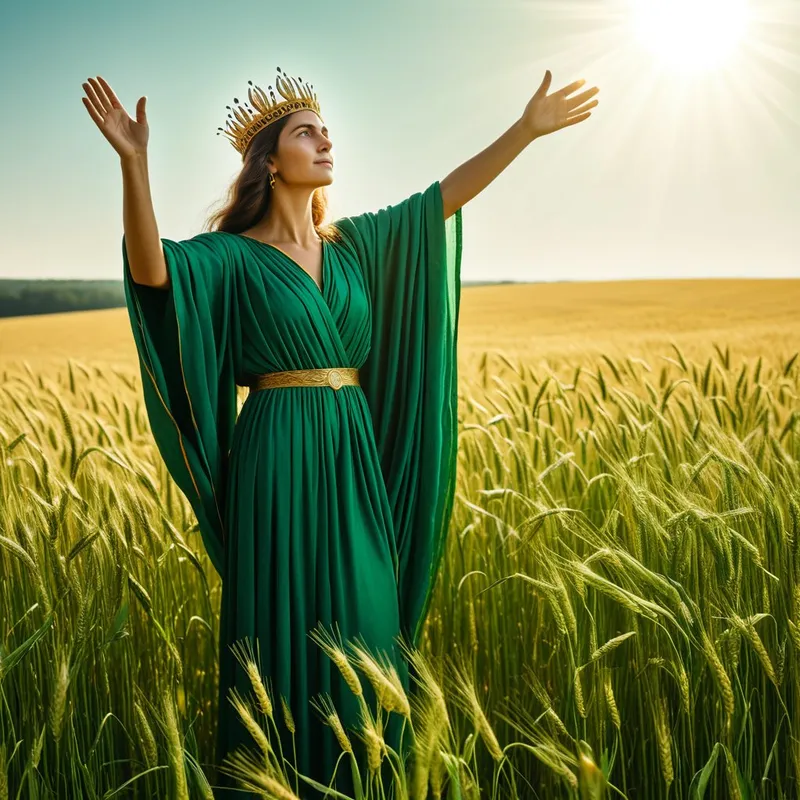
In the first days, when the world was young and laughter echoed in the sunlit meadows, the Earth was a place of unending bounty. This was the gift of Demeter, whose footsteps caused flowers to bloom and whose glance ripened the grain. Her joy was her daughter, Kore, later known as Persephone, a girl whose laughter was the sound of spring streams and whose hair held the scent of all blossoms.
But the world below, the realm of Hades, was a silent, shadowed place. From his sunless throne, he saw the maiden’s light and desired it for his own. With the silent assent of her father, Zeus, he devised a theft that would break the world. One day, as Kore wandered in a Nysian meadow, a narcissus of breathtaking beauty caught her eye. As she reached for it, the earth beneath her feet cracked open with a sound like thunder. From the chasm, Hades rose in his chariot of obsidian, seized the screaming maiden, and plunged back into the depths. The only witness was the sun god Helios, who saw all from his chariot in the sky.
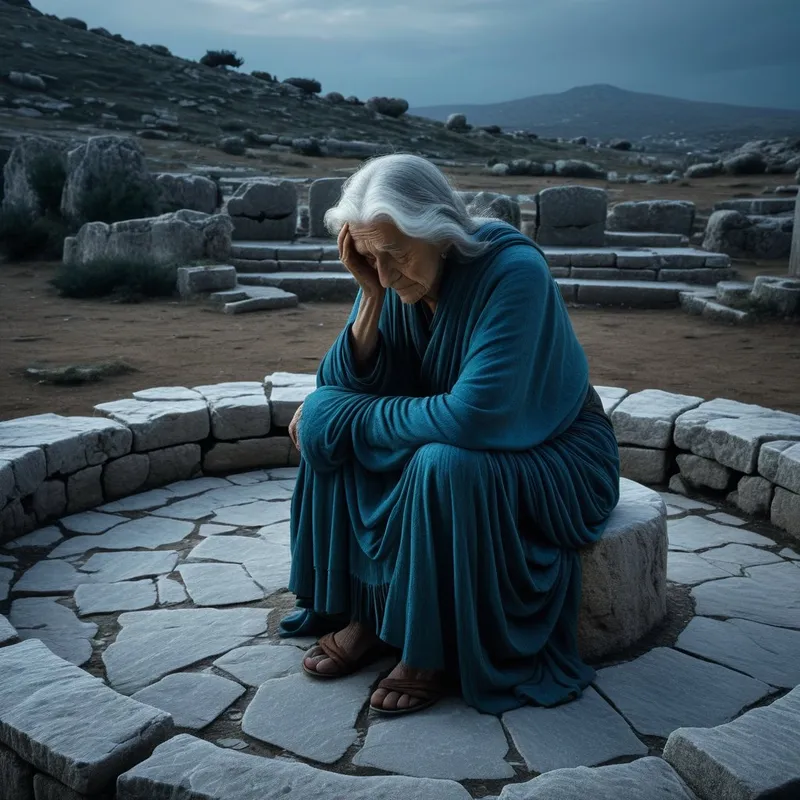
A silence fell upon the land. Then, a sound began—a mother’s cry. Demeter heard the echo of her daughter’s scream and felt the emptiness where her soul had been. With a grief that turned her bones to ice, she tore the headdress from her hair and cast aside her divine robes. For nine days and nights, she wandered the earth as a mortal crone, a torch in each hand, refusing ambrosia and nectar, her tears falling as acid rain upon the soil. Nothing grew. Nothing lived.
Her desperate search led her to the town of Eleusis. Disguised as an old woman named Doso, she sat by the Maiden Well upon the Agelastos Petra. There, the daughters of King Celeus found her and brought her to their home to nurse their infant brother, Demophoön. In her sorrow, a strange tenderness awoke. Seeking to gift the child with immortality, she anointed him with ambrosia and held him in the hearth’s sacred fire each night. But when his mother, Metaneira, discovered this, she screamed in terror, breaking the magic. Demeter revealed her terrible, glorious divinity and demanded a temple be built in her name.
There, in her temple at Eleusis, the goddess sat in wrathful mourning. The earth mirrored her soul. The soil hardened to iron. Seeds rotted in the ground. Trees became skeletons clutching at a grey sky. Famine stalked humanity, and the smoke of sacrifices ceased to rise to Olympus. The gods themselves grew weak.
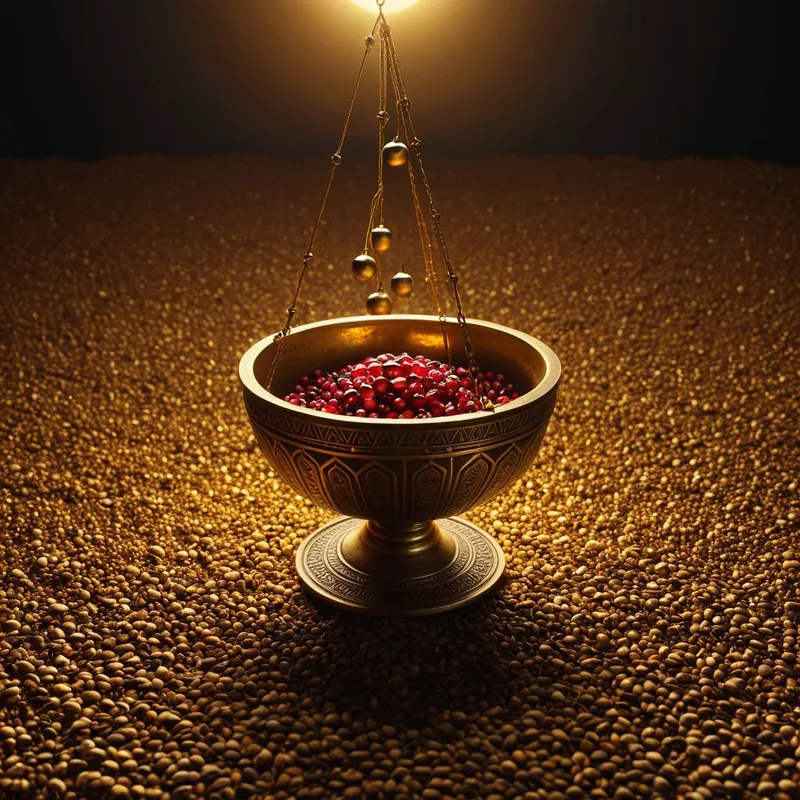
Finally, Hermes was sent to the underworld to parley. Hades, compelled, agreed to release Persephone—but only if she had eaten nothing in his realm. Alas, she had eaten. Tricked or perhaps resigned, she had consumed three seeds of a pomegranate. This was the unbreakable law of the Fates: consumption in the land of the dead meant eternal binding to it.
A compromise was forged, the great turning of the wheel. For each seed eaten, Persephone would spend one month of the year as Queen of the Dead beside Hades. The rest of the year, she would return to the light and her mother’s arms. When Hermes led Persephone from the cleft in the earth, Demeter’s gaze fell upon her, and winter broke. Flowers erupted through the snow. Grain surged from the frozen ground. Life returned, not as it was, but as it would forever be—a cycle born of profound loss and a hard-won return.
Cultural Origins & Context
This is not merely a story; it is the sacred heart of the Eleusinian Mysteries, the most revered and well-guarded initiatory cult of the ancient Greek world. For nearly two millennia, from Mycenaean times well into the Roman era, initiates—from slaves to emperors like Marcus Aurelius—made the pilgrimage to Eleusis. They participated in rituals that re-enacted Demeter’s search and Persephone’s return, culminating in the revelation of the epopteia, which promised a blessed afterlife free from the fear of death.
The myth was canonized in the Homeric Hymn to Demeter, our primary source. It functioned as a divine charter for the seasons, an etiological myth explaining why winter comes. But more profoundly, it served as societal bedrock. It sacralized the agricultural cycle, making the sowing and reaping of grain a holy act mirroring cosmic law. It validated the profound experiences of maternal love, feminine power, and the traumatic transition of marriage (symbolized by Persephone’s abduction). The myth provided a container for the most human of experiences—devastating loss and the fragile, miraculous hope of renewal.
Symbolic Architecture
The myth’s power lies in its perfect, painful symmetry. It is a map of the soul’s necessary descent.
The seed must fall into the dark earth and die to itself to become the stalk of grain. Persephone’s abduction is not a punishment, but a fate—the necessary journey into the underworld of the unconscious that precedes any true awakening.
Demeter represents the conscious, nurturing world—the ego, the known, the cultivated field. Her grief is the ego’s shattering when confronted with a loss it cannot control. Her wrath, which brings winter, shows that when the conscious mind is wounded to its core, the entire psyche can fall fallow. Persephone is the innocent, burgeoning life-force, the anima, or the potential self that must be taken into the depths to be transformed. Her return is not as the maiden Kore, but as Persephone, Queen of the Dead—integrated, powerful, and bearing the wisdom of both worlds.
The pomegranate seeds are the quintessential symbol of the paradoxical bargain. They represent the taste of the underworld, the knowledge of death, shadow, and sexuality that, once consumed, forever changes you. You cannot have the full richness of life without accepting your bond to the dark. Hades is not a villain, but the personification of the necessary, hidden ground of being—the shadow realm where vital energies and forgotten truths reside.
The Dreamer's Resonance
When this myth stirs in modern dreams, it signals a profound initiation underway in the dreamer’s psyche. You may dream of a lush garden suddenly freezing over; of a beloved child or younger self vanishing down a hole in the ground; of finding a single, luminous fruit in a dark cellar. You may be the searching mother or the descending daughter.
Somatically, this can feel like a deep, inexplicable grief unrelated to current events—a “winter of the soul.” It is the psyche’s process of “fallowing,” where conscious pursuits lose their meaning and energy withdraws inward. The dreamer is in the phase of Demeter at the well: sitting with absolute loss, feeling the world has turned to stone. This is not depression in a purely clinical sense, but a sacred withdrawal. The psyche is compelling a descent, forcing a confrontation with what has been “abducted”—perhaps one’s joy, creativity, or a sense of innocence—into the personal underworld of unresolved trauma, repressed desire, or un-lived life.

Alchemical Translation
The alchemy of Demeter’s Harvest is the transformation of prima materia—raw grief and barrenness—into the gold of conscious, cyclical living. It models the path of individuation.
The first stage is nigredo: the abduction, the winter, the despair. The ego’s known world is shattered. The second is albedo: the search, the lighting of the torches, the painful clarity of loss. Demeter’s refusal to let life continue falsely is a supreme act of psychic integrity.
The compromise—the cyclical return—is the citrinitas and rubedo. It is the realization that wholeness is not a static state of perpetual light, but a dynamic rhythm. The modern individual undergoing this alchemy learns to honor their own seasons. There are times to be in the world, productive and nurturing (the summer of Demeter’ joy). And there are necessary times to descend, to tend the inner Hades, to sit with the Queen of Shadows within (the winter of introspection and incubation).
The harvest is no longer just grain, but the hard-won wisdom of the cycle itself. To live this myth is to understand that every loss seeds a future return, that every descent grants a sovereignty you could not gain in the light alone, and that the most profound growth is born from the agreement to taste the pomegranate and carry its stain, knowing it is the price of being fully, messily, gloriously alive.
Associated Symbols
Explore related symbols from the CaleaDream lexicon: