Demeter's Grove Myth Meaning & Symbolism
A sacred grove becomes the epicenter of a goddess's grief, transforming the world and revealing the deep, cyclical nature of loss and renewal.
The Tale of Demeter's Grove
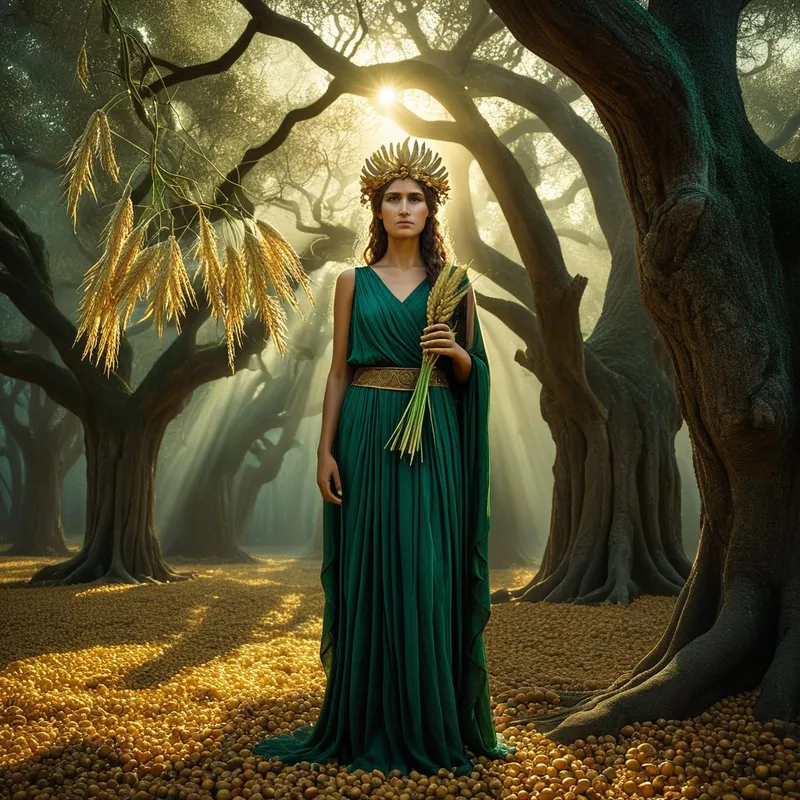
Listen. There is a place where the world holds its breath, a sanctuary older than kings. This is Demeter's Grove, a cathedral of oak and whispering poplar, of barley and vine. Here, the air is thick with the scent of fertile earth and ripening fruit, a perfume of pure, unthinking abundance. For this is the heart of the goddess's joy, the place where her daughter, Persephone, would dance with her Oceanid companions, her laughter a silver bell that made the flowers turn their faces to the sun.
But a shadow fell that knew no season. From a great chasm in the grove's very floor, the black chariot of Hades erupted, drawn by steeds of eternal night. The earth groaned. The laughter died. In a single, violent moment, the lord of the unseen world seized Persephone and plunged back into the depths, the scar in the earth sealing behind him as if it had never been. Only a single, torn narcissus blossom and a profound, echoing silence remained.
Then came the mother. Demeter felt the rupture in the world's soul, a cold knife in her own divine heart. She descended to the mortal plane, her radiance cloaked in a grief so vast it dimmed the sun. For nine days and nine nights, she wandered the earth, a torch in each hand, her voice a raw cry on the wind that withered the fields she passed. No nectar touched her lips, no ambrosia. Her search led her back, inevitably, to her own sacred grove—the site of the crime.
Here, she sat upon a rough outcropping the locals would later call the Agelastos Petra, the Mirthless Stone. Here, in the epicenter of her loss, the goddess of growth became the embodiment of barrenness. The grove itself began to mirror her inner state. The leaves, once vibrant, hung limp. The fruit shriveled on the branch. The very soil grew hard and cold. From this stone throne of despair, the great famine began to spread, a grey wave across the world, starving gods and mortals alike.
It was here, in the blighted heart of her own sanctuary, that the old goddess Hestia, and the keen-eyed Eos, witnessed her sorrow. It was here that the sun god Helios, from his lofty chariot, finally revealed the truth: Zeus himself had sanctioned the dark marriage. Betrayal was added to loss. Demeter's grief curdled into a silent, potent wrath. She would not return to Olympus. She would let the world die until her eyes beheld her child again.
The resolution was forged not in the bright halls of gods, but in the negotiated return from the underworld. Yet, the grove bore witness to the new, painful truth. For Persephone had eaten the seeds of the pomegranate in the land of the dead, binding her to it for a portion of each year. And so, the cycle was etched into the very soul of the grove. Now, it knows both the exuberant bloom of reunion and the silent, waiting grief of the descent. It is no longer just a place of untrammeled joy, but a temple to the sacred, necessary rhythm of holding and release, of life that is forever deepened by its acquaintance with loss.

Cultural Origins & Context
The myth of Demeter and Persephone, with her sacred grove as a pivotal setting, is central to the Eleusinian Mysteries, the most famous and revered initiatory cult of the ancient Greek world. For nearly two millennia, initiates made the pilgrimage from Athens to Eleusis to participate in secret rites that promised a blessed lot in the afterlife. The myth was not merely a story to be read, but a sacred drama (dromenon) to be ritually enacted and experienced.
The tale was passed down through the Homeric Hymn to Demeter, a poetic text likely composed in the 7th century BCE. It functioned as a foundational aition (origin story) for the Mysteries themselves. The grove, the Mirthless Stone, and the actions of the goddesses within that landscape were not just narrative details; they were believed to be the very historical and sacred geography of the Eleusinian sanctuary. The myth served a profound societal function: it explained the existential reality of the seasonal cycle, provided a framework for understanding profound grief, and, through the Mysteries, offered individuals a personal, transformative encounter with the promise of renewal beyond death, softening humanity's primal fear of the unknown.
Symbolic Architecture
At its core, the myth is an archetypal map of the psyche's experience of catastrophic loss and the arduous path toward a new, integrated consciousness. Demeter represents the primal, nurturing aspect of the Self that is utterly identified with its creation—her daughter. Persephone is that cherished creation: one's joy, innocence, vitality, or a beloved relationship.
The abduction is the unforeseen trauma that tears a vital part of the soul into the unconscious underworld.
The Grove symbolizes the inner sanctum of the psyche, the place where one's deepest identity and joy reside. Hades' eruption from within it is critical—the trauma does not come from an external enemy, but erupts from the unseen depths (chthonic) of life itself. Demeter's subsequent desolation of the grove illustrates a fundamental psychological truth: when a core part of the self is lost, the entire inner world can fall fallow. Creativity dries up, energy wanes, and a spiritual winter sets in.
The pomegranate seeds are the symbol of an irreversible psychological fact. Once one has tasted the fruit of the underworld—once one has known deep grief, trauma, or depression—one is forever changed. A part of the soul now has citizenship in that darker, richer realm. The resolution is not a return to a previous innocence, but the establishment of a cyclical rhythm. The ego (Demeter) must learn to live with the periodic descent of its vitality (Persephone) into the unconscious, trusting in its return.
The Dreamer's Resonance
When this mythic pattern stirs in the modern dreamer, it often signals a profound process of mortificatio or dark night of the soul. Dreaming of a once-beautiful, familiar place (a childhood home, a favorite garden) that has become overgrown, withered, or eerily silent mirrors Demeter's blighted grove. It is the psyche's somatic portrait of depression or bereavement.
Dreams of searching frantically for a lost child or a precious object in a labyrinthine landscape echo the goddess's torchlit quest. The "Mirthless Stone" may manifest as a feeling of being paralyzed on a cold, hard surface within the dream, a direct embodiment of depressive stasis. Conversely, dreaming of a single, luminous fruit (like a pomegranate) in a bleak landscape, or of a sudden, unexpected chasm opening in a safe place, points to the moment of rupture or the binding oath that changes everything. These dreams are not pathologies, but the psyche's innate, mythic way of processing deep loss and initiating the slow, non-linear journey toward a renewal that includes, rather than erases, the scar.

Alchemical Translation
The myth of Demeter's Grove is a perfect allegory for the Jungian process of individuation—the alchemical transmutation of the psyche toward wholeness. The initial state is one of unconscious unity (Mother and Daughter in the sunny grove). The abduction is the necessary separatio, the cruel but fateful act that differentiates the psyche, dragging a part of it into the shadowy nigredo.
The famine is the nigredo of the soul, the barren winter where all previous meanings die so that a new, more conscious relationship to life can be born.
Demeter's stubborn, grieving rage on the stone is the putrefactio, a necessary rotting of old attitudes. She refuses the false consolations of Olympus (the outdated persona) and forces a crisis. This descent into utter darkness is prerequisite for the albedo, the dawning awareness represented by Helios's revelation. Truth, however painful, is light.
The final negotiation and establishment of the cycle is the citrinitas and rubedo of the integrated Self. The modern individual undergoing this alchemy learns to hold the duality: to be both the nurturing, manifesting Demeter in the world and to honor the Persephone within who must periodically descend into the creative, restorative darkness. The sacred grove is no longer a static paradise, but a dynamic, living system that encompasses the full wheel of the year—of the soul. It teaches that wholeness is not the absence of winter, but the wisdom of its place in the eternal round.
Associated Symbols
Explore related symbols from the CaleaDream lexicon: