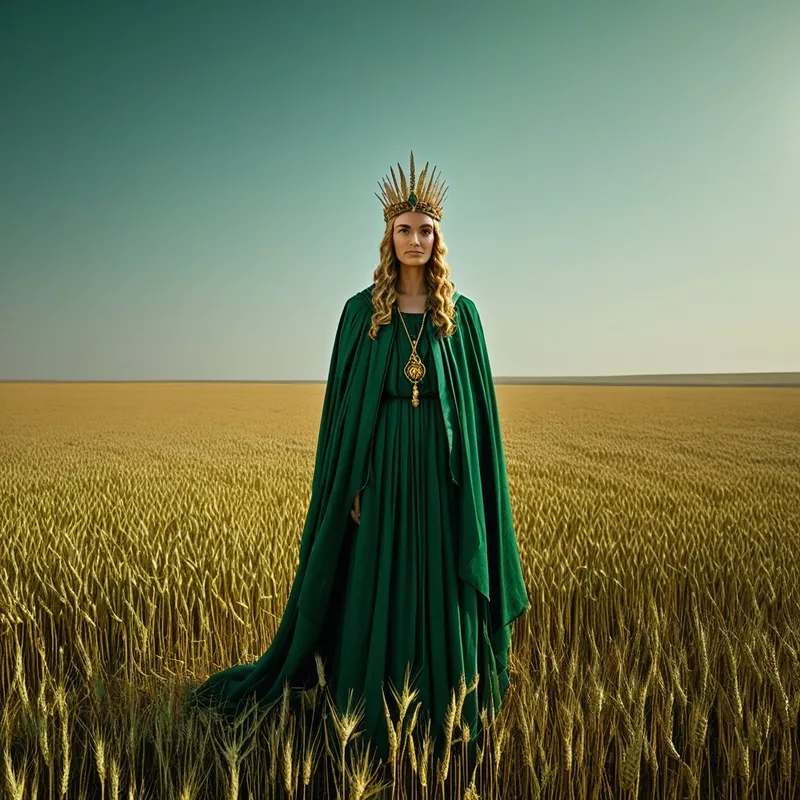
Demeter's Grieving Fields Myth Meaning & Symbolism
A mother's boundless grief for her abducted daughter halts all life, forcing a cosmic compromise that births the seasons and the cycle of death and rebirth.
The Tale of Demeter’s Grieving Fields
Hear now the story that cracks the world in two, the lament that stills the heart of the earth. It begins not with a bang, but with a scream swallowed by the ground.
In the sun-drenched fields of Nysa, the maiden Persephone was gathering flowers. Her laughter was the sound of buds bursting, her steps the promise of new growth. Then, the earth groaned and split. From the yawning chasm, a chariot of blackest obsidian erupted, drawn by steeds whose breath was the mist of tombs. The hand of Hades seized her. Her cry for her mother was cut short as the earth sealed itself above her, leaving only a trampled garland and a silence so profound it hurt the sky.
Her mother was Demeter, she who causes the grain to swell. When the echo of that stolen scream reached her, a coldness entered her being that no sun could touch. She cast off her splendor, wrapped herself in the cloak of a mortal crone, and began to walk the earth. Her grief was a physical force. Where her tears fell, flowers wilted. Where her shadow passed, the green sap in the trees turned to amber and hardened. She asked the sun, Helios, who told her of the pact: her own brother, Zeus, had given their daughter to Hades.
Then did Demeter’s sorrow turn to a wrath that froze the world. She withdrew her blessing, her life. The rich loam of the world became iron-hard. Seeds rotted in the ground. Vines crumbled to dust. The laughter of mortals turned to the wail of famine. The great cycle of life ground to a halt in what became known as Demeter’s Grieving Fields—a blight born not of malice, but of a love so vast its absence was an apocalypse.
In her wanderings, she came to Eleusis, and served in a mortal king’s house, nursing the prince Demophon. In a desperate act of love, she began to place the child in the hearth’s sacred fire each night to burn away his mortality. Discovered by the terrified queen, Demeter revealed her divinity, her anguish a blinding light. She commanded a temple be built for her at Eleusis, and there she sat, in monumental silence, while the world died around her.
Faced with the unmaking of his creation, Zeus relented. The messenger Hermes was sent to the sunless land to bring Persephone back. But in the underworld, a fateful act had occurred. Persuaded or parched, Persephone had eaten. Not a feast, but six small seeds from the fruit of the dead, the pomegranate. Those who eat the food of Hades are bound to him forever.
A compromise was struck in the cold halls of Olympus, a rhythm imposed upon chaos. For each seed eaten, Persephone would spend one month of the year in the underworld as its queen. The rest, she would walk in the upper world with her mother. When Persephone ascends, Demeter’s joy makes the earth burst forth in spring and bloom through summer. When her daughter descends, Demeter’s grief returns, and the world withdraws into autumn and the sleep of winter. The Grieving Fields are not erased, but woven into the very fabric of time.

Cultural Origins & Context
This myth, central to what scholars call the Homeric Hymn to Demeter, was far more than a story to explain the seasons for the ancient Greeks. It was the sacred, beating heart of the Eleusinian Mysteries, the most famous and revered initiatory cult of the ancient world for nearly two millennia. The myth was not merely recited; it was enacted in secret rituals by initiates in Eleusis. The details of these rites remain famously secret, but their goal was clear: to conquer the fear of death by revealing the promise of rebirth, just as Persephone returned from the land of the dead.
The story was passed down through a sacred oral tradition, likely performed by priestly bards during the Mysteries. Its societal function was profound. It provided a divine model for the most harrowing human experiences: the loss of a child (through marriage or death), the paralyzing power of grief, and the necessity of accepting cyclical change. It also positioned the maternal principle, Demeter, as a power so fundamental that even Zeus must negotiate with her. The myth validated the deep, chthonic (earthly) wisdom of the feminine, the cycles of agriculture upon which civilization depended, and the painful but necessary transition from maidenhood to the sovereignty of wife and queen.
Symbolic Architecture
At its core, this is a myth of the archetype of the Great Mother in her dual aspect: the Life-Giver and the Withdrawer. Demeter represents the nourishing, sustaining principle of the conscious world—the ego’s realm of light, growth, and relationship. Hades represents the inevitable pull of the unconscious—the realm of the unseen, the repressed, the ancestral, and the psychic depths where profound transformations occur.
The abduction is not a mere tragedy, but a necessary descent. No wholeness is possible without a confrontation with what lies beneath.
Persephone is the psyche itself, the youthful consciousness that must be severed from the exclusive domain of the mother (the conscious attitude) to encounter the king of the underworld (the latent, often feared, masculine principle of depth and sovereignty). The pomegranate seeds are the symbol of an irreversible commitment to this deeper layer of reality. Once you have tasted the fruit of self-knowledge, of shadow, or of profound loss, you can never fully return to a state of naive innocence. You are forever changed, carrying a piece of the underworld within you.
The compromise—the cyclical rhythm—is the myth’s greatest psychological insight. Wholeness is not a static state of perpetual spring. It is a dynamic process of engagement and withdrawal, of blooming in the light and incubating in the dark. The “Grieving Fields” are not a failure, but a sacred phase in the cycle of being.

The Dreamer’s Resonance
When this myth stirs in the modern dreamer, it often manifests as dreams of barren landscapes, frozen time, or a profound sense of life-force being drained away. One might dream of a beloved garden suddenly withering, a house that was once warm becoming cold and empty, or a personal project that turns to dust despite all effort. Somaticly, this can feel like a heavy lethargy, a depression that is less about sadness and more about a visceral sense of life gone fallow.
Psychologically, this signals that a core aspect of the dreamer’s identity or a primary relationship (the “Persephone” within) has been “abducted.” This could be a creative spark, a sense of purpose, a child leaving home, or the end of a vital partnership. The conscious ego (the Demeter aspect) is in a state of protest and profound grief, withdrawing its energy from the world. The dream is presenting the archetypal truth: your inner Demeter is on strike because something essential to your soul has descended into the unconscious. The dream invites you to acknowledge the legitimacy of the grief, to stop trying to “fix” the fallow period, and to begin the sacred search.

Alchemical Translation
The individuation process modeled here is the alchemy of accepting the necessary descent. The modern seeker often tries to live in perpetual summer, avoiding the underworld journeys of loss, depression, shadow-work, and introspection. Demeter’s myth teaches that this avoidance leads to a psychic winter far more devastating—a sterile, forced barrenness of the soul.
The first alchemical stage is the Abduction (Nigredo): the involuntary plunge into the depths, often triggered by crisis. The second is the Grieving Fields (the Mortificatio): the conscious ego’s necessary period of mourning, rage, and withdrawal. This is not pathology, but a sacred incubation. The third is the Pomegranate Seed (the Coniunctio): the moment of integration, where the conscious self makes a binding pact with what was found in the depths. It says, “This experience, this shadow, this loss, is now part of me.”
The final gold is not the return of the maiden, but the emergence of the Queen who knows both worlds.
The resolution is not a return to the beginning, but the establishment of a new, cyclical consciousness. The initiated individual becomes like Persephone-Queen, capable of functioning in the bright world of responsibility and relationship, yet intimately acquainted with, and sovereign over, their own inner depths. They carry the wisdom of the Grieving Fields within them, knowing that every period of fallowness contains the seed of the next spring. The psyche learns to honor its own seasons, finding fertility not in constant production, but in the sacred rhythm of engagement and sacred retreat.
Associated Symbols
Explore related symbols from the CaleaDream lexicon: