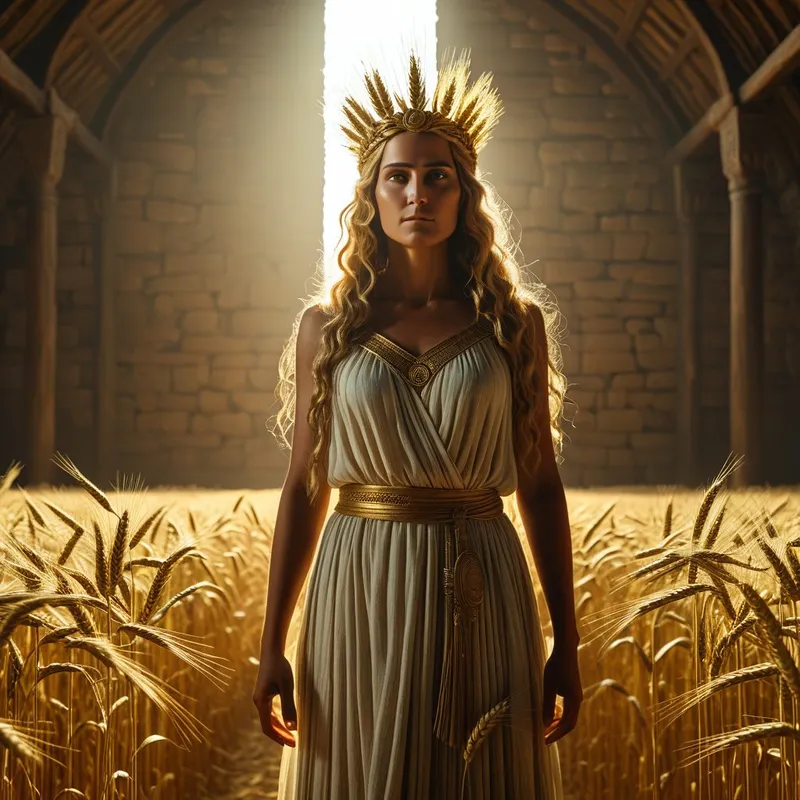
Demeter's Granary / Persephone's Pomegranate Seeds Myth Meaning & Symbolism
The abduction of Persephone by Hades and her consumption of pomegranate seeds creates the cycle of seasons, a myth of motherly grief and daughterly transformation.
The Tale of Demeter’s Granary / Persephone’s Pomegranate Seeds
Hear now the story that holds the turning of [the world](/myths/the-world “Myth from Tarot culture.”/) in its grasp, the tale that explains why [the earth](/myths/the-earth “Myth from Hindu culture.”/) grows cold and silent, and why it bursts forth again in a riot of life.
In the time before time was measured in seasons, the world was a place of eternal, gentle spring. [Demeter](/myths/demeter “Myth from Global/Universal culture.”/) tended her granary—not a storehouse of wood and stone, but the very heart of the living earth itself. From her boundless care flowed the wheat, the barley, the fruit of every vine and tree. Her joy was her daughter, Kore, whose laughter was the sound of clear springs and whose footsteps caused flowers to bloom. Kore, the Maiden, was the very spirit of the untamed, fertile meadow.
But in the deep, silent places under the earth, a longing stirred. [Hades](/myths/hades “Myth from Greek culture.”/), lord of the unseen realms, beheld Kore and was seized by a desire as vast and inevitable as the grave. With the tacit permission of her father, Zeus, he acted. One day, as Kore gathered [narcissus](/myths/narcissus “Myth from Greek culture.”/) blooms in a sun-drenched field, the earth before her cracked open with a sound like thunder. From the chasm, a chariot of blackest obsidian drawn by immortal steeds erupted, and [Hades](/myths/hades “Myth from Greek culture.”/), in his dark majesty, seized the shrieking maiden and plunged back into the depths. The rift closed. Only a few scattered flowers remained, trembling in the sudden silence.
A cry then pierced the heavens, a sound of such pure, rending loss that the sun itself seemed to falter. It was Demeter. She felt her daughter’s absence like a physical wound. Casting aside her divinity, she wrapped herself in the guise of an old mortal woman and wandered the earth, her grief a blight upon the land. Where she walked, green shoots withered. Trees shed their leaves in mourning. The rich soil of her granary turned to hard, frozen dust. Famine gripped the world, and the cries of mortals rose to an indifferent Olympus.
In her wanderings, she came to Eleusis, and served in a king’s household, nursing an infant prince. In her sorrow, she sought to make [the child](/myths/the-child “Myth from Alchemy culture.”/) immortal, holding him in [the hearth](/myths/the-hearth “Myth from Norse culture.”/)’s [sacred fire](/myths/sacred-fire “Myth from Various culture.”/) each night. Discovered by the terrified queen, Demeter cast off her mortal disguise, revealed her terrible glory, and demanded a temple be built for her. There, seated in her new, dark home, she let her grief settle over the world like a permanent shroud.
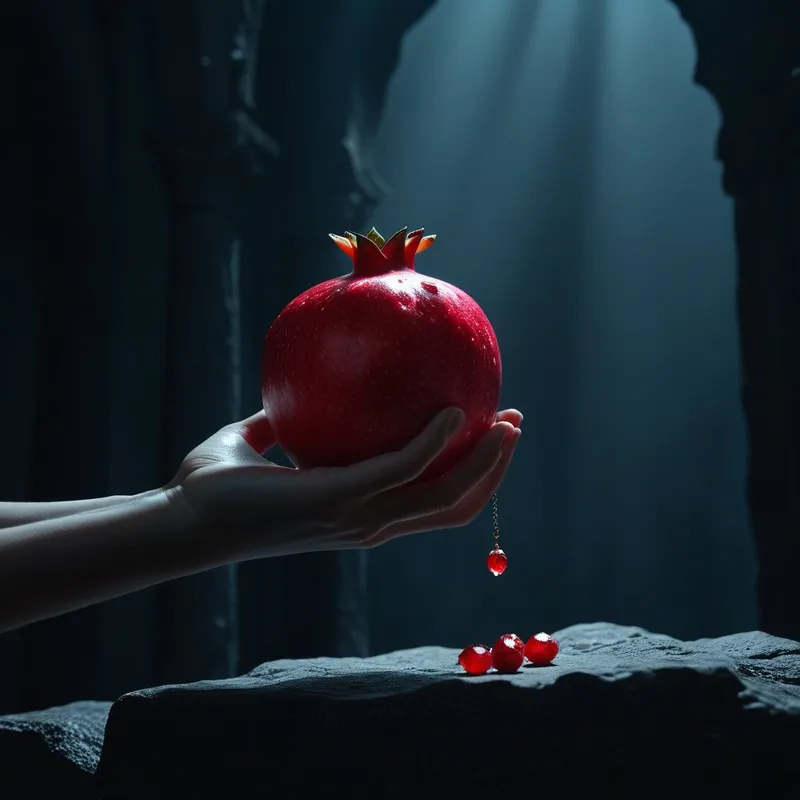
Faced with the utter annihilation of life—and thus the end of all tribute to the gods—Zeus was forced to intervene. He commanded [Hermes](/myths/hermes “Myth from Global/Universal culture.”/), the swift messenger, to descend to [the underworld](/myths/the-underworld “Myth from Greek culture.”/) and bid Hades release his bride. Hades, cunning and bound by the laws of hospitality, agreed. But before [Persephone](/myths/persephone “Myth from Greek culture.”/)—for she was no longer just Kore—ascended to the light, he offered her a simple, fateful gift: a few seeds of the ruby pomegranate. Hungry from her long fast, and perhaps touched by a new, complex understanding, she ate them.
She emerged into the world, and mother and daughter fell into a desperate embrace. But the celebration was cut short. The rules of the deep are absolute: whoever consumes the food of the dead is bound to them. Because Persephone had eaten those seeds, she must return. A compromise, brokered by the primordial goddess Ananke, was struck. For each seed consumed, a month of the year must be spent in the [underworld](/myths/underworld “Myth from Greek culture.”/) as Hades’ queen. For the rest, she could walk in the sun with her mother.
Thus, when Persephone descends, Demeter’s grief withdraws her gift, and winter reigns. When her daughter returns, Demeter’s joy makes the earth bloom once more. The granary of the world opens and closes with the beating of a mother’s heart.
Cultural Origins & Context
This myth, central to what scholars call the Homeric Hymn to Demeter, was not merely a story for the ancient Greeks; it was a foundational sacred narrative. Its primary home was the [Eleusinian Mysteries](/myths/eleusinian-mysteries “Myth from Greek culture.”/), the most famous and revered religious rites of the ancient world for nearly two millennia. The myth was the hieros [logos](/myths/logos “Myth from Christian culture.”/)—the sacred story—that underpinned the secret rituals.
It was passed down through initiated hierophants and priestesses, not in public texts but through oral tradition and ritual re-enactment within the Telesterion, the great hall of initiation at Eleusis. Its societal function was profound: it addressed the universal human terror of [death](/myths/death “Myth from Tarot culture.”/) and the mystery of the afterlife. By ritually experiencing the descent of Persephone and the grief of Demeter, initiates were believed to transcend the fear of mortality, gaining hope for renewal beyond the grave. The myth also sanctified the agricultural cycle, making the necessity of fallow winter and fertile spring a divine, and therefore meaningful, ordinance.
Symbolic Architecture
At its core, this is a myth of profound transformation through necessary [loss](/symbols/loss “Symbol: Loss often symbolizes change, grief, and transformation in dreams, representing the emotional or psychological detachment from something or someone significant.”/). Persephone is the archetypal Kore, the maiden [consciousness](/symbols/consciousness “Symbol: Consciousness represents the state of awareness and perception, encompassing thoughts, feelings, and experiences.”/), who must be severed from the primal, nurturing [matrix](/symbols/matrix “Symbol: A dream symbol representing the fundamental structure of reality, consciousness, or the self. It often signifies feelings of being trapped, controlled, or questioning the nature of existence.”/) of the [Mother](/symbols/mother “Symbol: The symbol of ‘Mother’ represents nurturing, protection, and the foundational aspect of one’s emotional being, often associated with comfort and unconditional love.”/) (Demeter’s [granary](/symbols/granary “Symbol: The granary symbolizes abundance, storage of resources, and the cyclical nature of life, embodying both nourishment and the need for preservation.”/)) to achieve her own sovereignty.
The pomegranate seed is the compacted symbol of the conscious choice within the unconscious act. It is the moment fate is sealed by one’s own hand, however unknowingly.
Demeter represents the [archetype](/symbols/archetype “Symbol: A universal, primordial pattern or prototype in the collective unconscious that shapes human experience, behavior, and creative expression.”/) of [the Great Mother](/myths/the-great-mother “Myth from Jungian culture.”/) in her [aspect](/symbols/aspect “Symbol: A distinct feature, quality, or perspective of something, often representing a partial view of a larger whole.”/) of inexorable, [life](/symbols/life “Symbol: The symbol of ‘Life’ represents a journey of growth, interconnectedness, and existential meaning, encompassing both the joys and challenges that define human experience.”/)-giving, and life-withholding [nature](/symbols/nature “Symbol: Nature symbolizes growth, connectivity, and the primal forces of existence.”/). Her [grief](/symbols/grief “Symbol: A profound emotional response to loss, often manifesting as deep sorrow, yearning, and a sense of emptiness.”/) is not petty; it is the creative force in its negative phase, the withdrawal that makes new growth possible. [Hades](/symbols/hades “Symbol: Greek god of the underworld, representing death, the unconscious, and hidden aspects of existence.”/) is not a mere [villain](/symbols/villain “Symbol: A character representing opposition, moral corruption, or suppressed aspects of self, often embodying fears, conflicts, or societal threats.”/) but the [lord](/symbols/lord “Symbol: The symbol of ‘Lord’ represents authority, mastery, and control, along with associated power dynamics in relationships.”/) of the [shadow](/symbols/shadow “Symbol: The ‘shadow’ embodies the unconscious, repressed aspects of the self and often represents fears or hidden emotions.”/) and the riches of the unconscious. His [realm](/symbols/realm “Symbol: The symbol of ‘Realm’ often signifies the boundaries of one’s consciousness, experiences, or emotional states, suggesting aspects of reality that are either explored or ignored.”/) is where unformed potential and forgotten psychic contents reside. The abduction is a brutal but necessary “call to [depth](/symbols/depth “Symbol: Represents profound layers of consciousness, hidden truths, or the unknown aspects of existence, often symbolizing introspection and existential exploration.”/),” pulling the conscious ego (Persephone) into a confrontation with what lies beneath.
The resulting compromise—the cyclical descent and return—models the fundamental [rhythm](/symbols/rhythm “Symbol: A fundamental pattern of movement or sound in time, representing life’s cycles, emotional flow, and universal order.”/) of the [psyche](/myths/psyche “Myth from Greek culture.”/): engagement with the outer, fertile world of relationships and creation (spring/[summer](/symbols/summer “Symbol: Summer often symbolizes warmth, growth, and abundance, representing a time of vitality and fruition.”/)), and the necessary retreat into the inner world of [reflection](/symbols/reflection “Symbol: Reflection signifies self-examination, awareness, and the search for truth within oneself.”/), [incubation](/symbols/incubation “Symbol: A period of internal development, rest, or hidden growth before emergence, often associated with healing, creativity, or transformation.”/), and processing of [the shadow](/myths/the-shadow “Myth from Jungian culture.”/) ([autumn](/symbols/autumn “Symbol: A season symbolizing transition, harvest, and decay, representing life’s cycles between abundance and decline.”/)/[winter](/symbols/winter “Symbol: Winter symbolizes a time of reflection, introspection, and dormancy, often representing challenges or a period of transformation.”/)).

The Dreamer’s Resonance
When this myth stirs in modern dreams, it signals a profound initiation underway in the dreamer’s psyche. To dream of being abducted, of falling into a chasm, or of wandering a barren landscape speaks to a felt experience of depression, a forced descent into parts of [the self](/myths/the-self “Myth from Jungian culture.”/) that feel alien and dark. The dreamer may feel “stolen” from their familiar life by a powerful, often unsettling force (a job loss, a betrayal, a depression, a calling).
Dreaming of a pomegranate, especially of eating its seeds, points to a point of no return in a psychological process. It is the moment one internalizes an experience, takes in a truth—however bitter—and is forever changed by it. The dreamer is making a [covenant](/myths/covenant “Myth from Christian culture.”/) with their own depth, binding themselves to a new phase of life or self-understanding. Somatic sensations might include a feeling of coldness, of being underground, or a paradoxical sense of rich fullness (the seeds) amidst emptiness.
Alchemical Translation
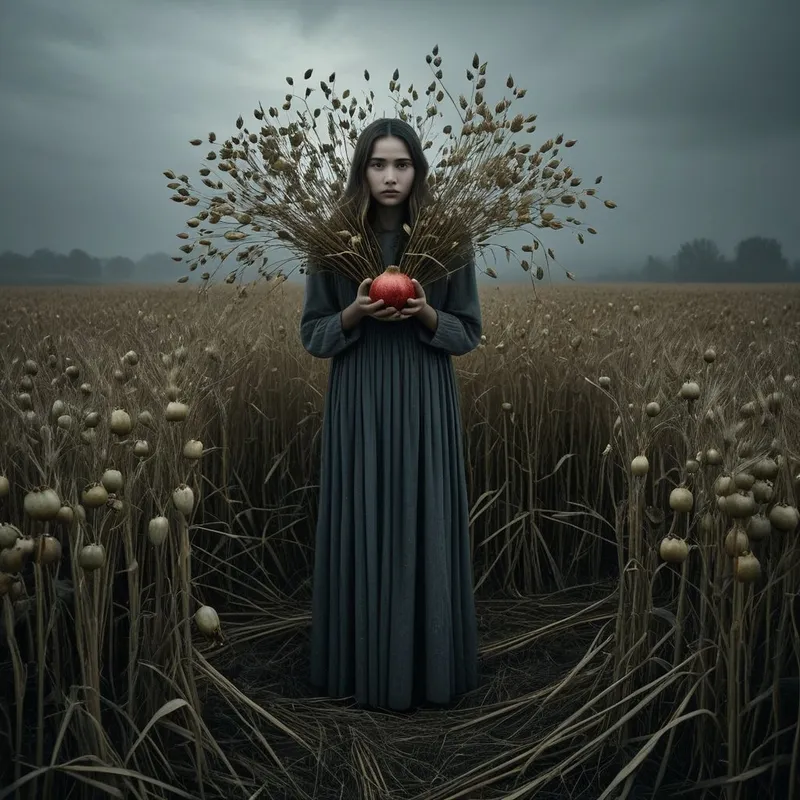
The alchemical journey of this myth is the process of individuation. The initial state is the unconscious unity of Demeter and Kore, a paradise of potential but not of distinct selfhood. The abduction is the [nigredo](/myths/nigredo “Myth from Alchemical culture.”/)—the blackening, the dissolution of that old state in [the crucible](/myths/the-crucible “Myth from Alchemical culture.”/) of suffering and alienation.
The granary must lie fallow for the seed of the self to germinate in the dark. The soul’ winter is not death, but the silent gathering of its unseen kingly power.
Persephone’s time in the underworld is the albedo—the whitening, the washing and learning in the solitude of the unconscious. She is not a prisoner but becomes Queen, learning to rule the hidden aspects of her being. Eating the seeds is the pivotal act of incorporation; she takes the substance of the Other into herself, transforming her identity from abducted maiden to sovereign bride of the depths.
Her return is the citrinitas (yellowing) and [rubedo](/myths/rubedo “Myth from Alchemical culture.”/) (reddening)—the integration of this deep self-knowledge back into the world of light and relationship. The final product is not a return to the old innocence, but the creation of a cyclical, resilient self. The modern individual undergoing this alchemy moves from a life dictated by external forces and parental complexes (Demeter’s will, Zeus’s schemes) to one governed by an internal, cyclical wisdom. They learn that creativity requires fallow periods, that wisdom is born in the underworld of introspection, and that wholeness means honoring both the mother of manifestation and the king of the inner depths.
Associated Symbols
Explore related symbols from the CaleaDream lexicon: