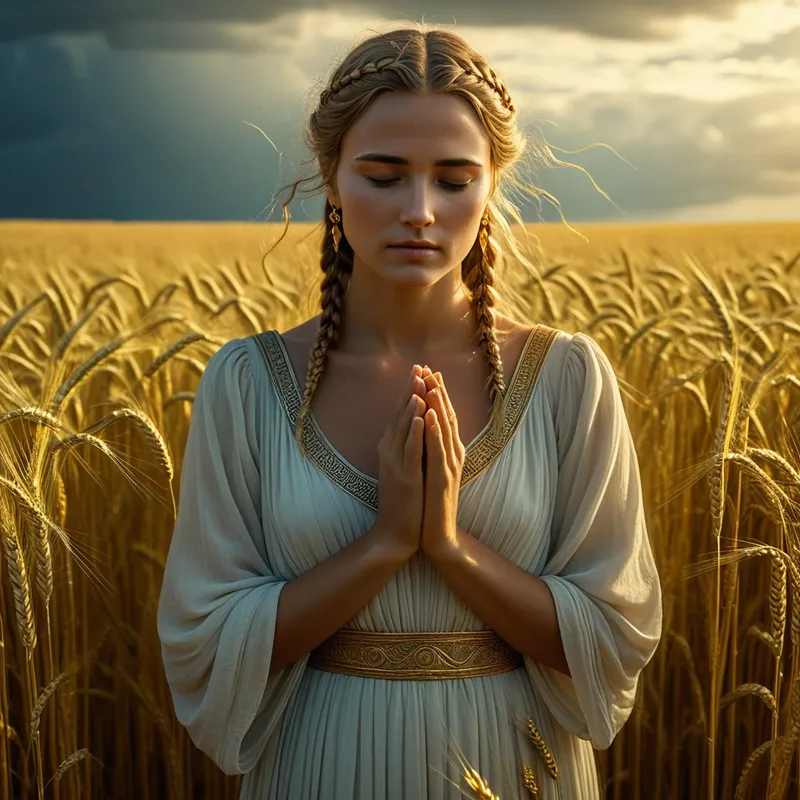
Demeter's Grain Myth Meaning & Symbolism
The myth of Demeter's sacred grain, born from her grief for Persephone, symbolizes the cycles of life, death, and the soul's descent into the unconscious.
The Tale of Demeter's Grain
Hear now the story not of thunder or war, but of the silent scream that cracked the world. In the time before time was measured, the earth was a creature of boundless generosity. Its breath was the scent of ripe fruit, its skin the soft loam, and its heartbeat the steady, green pulse of growing things. All this lived within the care of Demeter, whose joy was her daughter, Persephone.
Persephone was the embodiment of that joy—a girl whose laughter caused hyacinths to bloom and whose footsteps left trails of violets. On a day indistinguishable from paradise, she wandered in a meadow of Nysa, gathering narcissus with her companions. The sun was high, the air warm with the promise of endless summer. Then, the earth groaned. A chasm, black and soundless, tore open at her feet. From it erupted a chariot of polished obsidian, drawn by steeds of shadow. The hand that seized her was that of Hades, lord of the unseen realms. Her cry was swallowed by the closing earth, and the meadow fell silent, save for the echo of a single dropped blossom.
Demeter’s anguish was not a sound, but a cessation. Where her grief touched, life recoiled. She cast off her divinity, wrapping herself in the cloak of an old mortal woman, and began to wander the world, a hollow-eyed specter. Rivers dried in her path. Trees shed their leaves as she passed. The very soil grew hard and cold, refusing the seed. Famine, the great leveler, began to stalk humanity. The gods’ altars grew cold, for what use are prayers when the earth itself has turned to stone?
In her despair, she came to Eleusis and served in the king’s household, nursing the infant prince Demophoön. In a fleeting moment of connection, she sought to make the child immortal, anointing him with ambrosia and holding him in the hearth’s sacred fire. But the queen’s startled cry shattered the ritual. In her wrath and renewed sorrow, Demeter revealed her true, terrifying form and demanded a temple be built for her.
There, in the temple at Eleusis, she sat. And the world sat with her. An eternal winter gripped the land. No grain sprouted; no fruit swelled. Humanity faced extinction. The gods, weakened by the lack of offerings, pleaded with Zeus to intervene. Zeus commanded Hades to release his bride. Hades agreed, but not before offering Persephone a pomegranate seed—a simple, bloody token. She ate it, binding herself to the kingdom of shades for a portion of each year.
When Hermes led Persephone back to the light, Demeter’s frozen heart shattered into a million pieces of life. She rushed to embrace her daughter, and where her tears fell on the barren ground, green shoots pierced the crust. But the reunion was tempered by the truth of the seed. Thus, a compromise was woven into the fabric of existence: for the months Persephone walked above, Demeter’s joy would make the earth fertile and warm. But when her daughter descended to her dark throne, Demeter’s grief would withdraw, and the world would fall into sleep and frost.
And from this first cycle of loss and return, from the very soil watered by a goddess’s tears, sprang the first sacred grain. It was not merely wheat; it was the physical testament of her love, her sorrow, and her hard-won wisdom—the knowledge that life is only precious because it contains the seed of its own departure.

Cultural Origins & Context
This story, central to what scholars call the Homeric Hymn to Demeter, was far more than entertainment. It was the foundational narrative of the Eleusinian Mysteries, the most revered and well-guarded initiatory cult of the ancient Greek world. For nearly two thousand years, initiates—from slaves to emperors—traveled the Sacred Way to Eleusis to undergo rites that promised a blessed afterlife and liberation from the fear of death.
The myth was not merely told; it was experienced through ritual, drama, and sacred re-enactment. Its tellers were the hierophants, the “revealers of sacred things,” who guided initiates through the stages of the story: the descent (Persephone’s abduction), the search (Demeter’s grief), and the ascent (the joyful return). The myth functioned as a societal and psychological anchor. It explained the non-negotiable reality of seasonal cycles upon which agrarian life depended, transforming a source of anxiety (winter’s famine) into a sacred story with a promise of return. It provided a template for processing profound personal loss, framing grief not as a meaningless void but as a necessary, sacred season of the soul.
Symbolic Architecture
At its core, the myth is a profound map of the psyche. Demeter represents the conscious, nurturing, and generative aspect of the Self—the ego that builds, cultivates, and seeks to preserve life and relationship. Persephone is the soul-image, the innocent, burgeoning potential of the psyche (the Kore) that must, for wholeness, make a necessary descent.
The abduction is not a tragedy, but an initiation. The soul cannot remain forever in the sunny meadow of the conscious mind; it must be claimed by the depths.
Hades is the ruler of the unconscious, the compelling force that pulls a part of us into the underworld of forgotten memories, instincts, and latent power. The pomegranate seed is the symbol of conscious choice within the realm of the unconscious—the moment Persephone, now Queen, accepts a portion of her identity as belonging to the dark. This is the integration of the shadow.
The grain itself is the ultimate symbol. It is the fruit of the union between Demeter’s conscious striving (cultivation) and Persephone’s unconscious journey (the seed’s burial in dark earth). It dies to be reborn; it is buried to yield a harvest. It embodies the alchemical solve et coagula—dissolve and reconstitute—on a cosmic scale.
The Dreamer's Resonance
When this myth stirs in modern dreams, it rarely appears in classical garb. The dreamer may not see a goddess, but they will feel the myth’s architecture. It manifests as dreams of a cherished project suddenly vanishing, a relationship ending without warning, or a profound, inexplicable depression that descends like a winter, freezing all creative and emotional energy. This is the “Demeter phase”—a somatic experience of life-force withdrawal.
Conversely, one might dream of finding a door in a basement leading to a vast, unfamiliar landscape (the descent), or of discovering a simple, potent object—a key, a stone, a seed—in a place of darkness (the pomegranate seed). These dreams signal the “Persephone process”: a necessary, if frightening, engagement with the depths of one’s own psyche. The dreamer is undergoing an involuntary but crucial initiation, where a part of the self is being required to separate from familiar, sunny identities and learn to rule in a darker, richer interior kingdom.
Alchemical Translation
For the individual, the myth of Demeter’s Grain models the painful but essential process of individuation. Our initial state is often a Persephone-like innocence, identified with a “meadow” of pleasant, socially acceptable traits. Then comes the abduction: a crisis, a loss, a depression, a failure—something that shatters our world and drags a part of us into an emotional or psychological underworld.
The famine in the upper world is the necessary cost. The old, unconscious way of living must die for the new consciousness to be born.
We then become Demeter, wandering in the grief of what was lost, feeling barren and powerless. This is the nigredo, the blackening, the crucial stage of dissolution. The temptation is to rage against the darkness or to numb the pain. But the myth instructs us to sit in our temple of grief, as Demeter did. It is in this full acceptance of the winter that the secret is revealed.
The return is never to the old innocence. Persephone comes back changed, as Queen. The integrated self carries the knowledge of both worlds. The “grain” that results from this cycle is the transformed personality: a consciousness that has tasted the dark earth and contains within it the wisdom of cyclical death and rebirth. We learn that our creativity, our love, our very vitality (the grain) is dependent not on avoiding the underworld, but on honoring its necessary seasons. We become, in a sense, both the mourning mother and the queen of shadows, sowing the seeds of our own continual becoming.
Associated Symbols
Explore related symbols from the CaleaDream lexicon: