
Demeter's Cycles Myth Meaning & Symbolism
A mother's grief for her abducted daughter brings eternal winter, forging a sacred cycle of loss, descent, and seasonal rebirth.
The Tale of Demeter's Cycles
The world was young, and the green was eternal. In the sun-drenched fields of Sicily, laughter like silver bells danced on the warm breeze. It was the laughter of Persephone, gathering flowers with her nymph companions. Her mother, Demeter, whose touch turned soil to bounty, watched from afar, her heart a ripe fruit of love.
But in the sunlit meadow, a flower of unearthly beauty caught Persephone’s eye—a narcissus, planted by the dark design of the earth itself. As she reached for its radiant bloom, the very ground groaned and split. From the yawning chasm, a chariot of blackest iron erupted, drawn by steeds as dark as a starless midnight. The hand that seized her was that of Hades, lord of the unseen realms. Her cry was swallowed by the closing earth, and the meadow fell silent, save for the lonely rustle of discarded blossoms.
A coldness entered Demeter’s heart, a chill that had never known the world. She heard the echo of the vanished cry and knew. For nine days and nine nights, the great goddess wandered the earth, a torch in each hand, her divine form cloaked in mortal grief. She asked the sun, who sees all; Helios, in pity, told her of the dark pact, of Zeus’s silent consent. Fury then tempered her sorrow. If her child was lost to the world, then the world would share her loss.
She withdrew her grace. The rich soil turned to dust. Vines withered; trees shed their leaves as if in mourning. A great winter fell, not of snow, but of barren stillness. Humanity faced extinction, and the gods of Olympus found their altars cold.
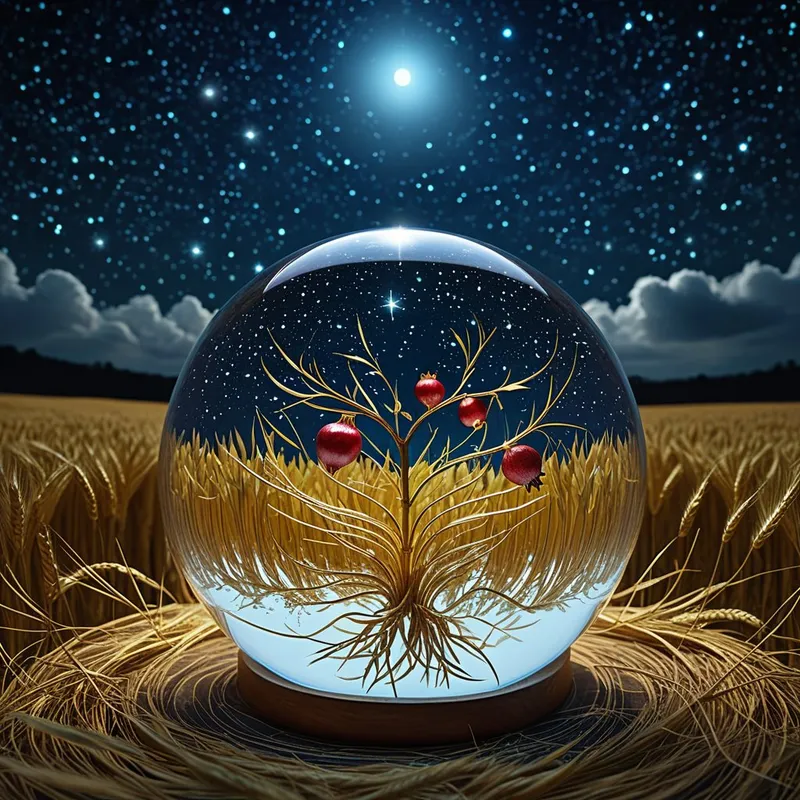
In the depths of Hades, Persephone sat, a queen in a kingdom of shades, fasting in her silent protest. Yet, tricked or perhaps yielding to a deeper fate, she accepted from Hades’ hand a few seeds of the pomegranate. Their sweet, bloody juice sealed her bond to the underworld.
Zeus, pressured by the dying world and the relentless grief of his sister, decreed a compromise. For each seed consumed, Persephone would spend a month of the year in the realm below. The rest, she would walk again in the light.
When the messenger Hermes led Persephone from the gloom, Demeter, waiting in the still-frozen temple of Eleusis, saw her daughter emerge. In that moment, her winter broke. Flowers erupted at their feet. The hard earth softened. Life, held in a breath of despair, exhaled in a torrent of green. But in Persephone’s eyes, Demeter saw the knowledge of the dark, the taste of the pomegranate—a wisdom that meant her return to the depths was forever part of the great turning. Thus, the cycle was forged: the joyful ascent, the inevitable descent, and the mother’s grief that both kills and renews the world.

Cultural Origins & Context
This myth, central to the Eleusinian Mysteries, was not merely a story but the foundational narrative of one of the most important religious cults of the ancient Greek world. For nearly two thousand years, from the Mycenaean era to the late Roman Empire, initiates traveled to Eleusis to be shown the "holy things" and to experience the sacred drama of the Homeric Hymn to Demeter, our primary source for the tale.
The myth functioned on multiple societal levels. Agriculturally, it was the divine explanation for the seasons, a matter of literal life and death for an agrarian society. Religiously, it offered a potent narrative of hope beyond death, with Persephone’s return symbolizing the possibility of rebirth. The Mysteries promised initiates (mystai) a better fate in the afterlife, a comfort the official Olympian religion often lacked. The story was passed down through ritual re-enactment, sacred poetry, and oral tradition within the secretive confines of the Telesterion at Eleusis, making it a lived, experiential truth for generations.
Symbolic Architecture
At its core, the myth maps the psyche’s confrontation with profound, involuntary loss. Demeter represents the conscious, nurturing aspect of the soul—the ego that cultivates, sustains, and seeks to protect its most cherished creation (the daughter-self, Persephone). Hades is the sudden, irrevocable pull of the unconscious—the trauma, the depression, the call to a depth that the conscious mind perceives only as death and abduction.
The abduction is not a crime, but a summons. The underworld is not a prison, but the realm of the un-lived.
Persephone’s journey is the ego’s necessary descent. Her initial resistance (fasting) signifies the psyche’s refusal to integrate the shadow. The pomegranate seeds are the moment of assimilation; by taking nourishment from the underworld, she accepts its reality and its claim on her identity. She returns not as the innocent maiden Kore, but as Persephone, Queen of the Dead, a being who contains both light and dark.
The cycle itself is the master symbol. It rejects a linear narrative of perfect recovery or eternal damnation. Instead, it posits a rhythmic psychology: periods of flourishing (spring/summer) inevitably give way to periods of introversion, grief, and inner work (autumn/winter). The myth sanctifies this rhythm, making it not a failure of the soul, but its sacred law.
The Dreamer's Resonance
When this myth stirs in modern dreams, it often manifests as a profound somatic sense of falling away or a landscape turning barren. One may dream of a cherished room in their house suddenly revealing a hidden, dark basement, or of a lush garden that frosts over in an instant. The figure of the "Disappearing Child" or the "Unreachable Mother" are common motifs.
Psychologically, this signals a process of what James Hillman called "soul-making." The dreamer is experiencing an involuntary initiation. The conscious attitude is being challenged by a depth emotion—a grief, a depression, a longing—that feels like it is stealing one’s vitality (Persephone). The dreamer in the role of Demeter is undergoing the crushing, world-stopping experience of a loss that forces a withdrawal from normal life to tend to a primal wound. This is not pathology, but the psyche’s demand for a re-valuation of what truly nourishes it. The dream is the chasm opening, the call to attend to what has been abducted into the shadows.

Alchemical Translation
The alchemical work modeled here is the transmutation of attachment into cyclical wisdom. Demeter’s initial stance is one of absolute, possessive attachment. Her grief is so total it threatens all of creation. The alchemical fire of her suffering, however, forces a negotiation with the highest authority (Zeus) and the deepest reality (Hades’ claim).
Individuation requires tasting the pomegranate of the underworld—assimilating the parts of ourselves we wished abducted and forgotten.
The triumph is not in a final rescue, but in the establishment of the sacred agreement—the cycle. For the modern individual, this translates to the hard-won understanding that wholeness includes rupture. The integrated self is not a perpetually sunny field, but one who, like Persephone, can rule in both the upper and lower worlds. The "work" is to honor the depressive, introverted phases as periods of necessary queen-ship in the inner realm, where soul-work is done. The return to the world is then not an escape, but a conscious bringing forth of the riches gleaned from the dark: resilience, depth, compassion, and the quiet knowledge that every blossoming is temporary, and every descent holds the seed of the next renewal. We become, at last, both the grieving mother and the returning queen, stewards of our own eternal, interior seasons.
Associated Symbols
Explore related symbols from the CaleaDream lexicon: