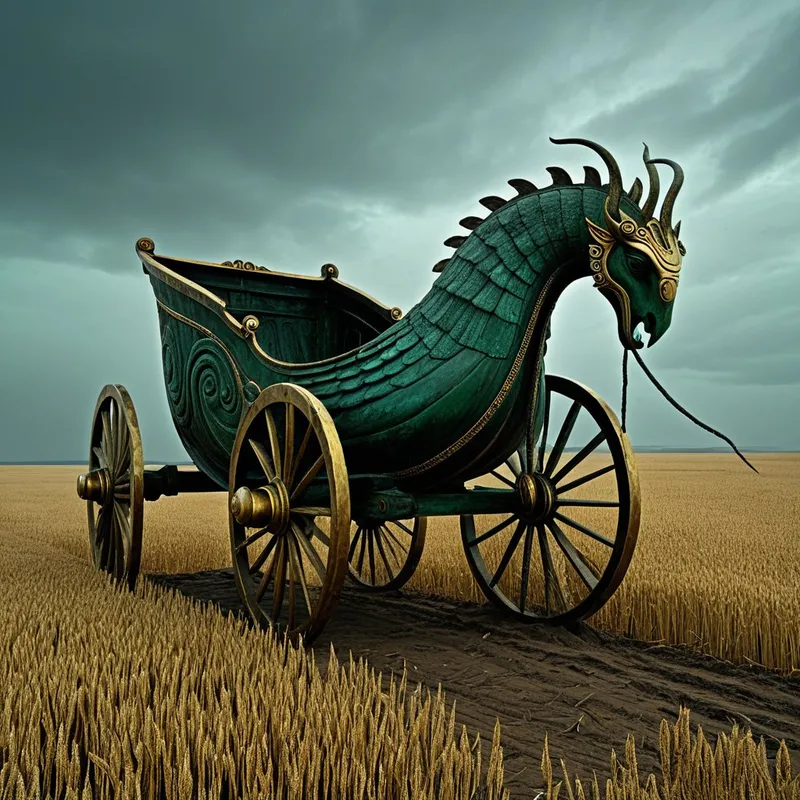
Demeter's chariot in Greek myt Myth Meaning & Symbolism
The goddess Demeter, in her grief for Persephone, abandons her chariot and divine duties, plunging the world into barren winter until a compromise is forged.
The Tale of Demeter's Chariot
Hear now the story of the Abandoned Chariot, a tale not of glorious battle, but of a silence more terrible than any war cry. It begins not with a beginning, but with an ending—the ending of a mother’s world.
In the sun-drenched fields of Hellas, where life burst forth in an endless, golden hymn, Demeter held sway. Her chariot was the very pulse of the earth. Crafted by the Hephaestus himself, its wheels were of stout oak banded with iron, its rails carved with sheaves of barley and clusters of grapes. It was drawn not by horses, but by twin serpents, ancient and wise, whose scales shimmered like wet soil in the rain. To see Demeter in her chariot was to see the promise of life itself, coursing over the hills, her presence causing seeds to quicken and vines to reach for the sun.
But a shadow fell from a world beneath. Hades, lord of the sunless realms, pierced the flowering meadow of Nysa and stole away Demeter’s radiant daughter, Persephone. The earth itself gasped. Demeter’s joyous cry turned to a wail that withered the grasses at its touch.
She did not mount her chariot to give chase. No. In a gesture of ultimate negation, she stepped down from it. She let the reins, still warm from her hands, fall slack upon the ground. The serpents, confused, coiled about the silent vehicle. Demeter turned her back on her own divinity, on her duty, on the very symbol of her power. She wrapped herself in the guise of an old mortal woman and began to walk, a solitary figure of immeasurable grief upon a world growing colder by the hour.
Where her feet trod, life retreated. The green fields turned the color of ash. Trees became skeletons clutching at a bleached sky. Rivers sank into their stony beds. The chariot stood where she left it—a monument to absence in a dying field. For nine days and nights, the goddess wandered, fasting, weeping, a winter contained within a single heart that now governed the entire world. The great chariot gathered dust, then frost.
It was this profound cessation, this divine strike, that forced the hand of Zeus. The cosmos could not endure the hunger of mortals or the silence of the earth. A compromise was forged in the cold halls of fate: Persephone would return, but having tasted the seed of the underworld, she must descend again for a portion of each year.
Only then, when the deal was struck and she heard the footfall of her returning daughter, did the ice in Demeter’s heart crack. She did not immediately return to her chariot. First, she touched the barren soil. Then, a slow, green fire kindled at her fingertips. Life, tentative and fierce, returned. And finally, she walked back to the field where her power sat dormant. She placed a hand upon the cold rail of the chariot. The frost melted. The serpents stirred, lifting their heads as the first true warmth in months touched their scales. She did not take up the reins with her former careless joy, but with a new, solemn knowledge. The chariot was hers again, but the path it would now travel was forever changed—a circuit that included both the zenith of summer and the depths of winter.
Cultural Origins & Context
This core narrative is woven into the Homeric Hymn to Demeter, a text central to the Eleusinian Mysteries. Unlike the public, Olympian myths, this story was the heart of a profound mystery cult. It was not merely told; it was experienced by initiates in secret ceremonies at Eleusis. The myth provided the sacred script for rituals that promised initiates a blessed lot in the afterlife, transforming the fear of death into hope.
The storytellers here were not just poets, but priests and hierophants. The societal function was dual: it explained the inescapable reality of seasonal death (winter) and rebirth (spring), offering agricultural communities a divine reason for their hardship and hope. On a deeper, initiatory level, it modeled a spiritual journey through loss, despair, and ultimate revelation—a personal encounter with the cycle that governs all life. The abandoned chariot was not just a plot point; it was a powerful cultic image representing the suspension of the known world before a profound revelation.
Symbolic Architecture
The chariot is far more than a vehicle; it is the symbol of Demeter’s sovereign function, her conscious, directed power to nurture and sustain. To abandon it is the ultimate symbolic act: the withdrawal of generative, caring energy from the world—and from the self.
The abandonment of the chariot is the psyche's necessary collapse when faced with a loss so core it invalidates the previous mode of being.
Demeter represents the Archetypal Mother, but specifically the mother whose primary function—to nurture and protect—has been violently ruptured. Her grief is not passive; it is a world-ending power. The serpents, chthonic and connected to the earth’s secrets, signify the deep, instinctual wisdom that remains tethered to the abandoned structure of the self, waiting. The resulting winter is a state of psychic atrophy, where all growth, all feeling, all "greenness" ceases. This is a necessary depression, a fallow period mandated by the soul. The resolution—the return of Persephone and the reclamation of the chariot—does not restore the old world. It institutes a new order based on a painful truth: life includes death; joy is forever tempered by the knowledge of loss, and caregiving must mature to acknowledge separation.
The Dreamer's Resonance
To dream of an abandoned vehicle—a car left in a field, a bicycle rusting by a track, a chariot on a barren plain—is to dream from the place of Demeter. This is the somatic signature of a profound, life-altering loss or betrayal that has caused the dreamer to "step down" from their own power, trajectory, or identity. The vehicle represents your means of moving through the world, your agency, your "drive." To find it abandoned is to experience a paralysis of will and purpose.
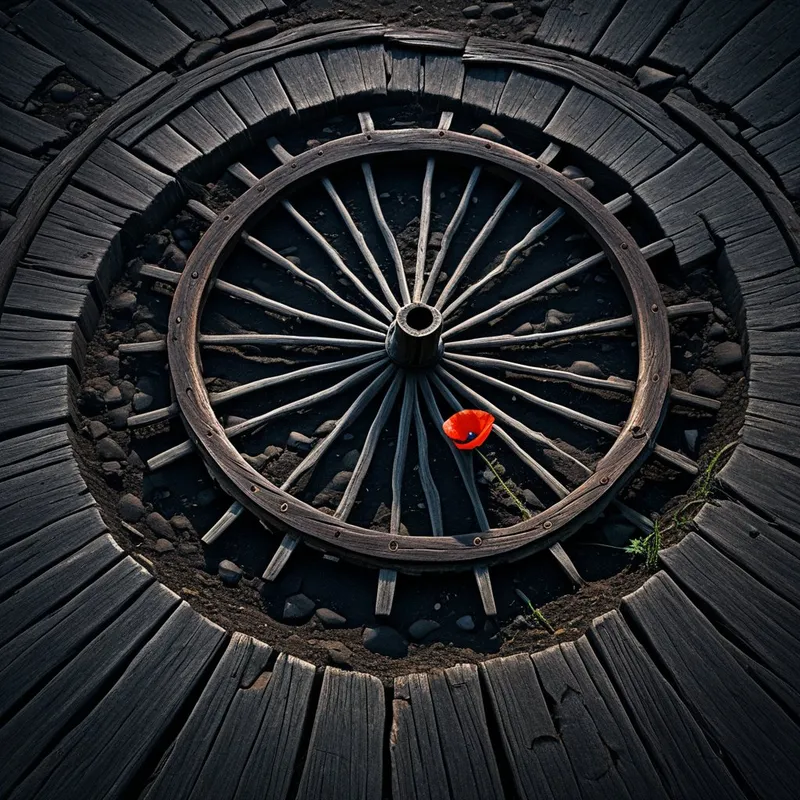
The dream may carry the chilling silence and monochrome palette of winter. The dreamer might feel the cold of the metal or the crumbling dryness of the earth around it. This is the psyche forcing a confrontation with a depressive state, not as a failure, but as a sacred, if terrible, process. It asks: What has been taken from you that was so essential it made your previous journey seem meaningless? The dream invites not an immediate fixing, but a recognition of the freeze. The eventual appearance of a single flower (like the poppy Persephone plucked) near the vehicle in a later dream can signal the first, fragile thaw of feeling and the possibility of reclaiming one's path, albeit a changed one.

Alchemical Translation
The alchemical journey mirrored here is Nigredo—the blackening, the descent into utter despair and the dissolution of the old identity. Demeter’s wandering as a crone is the ego’s immersion in this primal darkness. The chariot, left behind, is the conscious personality structure that has become obsolete; it cannot function until the work of the underworld is done.
Individuation demands that we, like Demeter, cease our productive circling and dare to let the world within us grow cold, so that a more authentic, cycle-aware self can be born.
The reconciliation is the Albedo, the whitening, which is not a return to innocence but a cleansing insight. Persephone’s return represents the retrieval of a vital part of the soul (the anima, the core joy) that has been transformed by its encounter with the shadow, with death, with the unconscious. Reclaiming the chariot is the stage of Citrinitas (yellowing) and Rubedo (reddening): the integration of this new knowledge into a renewed conscious attitude. The mature individual no longer drives the chariot of life with the assumption of eternal summer. They now guide it with a sober wisdom, honoring the seasons of growth and withdrawal, creativity and rest, knowing that care for the self and the world must make space for the necessary, fertile dark. The chariot becomes a vehicle not just of nurture, but of conscious, cyclical transformation.
Associated Symbols
Explore related symbols from the CaleaDream lexicon: