Demeter's Chariot Myth Meaning & Symbolism
The goddess Demeter, in her chariot, traverses a world made barren by grief, seeking her lost daughter and forcing a cosmic renegotiation of life and death.
The Tale of Demeter's Chariot
Hear now of the great silence that fell upon the world, a silence born not of peace, but of a mother’s shattered heart. It began in the sun-drenched fields of Nysa, where the earth was soft and fragrant. Demeter, she of the golden sheaf and the life-giving soil, had turned her back for only a moment. In that moment, the earth gaped open. From the abyss roared a chariot of polished obsidian, drawn by steeds that breathed the chill of the tomb. Its driver was Hades, lord of the unseen realms, and his hand, swift as a striking hawk, seized Persephone. Her cry for her mother was swallowed by the closing earth, leaving only a trampled garland of meadow flowers.
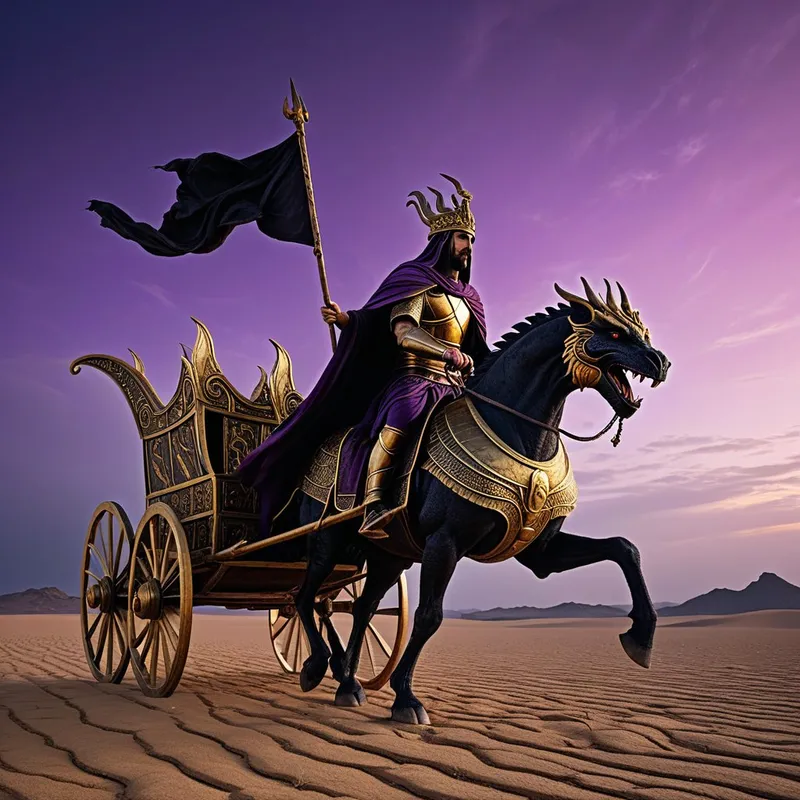
Then began the wandering. Demeter’s grief was not a quiet weeping; it was a force of nature unleashed. She tore the glittering diadem from her hair and shrouded herself in a mortal’s dark cloak. But her true vehicle was her chariot—a vessel not of war, but of profound, searching sorrow. Forged by the divine smith Hephaestus, it was drawn not by horses, but by two immortal dragons, their scales the color of tilled soil and twilight. Where other gods rode to conquer or to revel, Demeter mounted her chariot to enact a terrible, silent proclamation.
She took the reins, and the world held its breath. The chariot’s wheels, once meant to trace the paths of abundance, now cut furrows of desolation. Where the dragons’ claws touched the earth, the green vitality drained away. Where the chariot passed, the warm breath of summer turned to a killing frost. Fields that had laughed with grain became hard, gray wastelands. Rivers slowed to a trickle, and the laughter of nymphs was replaced by the howl of a barren wind. For nine days and nine nights, a celestial year in mortal time, she drove her chariot across the face of the world, her eyes seeing nothing but the memory of her daughter’s face, her ears hearing nothing but the echo of that stolen cry. The gods on Olympus looked down upon a dying earth and felt, for the first time, a cold fear. The source of life itself was in mourning, and all creation would perish with her.
Her journey ended not in a palace, but in the humble court of King Celeus at Eleusis. Disguised, she served as a nurse to his infant son, Demophoön. In a moment of desperate, misguided love, she sought to place the child in the hearth’s immortal fire, to burn away his mortality. The queen’s scream broke the spell, and Demeter, revealed in her full, awful divinity, cast off her mortal guise. “Foolish are you who do not understand the lengths of a mother’s love or the depth of her wrath!” she declared. She commanded a temple be built for her at Eleusis, and there she sat, in adamant silence, while the world starved.
The resolution came not from battle, but from negotiation, forced by the chariot’s relentless testament. The messenger Hermes was sent to the underworld to parley. A compromise was struck, sealed by the fateful pomegranate seeds Persephone had consumed. For two-thirds of the year, she would ascend, riding in her mother’s chariot of renewal. For one-third, she would descend, ruling as queen beside Hades. Demeter finally accepted the reins once more. This time, as the chariot rolled forth from Eleusis, the dragons’ flight stirred not blight, but a great, sighing exhalation from the soil. Life returned, not as it was, but forever changed—cyclical, precious, and born from an acknowledged loss.

Cultural Origins & Context
This myth, central to the Eleusinian Mysteries, was not merely a story but the foundational narrative of one of the most important religious cults of the ancient world. Its primary literary source is the Homeric Hymn to Demeter, a text likely composed in the 7th century BCE. Unlike the epic tales of heroes, this hymn focuses on the experience of the goddesses, giving voice to feminine divinity, maternal power, and profound emotional states.
The myth was performed, recited, and ritually re-enacted, particularly at Eleusis near Athens. For over a thousand years, initiates—from slaves to emperors—underwent secret rites there, believed to grant them a blessed lot in the afterlife. The function of the myth, therefore, was multifaceted: it was an etiological tale explaining the seasons, a theological cornerstone for a major mystery cult, and a profound social narrative about the power of maternal bonds, the trauma of loss, and the necessity of cycles that govern even the divine. The chariot, as Demeter’s vehicle, symbolized her active, sovereign power to affect the entire cosmos through her emotional state, making her grief a matter of universal consequence.
Symbolic Architecture
Demeter’s chariot is the symbol of sovereign, directed power in a state of profound emotional transformation. It is not a passive vessel but an active instrument of her will.
The chariot represents the vehicle of the soul in its darkest pilgrimage, where grief becomes the engine that dismantles the known world to rebuild it on truer terms.
The dragons, chthonic and ancient, connect her to the raw, untamed forces of the earth itself—forces that can nurture or destroy. Her journey is not a search in the mundane sense; it is a manifestation. Her internal state of loss becomes an external, ecological reality. The barren earth is not a punishment she inflicts, but the somatic expression of her psyche. The world becomes her body, and its famine is her starvation.
Persephone’s abduction symbolizes the inevitable, often traumatic, separation required for individuation—the daughter must leave the mother’s sphere to claim her own kingdom, even if that kingdom is the underworld of the unconscious. Demeter’s refusal to accept this is the caregiver’s archetypal shadow: the love that seeks to preserve can become a force that stifles and, ultimately, destroys all life in its attempt to control the cycle.
The Dreamer's Resonance
To dream of Demeter’s chariot is to dream of a powerful, autonomous force within the psyche that is currently in a state of transformative grief or righteous wrath. The dreamer may not be consciously aware of a profound loss; the dream presents it as a climate change of the soul.
If the chariot is moving relentlessly across a barren landscape, the dreamer may be in a period of emotional or creative desolation, where a core part of their inner life (their “Persephone”) feels stolen or hidden. The somatic experience is one of coldness, emptiness, and a suspension of growth. If the dreamer is driving the chariot, it suggests an active, if painful, engagement with this process—a conscious withdrawal of energy from the external world to tend to a deep, interior wound. The chariot’s appearance signals that the psyche is mobilizing its deepest resources (the dragon-power) to force a crisis that can no longer be ignored, demanding a renegotiation between the conscious world and what has been taken into the personal underworld.

Alchemical Translation
The myth models the alchemical process of nigredo—the blackening, the descent into darkness and putrefaction—as a necessary prelude to renewal. Demeter’s chariot ride is the opus (the great work) of grief.
The chariot is the alembic in which the prima materia of attachment is dissolved by the acid of loss, not to destroy it, but to separate its essence and prepare it for a higher union.
The modern individual undergoes this when a foundational identity—as a parent, partner, or creator—is shattered by loss or necessary separation. The instinct is to shut down, to make the inner world a frozen mirror of the pain. This is Demeter’s barren earth. The alchemical translation requires mounting the chariot: consciously embracing the journey through the desolation, allowing the grief its full, world-altering expression. One must become the sovereign of one’s own wasteland.
The resolution is not a return to the previous state, but the establishment of a new, cyclical order—the coniunctio or sacred marriage. Persephone, integrated, becomes the queen of both light and darkness. For the individual, this means the lost part of the self (innocence, a relationship, a former life) is not recovered but transformed. It returns periodically as wisdom, memory, or renewed creativity, while its absence teaches the soul to rule the underworld realms of shadow, memory, and depth. One learns to hold the reins, not to prevent the descent, but to guide the return, creating an inner ecology where growth and dissolution are eternally, sacredly linked.
Associated Symbols
Explore related symbols from the CaleaDream lexicon: