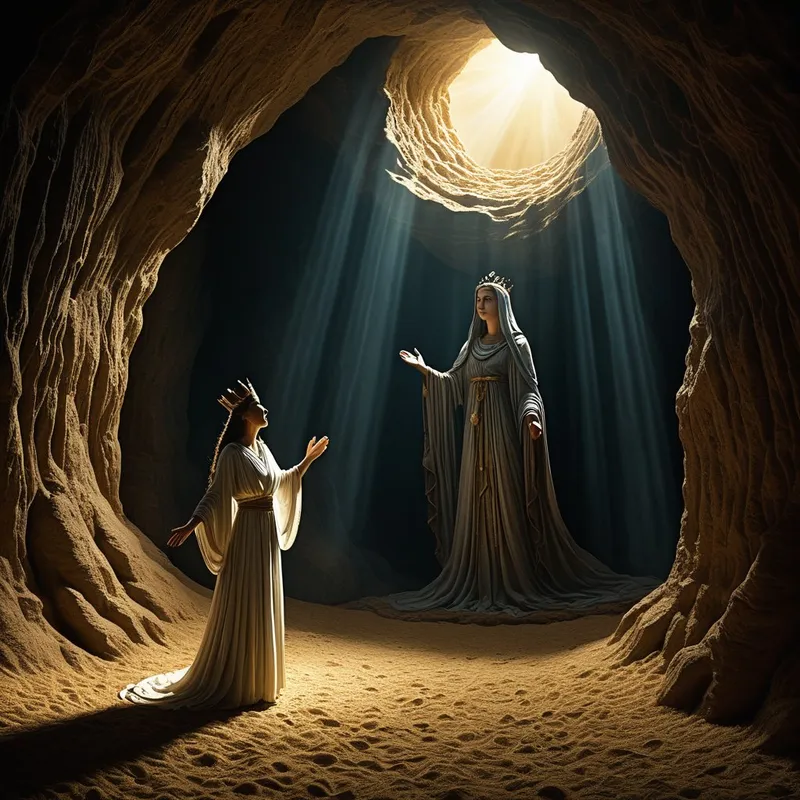
Demeter and Persephone - the a Myth Meaning & Symbolism
A mother's grief for her abducted daughter creates the seasons, revealing the sacred cycle of descent, loss, and cyclical return.
The Tale of Demeter and Persephone - the a
Hear now the story that moves the sun and paints the world in gold and grey, the tale of the mother who lost the world for love, and the daughter who became queen of another.
In the first age, when the earth was an eternal garden, Demeter walked the fields. Where her feet touched, life sprang forth—fat grains of wheat, barley that whispered in the wind, vines heavy with promise. Her joy was her daughter, Persephone, whose laughter made flowers bloom and whose hair was the color of sunlight on ripe stalks. They were two halves of one heart, the giver and the gift.
But deep beneath the roots of the world, in a palace of silence and remembered forms, Hades watched. His realm was full of shades, but empty of life. A longing, sharp as a splinter of obsidian, pierced his stony heart when he saw the maiden gathering narcissus in a meadow. With the silent consent of her father, Zeus, the earth cracked open. A chariot of black horses, snorting steam, erupted from the cleft. A strong, dark arm encircled Persephone’s waist. Her cry was swallowed by the closing earth as the meadow fell silent, leaving only a trampled garland and a deep, raw scar.
Demeter’s scream was a wind that withered the edges of leaves. She cast off her divinity, wrapped herself in the cloak of a mortal crone, and began her desperate wander. The sun grew cold. The soil turned to iron. Green shoots browned and died in the womb of the earth. Famine walked the land, for the goddess of life had turned her face away, consumed by a grief that froze the very source of nourishment.
In her wandering, she came to Eleusis. There, in the house of a king, she nursed a mortal prince, seeking to make him immortal, to replace her lost child. But she was discovered, and in her rage and sorrow, she revealed her true, terrible glory. She demanded a temple, and there she sat, a monument to loss, while the world starved.
Finally, the cries of dying humanity reached Olympus. Zeus sent messenger after messenger, but Demeter was immovable: no life without her daughter. At last, the king of gods commanded Hades to release his bride. Hermes, the swift guide, descended the dark path to negotiate the return.
In the sunless halls, Persephone had changed. The maiden was becoming a queen. Yet, when the message of release came, she rose with hope. But as she turned to go, Hades, with a gesture both cruel and loving, offered her a pomegranate seed—a final, fatal courtesy. Hungry from her fast of grief, she accepted, eating six of the blood-red arils. That simple, profound act bound her to the realm of the dead, for whoever tastes the food of that land must forever return.
A compromise was struck in the high court of the cosmos. For each seed eaten, a month of the year Persephone must reign as Queen beside Hades in the deep earth. The rest, she may walk in the light with her mother. Demeter, hearing this, allowed her heart to thaw. As Persephone ascended, the iron ground softened. Grass pierced the frost. The first, tentative blossom opened. Life returned, not as an eternal summer, but as a cycle—a wheel of presence and absence, of abundance and barrenness, driven by the rhythm of a mother’s heart and a daughter’s dual crowns.

Cultural Origins & Context
This is the heart of the Eleusinian Mysteries, the most sacred and revered ritual series of the ancient Greek world for nearly two millennia. Unlike the public dramas of Olympus, this myth was not merely a story to be recited, but a profound mystery to be experienced. The Homeric Hymn to Demeter, our primary source, functions as a sacred text, detailing the founding of the rites at Eleusis.
The myth was transmitted through initiation, a guarded secret that promised initiates (mystai) knowledge of the cycle of life and death and a favorable fate in the afterlife. Its societal function was immense: it provided a theological framework for agriculture, yes, but more importantly, it offered a personal, psychological map for facing mortality, loss, and the hope of renewal. It democratized access to a blessed afterlife, not based on heroic deeds, but on the sacred, inward experience of the mystery. The tellers were the hierophants, the priests and priestesses of Eleusis, who guided initiates through re-enactments and revelations that forged a direct, transformative encounter with the mythic pattern.
Symbolic Architecture
The myth is a perfect symbolic engine of the psyche’s relationship with loss, depth, and cyclical transformation.
Demeter represents the conscious, nurturing, life-giving principle—the ego that seeks to maintain connection, growth, and visible fruition. Her grief is the ego’s catastrophic reaction when a vital part of the psyche (the innocent, budding consciousness represented by Persephone) is suddenly taken by an unconscious force.
Persephone is the soul-image, the anima, or the nascent self that must undergo a necessary abduction into the unconscious. Her initial role is the Kore, the untouched maiden living in perpetual spring in her mother’s realm. Her abduction is not merely a violation, but an inevitable call to individuation.
Hades is the lord of the underworld—not evil, but the personification of the deep, structuring unconscious, the realm of the forgotten, the ancestral, and the potential that lies in darkness. He is the “rich one,” for his kingdom holds the wealth of unlived life and latent wholeness.
The pomegranate is the fruit of oath and binding. To eat of it is to consciously integrate a piece of the underworld’s reality, to accept the knowledge and responsibility that comes from the descent. It is the symbol of the irreversible transformation of innocence into experience.
The cyclical resolution—the shared custody of Persephone—models the health of the mature psyche. One cannot live forever in the bright field of conscious productivity (Demeter’s eternal summer), nor can one remain forever in the introverted depths of the unconscious (Hades’ eternal night). Wholeness is a rhythmic movement between the two.
The Dreamer’s Resonance
When this mythic pattern stirs in modern dreams, it signals a profound somatic and psychological process of descent and reintegration. It is the psyche’s way of initiating its own Eleusinian mystery.
Dreaming of a sudden fall, an elevator plunging, or being pulled into a cave or basement mirrors Persephone’s abduction. This is not necessarily a nightmare, but an announcement: a core part of the dreamer’s identity or a cherished relationship is being called into the depths for transformation. The somatic feeling is often one of weight, gravity, and a loss of control.
Dreams of a grieving, powerful, or barren maternal figure reflect the Demeter phase—the conscious ego’s experience of depression, creative barrenness, or profound grief after a loss (of a relationship, a role, an ideal). The body may feel heavy, cold, or lethargic, mirroring the frozen earth.
Dreaming of eating a strange, dark fruit, signing a contract in a shadowy place, or receiving a crown of dark jewels signifies the pomegranate moment: the point of no return in a psychological process. It is the dream-ego’s acceptance of a new, often challenging, truth about itself. This is the moment of binding to the depths, which feels both like a fate and a choice. The resolution—dreams of emerging from a tunnel into light, or of a figure who is both radiant and somber—signals the beginning of the cyclical return, the integration of the queenly authority gained in the underworld with the life above.
Alchemical Translation
The alchemical work modeled here is the nigredo and albedo, the blackening and the whitening, repeated in an eternal cycle. It is the process of psychic transmutation through necessary loss.
The abduction is the involuntary nigredo. The conscious personality is plunged into the prima materia of grief, depression, or crisis—the black, fertile mud. Demeter’s wandering and stagnation represent this stage of dissolution, where all previous structures of meaning and identity (the eternal harvest) fall apart.
The secret of the mystery is that the goal is not to rescue Persephone from the underworld, but for her to become its queen. The triumph is in the acquisition of dual citizenship—in light and in depth.
Persephone’s sojourn in Hades is the soul’s incubation in the dark. Here, in the silence away from the mother’s defining gaze, the maiden discovers her own authority, her own capacity to rule a kingdom of shades and riches. This is the albedo—the whitening, the emergence of a new, more complex consciousness from the dark. She does not escape the underworld; she marries it.
The eating of the pomegranate seeds is the coniunctio oppositorum, the sacred marriage. It is the conscious act that seals the union between the once-innocent consciousness and the power of the deep unconscious. Each seed represents a piece of shadow integrated, a month of the year where one must consciously dwell with one’s depths.
For the modern individual, the alchemical translation is this: we are not meant to live in unbroken summer. Our wholeness depends on our consent to descend—into grief, into shadow, into the fertile darkness of our own unexplored depths—and to return, not as we were, but carrying the authority and wisdom of that realm. We are both the grieving mother, learning to let go, and the abducted daughter, learning to rule what once terrified us. The myth teaches that life, in its fullest sense, is this very cycle of presence and absence, attachment and release, flowering and rooting, forever turning on the axis of a love that is deep enough to encompass both joy and despair.
Associated Symbols
Explore related symbols from the CaleaDream lexicon: