Deborah the Prophetess Myth Meaning & Symbolism
A prophetess and judge delivers Israel from oppression, orchestrating a victory that sings of divine wisdom and unshakeable courage.
The Tale of Deborah the Prophetess
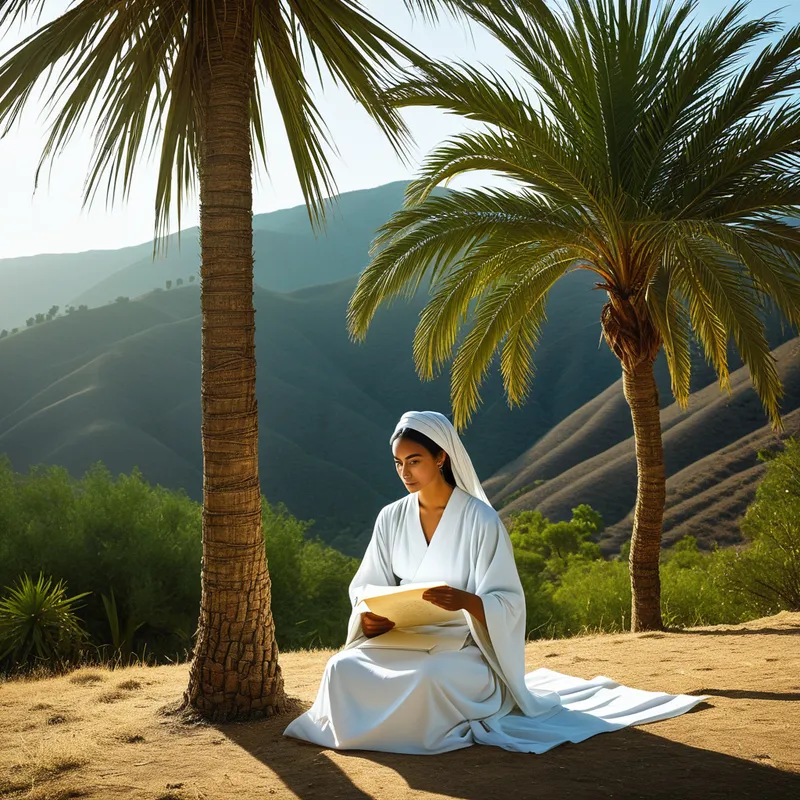
Listen. In the days when the judges ruled, when the roads were empty and travelers kept to the winding paths, when the people’s hearts turned inward with fear, there was a woman. Her name was Deborah. She did not dwell behind city walls, but under the open sky, beneath the broad fronds of a palm tree between Ramah and Bethel. This was her court. The earth was her throne, the rustling leaves her canopy.
To her came the people of Israel, bearing the weight of twenty years of crushing oppression. Jabin, king of Canaan, ruled with an iron fist, and his commander, Sisera</abbr, commanded nine hundred chariots of iron—a sound that made the very ground tremble and the hearts of warriors turn to water. They came to Deborah not because she bore a sword, but because she held a vision. She was a prophetess, a wife, a mother in Israel. And she listened. She listened to the whispers of the wind through the palm fronds, to the silent cries of the people, and to a Voice deeper than silence.
She sent for a man named Barak, from Kedesh in Naphtali. When he stood before her, the air itself seemed to still. “Has not the Lord, the God of Israel, commanded you?” she said, her voice clear as a mountain spring. “Go, gather your men at Mount Tabor. He will draw out Sisera, with his chariots and his troops, to the river Kishon, and I will give him into your hand.”
But Barak’s courage, kindled by her words, still flickered with doubt. “If you will go with me, I will go,” he said. “But if you will not go with me, I will not go.” Deborah’s gaze did not waver. “I will surely go with you,” she declared. “However, the road on which you are going will not lead to your glory, for the Lord will sell Sisera into the hand of a woman.” And so it was set.
Deborah rose from beneath her palm tree. She journeyed with Barak to Kedesh, and ten thousand men rallied to them. From the heights of Mount Tabor, they looked down upon the vast plain, where the army of Sisera gathered, a sea of polished iron and dust, the chariot wheels grinding like the teeth of a monstrous beast. Then Deborah spoke to Barak, a command that was both a prophecy and a battle cry: “Up! For this is the day in which the Lord has delivered Sisera into your hand. Has not the Lord gone out before you?”
Barak charged down the slopes. And the heavens answered. A storm, fierce and sudden, broke upon the plain of Megiddo. The Kishon River, a tame stream, swelled into a raging torrent. The iron chariots, the pride of Canaan, became their own prison—sinking, stuck, useless in the churning mud. Chaos descended upon Sisera’s host. The army of Israel, fighting with the fury of those long oppressed, swept through them. Sisera alone fled on foot, abandoning his splendor, seeking refuge in the tent of Jael.
And there, in the quiet darkness of a nomad’s tent, the final note of Deborah’s prophecy was fulfilled. Not by the hand of a warrior, but by the hand of a woman offering milk, a tent peg, and a decisive, terrible mercy. When the news reached Deborah, she did not merely rejoice. She sang. Her voice, once the instrument of judgment, became the instrument of poetry. The Song of Deborah echoed through the hills, a tapestry woven with praise, with stark remembrance of who fought and who held back, with the raw imagery of a mother waiting at a window for a son who would never return. And the land had rest for forty years.

Cultural Origins & Context
This story is preserved in the Book of Judges (chapters 4 and 5), a text that chronicles a cyclical, turbulent period in early Israelite history. The narrative of Deborah stands out as a unique and powerful anomaly. It exists in a dual form: a prose account (Judges 4) and a poetic victory hymn (Judges 5), the Song of Deborah. Scholars believe the song is among the most ancient texts in the Hebrew Bible, possibly contemporaneous with the events it describes from the 12th century BCE.
The societal function of this myth was multifaceted. In a patriarchal tribal society, the figure of Deborah served as a powerful validation of charismatic, spirit-led leadership that transcended gender norms. She was a judge in the fullest sense—a judicial arbiter, a military strategist, and a spiritual conduit. Her story reinforced the core theology of the time: that deliverance comes from divine will, often through unexpected vessels, in response to the people’s cry. The song, likely performed communally, served to solidify tribal identity, commemorate a hard-won unity, and warn against the consequences of cowardice and disunity.
Symbolic Architecture
Deborah is an archetypal embodiment of mishpat—justice, judgment, and right ordering. Her seat under the palm tree is not a place of hiding, but a radical center. The palm tree itself is a symbol of victory, resilience, and righteous stature.
The prophetess under the palm does not seek power; she becomes the axis where heaven’s will and earth’s cry intersect, and from that still point, order is born.
The central conflict is between the rigid, crushing order of the iron chariot (human tyranny, technological oppression, paralyzed fear) and the fluid, adaptive power of inspired action and natural force (the storm, the river, the tent peg). Deborah’s authority is not wielded over others, but through her unwavering connection to a source beyond herself. Her call to Barak, and his conditional acceptance, reveals a profound psychological truth: true courage often requires the presence of the affirming, witnessing spirit (the anima, in Jungian terms) to manifest.
The victory being credited to a woman (Jael) completes a potent symbolic circuit. It dismantles the expectation of where and how deliverance arrives, emphasizing that salvation often comes from the marginalized, the domestic sphere, the “weaker” vessel that proves to be the instrument of decisive transformation.

The Dreamer's Resonance
When the pattern of Deborah the Prophetess stirs in the modern psyche, it often surfaces in dreams of being called to a daunting responsibility. One might dream of being asked to lead a meeting, mediate a family conflict, or speak a difficult truth in a setting where they feel ill-equipped or out of place. The somatic sensation is often one of a deep, resonant certainty in the chest or gut, coexisting with anxiety in the limbs—a feeling of being both the still palm tree and the one who must march to Mount Tabor.
This dream motif signals the emergence of the inner Ruler archetype, struggling to integrate with the individual’s conscious identity. The dreamer is undergoing a process of claiming their own authority, not as egoic dominance, but as a capacity to discern, decide, and direct energy in alignment with a deeper ethical or spiritual imperative. The “iron chariots” in the dream may appear as oppressive systems (a job, a relationship pattern, an internal critic), and the swelling “river” represents the release of pent-up emotional or psychic energy that clears the blockage when action is finally taken.

Alchemical Translation
The myth of Deborah models a complete alchemical cycle of psychic transmutation. It begins with the nigredo: the twenty years of oppression, the empty roads, the collective depression and fear (the leaden state). Deborah represents the albedo, the clarifying, illuminating principle. She sits in the temenos under the palm, engaging in the opus of listening and discerning. This is the stage of gaining consciousness, of separating the divine mandate from the chatter of fear.
Her command to Barak is the citrinitas, the dawning of the solar will, the yellowing that initiates action. The descent into battle is the necessary confrontation with the shadow—the entrenched, oppressive complexes (Sisera and his chariots). The divine storm and flood represent a catastrophic, purging influx from the unconscious, which dissolves the rigid defenses of the ego (the iron chariots stuck in mud).
The victory is not in the ego’s strength alone, but in its willingness to be the vessel for a transpersonal force that reorders reality.
Finally, the rubedo, the reddening or culmination, is achieved not in simple conquest, but in the creative act of the Song. The experience is integrated, memorialized in poetry and praise. The individual who undergoes this Deborah-process moves from being a subject of internal oppression to becoming a conscious, creative ruler of their own psychic landscape. They learn to hold the tension between the receptive, intuitive wisdom (the prophetess) and the active, executing will (Barak), forging a sovereign self that can both judge justly and sing of the struggle.
Associated Symbols
Explore related symbols from the CaleaDream lexicon:
- Tree — The palm tree under which Deborah holds court, representing righteous judgment, resilience, victory, and a living connection between earth and heaven.
- Prophet — Deborah as the archetypal prophet, the voice that interprets divine will and foresees the unfolding pattern of fate and justice.
- Lightning — The sudden, illuminating command of Deborah and the storm from heaven that brings clarity and decisive action, shattering stagnation.
- River — The Kishon River, transformed from a boundary into a torrent of deliverance, symbolizing the overwhelming flow of psychic or emotional energy that clears obstacles.
- Chariot — Sisera's iron chariots, representing rigid, oppressive systems, inflated ego defenses, and a technology of control that ultimately becomes a trap.
- Mother — Deborah as "a mother in Israel," embodying the nurturing yet fiercely protective aspect of leadership that fights for the life of the community.
- Song — The Song of Deborah, representing the creative integration of victory, the transformation of raw experience into lasting wisdom and cultural memory.
- Tent — Jael's tent, the domestic, marginalized space that becomes the site of ultimate reversal and the fulfillment of prophecy in an unexpected way.
- Warrior — Barak, the necessary active principle who must execute the vision, though his courage requires the anchoring presence of the prophetic spirit.
- Crown — The implicit authority of Deborah, a crown not of gold but of moral clarity and recognized wisdom, bestowed by the people and the divine.
- Order — The central theme of mishpat (justice/judgment) that Deborah embodies, the act of restoring right relationship and harmony from chaos and oppression.
- Thunder — The voice of Deborah as judgment and the sound of the approaching storm, representing the awe-inspiring, unavoidable power of truth being declared.