
Daphne Myth Meaning & Symbolism
A nymph, fleeing the god Apollo's relentless desire, prays for escape and is transformed into the first laurel tree, finding sanctuary in rooted stillness.
The Tale of Daphne
Hear now the story spun from sunlight and shadow, of a desire that scorched the earth and a sanctuary found only in surrender.
It began not with love, but with a god’s wounded pride. Apollo, radiant and arrogant, had just slain the great serpent Python. Laughing, he spied Eros drawing his own tiny bow. “Impudent child,” Apollo mocked, his voice like golden bells, “what have you to do with the weapons of war? Leave them to those whose hands can truly wield power.”
A silent, dangerous smile touched Eros’s lips. In answer, he selected two arrows from his quiver. One was sharp and tipped with gold, forged to ignite consuming, possessive passion. This he fired into the very heart of the Sun God. The other was blunt and tipped with lead, crafted to instill cold, repelling aversion. This he loosed into the heart of a nymph who wandered the forest glades—Daphne, child of the river god Peneus.
The change was immediate and catastrophic. Apollo’s veins flooded with a fire he had never known. He saw Daphne by her father’s stream, her hair a cascade of dark water, her skin like dappled shade, and he was undone. He called to her, his voice full of divine music. But Daphne felt only a chilling dread, a primordial revulsion at his approach. The moment she saw the brilliance in his eyes, she fled.
What followed was not a chase, but a convergence of two absolute forces: one of relentless pursuit, the other of desperate flight. Apollo, swift as thought, closed the distance, his words falling around her like burning petals—promises of glory, of immortality, of his celestial love. Daphne, her breath tearing at her lungs, felt the heat of him at her back. The world blurred into a streak of green and gold. She could smell the ozone of his divine presence, hear the rustle of his chiton as he reached.
As his fingers grazed her shoulder, she screamed a prayer not to the pursuing god, but to the deep, silent earth. “Father! Peneus! Destroy this beauty that has doomed me! Open the earth, or transform this shape that brings such ruin!”
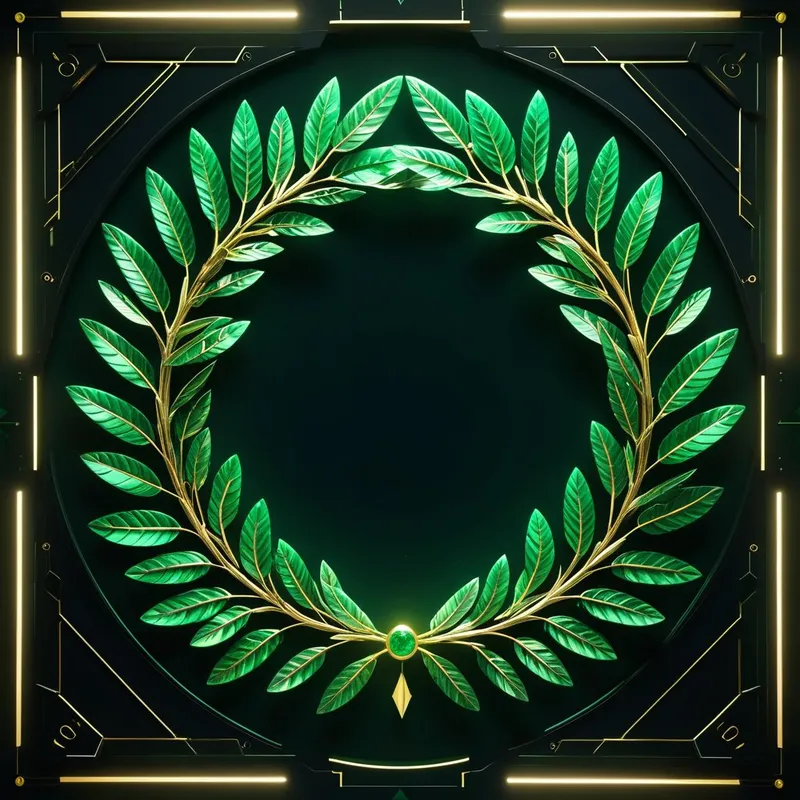
The prayer was heard. A profound heaviness seized her limbs. Her feet, pounding the soft loam, became fixed, driving roots deep into the dark heart of the world. Her skin hardened into rugged bark. Her outstretched arms, pleading to the sky, stretched and branched, sprouting clusters of glossy, evergreen leaves. Her hair became a crown of fragrant foliage. Where the nymph Daphne stood, now stood the first laurel tree, trembling in the still air.
Apollo skidded to a halt, his arms closing on rough bark instead of soft flesh. The fire in him did not die, but it changed. He laid his hand upon the trunk, feeling the frantic pulse within slow to a deep, vegetal rhythm. “If you cannot be my bride,” he whispered, his voice thick with a new, aching reverence, “you will be my tree. Your leaves will crown the heads of heroes, poets, and victors. You will be ever green, ever sacred, ever mine in this form.” And the laurel, in the breeze, seemed to sigh—a sound of terror ended, of a chase concluded, of a fierce, final autonomy won in the stillness of wood and leaf.

Cultural Origins & Context
This poignant myth comes to us primarily from the Roman poet Ovid in his epic Metamorphoses, a tapestry of tales about transformation. While Ovid’s version is the most famous and psychologically nuanced, the core story is Greek, rooted in the rich oral traditions that explained the natural and divine world. It was a story told not just to explain the origin of the laurel tree (dáphnē), but to explore profound cultural tensions.
In the Greek worldview, nymphs like Daphne were liminal spirits—powerful, yet vulnerable to the desires of the greater gods. The myth served as an aetiology, explaining why the laurel was sacred to Apollo and used to fashion the laurel wreath, the ultimate symbol of poetic, athletic, and military triumph at the Pythian Games at Delphi. But its societal function ran deeper. It dramatized the clash between eros (passionate, often possessive desire) and aidōs (shame, modesty, reverence for one’s own boundaries), a fundamental dynamic in Greek social and gender relations. It was a cautionary tale about the unchecked power of the gods, yet also a strangely comforting one about finding an inviolable sanctuary, even if that sanctuary is a radical change of being.
Symbolic Architecture
At its core, the myth of Daphne is a profound map of psychic boundaries and the ultimate defense of the Self.
The transformation is not a defeat, but a final, unassailable statement of being. The soul, pressed to its absolute limit, chooses to become its own sanctuary.
Apollo represents far more than lust. He is the radiant, conscious principle—light, reason, culture, music, and the drive to possess, name, and assimilate all that is Other into his luminous domain. His pursuit is the ego’s desire to make the mysterious and wild aspects of the psyche (the nymph) conform to its own brilliant self-image. Daphne, the nymph, embodies the untamed, instinctual soul, the part of nature that wishes only to be itself, un-captured, un-defined. She is autonomy in its purest form.
The river god Peneus, who answers her plea, symbolizes the deep, fluid unconscious from which all life—and all transformations—emerge. The metamorphosis into the laurel tree is the psyche’s ultimate defense mechanism. When conscious assimilation (Apollo’s chase) threatens to annihilate the essential nature of a psychic content, that content can “petrify,” or in this case, “vegetize.” It retreats into a symbolic, static, and eternal form. It becomes an image—beautiful, sacred, but untouchable in its original living reality. The laurel is that image: evergreen, fragrant, crowned in glory, but forever rooted, forever still, forever separate from the god who adores it.
The Dreamer's Resonance
When this mythic pattern stirs in the modern dreamer, it signals a profound crisis of integrity. To dream of being relentlessly chased, especially by a luminous or authoritative figure, and to then find oneself turning into a tree, a stone, or another immobile natural object, is to experience the Daphne Complex somatically.
The dreamer is likely facing a situation in waking life where their core identity or autonomy feels violently encroached upon—perhaps by the demands of a relationship, a career, a family role, or their own internalized “Apollo” drive for perfection and recognition. The chase is the experience of hyperarousal, anxiety, and the loss of psychological breath. The transformation in the dream is not a nightmare’s end, but the psyche’s radical solution: a deep, somatic shutdown. It is the self choosing to “root” rather than be consumed, to become a symbol of itself rather than a living participant in a dynamic that feels annihilating. The feeling upon waking is often not of terror, but of a strange, hollow peace—the peace of the inviolable, even if it is the peace of a monument.

Alchemical Translation
For the individual on the path of individuation, the Daphne myth models a critical, if paradoxical, stage of psychic transmutation. The initial chase represents the necessary, often painful, engagement between the conscious attitude (Apollo) and a vital but repressed part of the soul (Daphne). The ego seeks to make this wild nymph “useful,” to bring her into its service. But some aspects of the soul refuse to be “loved” in the ego’s possessive terms.
The alchemical gold here is not the capture of the nymph, but the god’s transformation in the face of the tree. The work is to let the desire to possess be transmuted into reverence for what is.
The true alchemy occurs in Apollo’s response. He does not burn the tree in his rage. Instead, he sanctifies it. He makes its leaves a crown for the highest human achievements. This is the model for psychic integration: when the conscious mind, having failed to assimilate a powerful autonomous complex, learns instead to honor it. The complex remains rooted in the unconscious (the earth), but its essence—its “leaves”—is woven into the fabric of conscious life as a sacred symbol, a source of inspiration, poetry, and victory.
The individuation lesson is stark: not everything in the psyche can or should be made to serve the ego’s direct purposes. Some parts must be allowed their rooted, silent, eternal otherness. The triumph is to touch that bark, feel the life within that follows a different, slower law, and to crown oneself with its leaves—not as an owner, but as a devotee. In doing so, the relentless fire of possessive desire is transmuted into the steady, respectful light of understanding, and the soul finds its unassailable peace.
Associated Symbols
Explore related symbols from the CaleaDream lexicon: