
Danu Myth Meaning & Symbolism
The story of Danu, the great mother of the Tuatha Dé Danann, whose essence is the river of life, sovereignty, and the nourishing unconscious.
The Tale of Danu
Listen, and let the mists of memory part. Before the Tuatha Dé Danann walked the green hills of Ériu, there was only the deep, dark potential. And from that potential, she flowed. She was not born; she became. She was the first sigh of the world, the gathering of all that was wet and wild and waiting. Her name was Danu, and she was the Mother of Waters.
From her endless, dreaming depths, the first of the Shining Ones arose. They were her children, the Tuatha Dé Danann, the People of Danu. They did not spring from her womb, but from her essence, from the very wellspring of her being. She was the river that carried them, the rain that fed them, the dew on the grass at dawn that whispered of her presence. She gave them not just life, but sovereignty—the sacred right to belong to the land and for the land to belong to them.
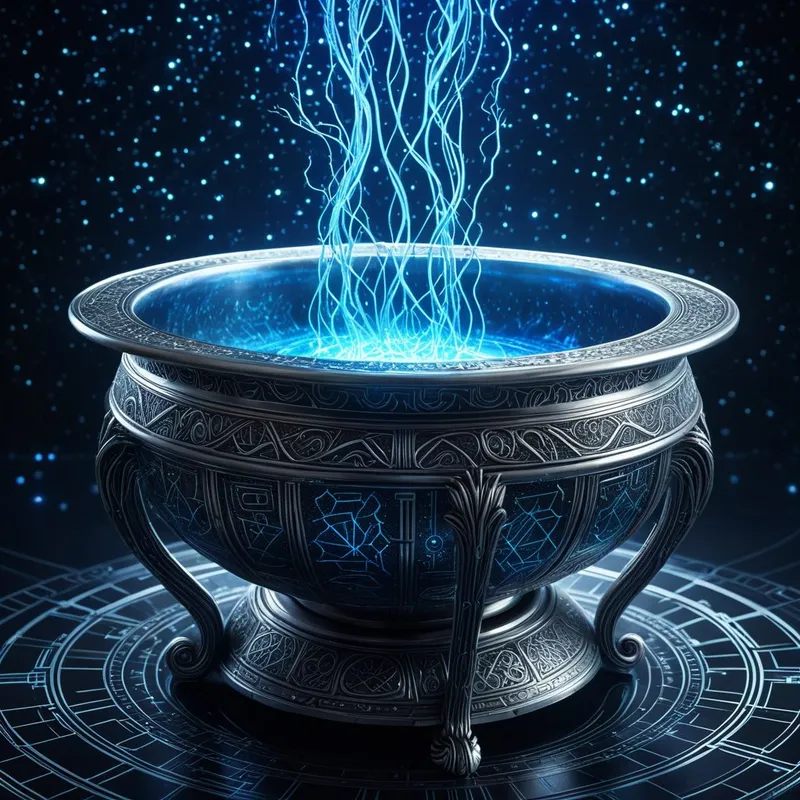
The Tuatha Dé, armed with the arts of magic and druidry, came to the misty shores in clouds of fog. But they did not come empty-handed. To win the land, they brought four treasures, each forged in the cities of the north, each a facet of Danu’s own power. The Lia Fáil that roared for the rightful king, was the stability of her bed. The Spear of Lugh that never missed, was the direct, life-giving flow of her current. The Sword of Nuada that none could escape, was the cutting clarity of her purpose. And the Cauldron of the Dagda, was her own boundless, nourishing womb.
The battles were fierce—against the Fir Bolg, and later, the monstrous Fomorians. The land shook with the clash of magic and might. Through it all, Danu was the silent, sustaining force. She was the river that healed the wounded, the hidden spring that refreshed the weary, the deep, dark loch that held the secrets of victory. When the Tuatha Dé Danann finally claimed the land, their triumph was hers. They ruled from the heights of Tara, but their power was rooted in her waters below.
And when a new race, the Children of Mil, came to claim Ériu, the age of the gods passed from the surface of the world. The Tuatha Dé Danann did not die. They retreated, as Danu herself might withdraw into the earth. They slipped into the sídhe, the hollow hills, becoming the Aos Sí. And Danu? She did not vanish. She became the land itself. Every river that courses to the sea is a thread of her being. Every well that bubbles from the dark earth is a whisper of her name. She is the deep, nourishing darkness from which all life emerges and to which it all returns. She is the first mother, forever flowing, forever full.

Cultural Origins & Context
The figure of Danu presents one of the most profound and elusive challenges in Celtic studies. Unlike the more narrative-rich figures of the Mabinogion, Danu exists primarily as a name—a powerful, generative absence. She is the root of the tribal name Tuatha Dé Danann, "the people of the goddess Danu," which firmly establishes her as a primordial matriarch. Her traces are found in the river names Danube, Don, and Dnieper, suggesting a pan-Indo-European water deity whose worship spread with early Celtic migrations.
This myth was not passed down in a single, coherent epic. It was preserved in fragments within medieval Irish manuscripts like the Lebor Gabála Érenn (The Book of Invasions), which were Christian redactions of much older oral traditions. The bards and filí (poet-seers) would have known her not through a linear biography, but through invocation and genealogy. Her societal function was foundational: she was the mythic source of sovereignty (flaith), the divine legitimacy that connected a king to the land. A true king did not just rule the people; he was wed to the goddess of the land, a concept often embodied by Danu or her later incarnations. She was the ultimate source of fertility, wisdom, and the magical power (draíocht) of her people.
Symbolic Architecture
Danu is not a goddess of something; she is the something itself. She is the archetypal matrix, the unformed potential from which all forms arise.
She is the water before the vessel, the silence before the song, the darkness that holds the light.
Her primary symbol is, unequivocally, water in its most primordial sense: the source, the underground aquifer, the great river of life. This is not the water of the surface storm, but the deep, slow, nourishing water that feeds roots and dreams. Psychologically, she represents the collective unconscious in its most nurturing aspect—the deep, impersonal well of life from which individual consciousness bubbles forth.
The four treasures of the Tuatha Dé Danann are extensions of her symbolic body. They represent the structuring principles that emerge from the formless source: Authority (the Stone), Will (the Spear), Discernment (the Sword), and Nourishment (the Cauldron). Her retreat into the landscape signifies a fundamental psychic truth: the source does not dominate; it underlies. The conscious ego (the ruling tribe) may believe it is in charge, but its vitality and legitimacy depend entirely on its connection to this deeper, sustaining layer of being.
The Dreamer's Resonance
When the pattern of Danu stirs in the modern psyche, it often manifests in dreams of profound, quiet nourishment or a desperate search for it. One might dream of discovering a hidden spring in a barren place, of drinking deeply from a cool, clear well and feeling revitalized to the core. Conversely, her absence is felt in dreams of drought, of polluted or receding waters, of a profound spiritual and emotional dehydration.
Somatically, this can correlate with feelings of chronic depletion, a lack of "life-juice," or a deep, wordless yearning for sustenance that food or company cannot satisfy. Psychologically, the dreamer is encountering the need for connection to the inner source. This is not about acquiring a new skill or achieving a goal, but about being nourished at the level of soul. It is a process of rooting down into the bedrock of one's own being, below the dramas of the personal unconscious, to tap into the impersonal, life-giving waters of the primal caregiver archetype. The dream asks: What truly feeds you? From what deep, ancient source does your energy and legitimacy flow?

Alchemical Translation
The alchemical journey modeled by Danu is not one of fiery confrontation or heroic questing, but of return and immersion. The modern individual, identified with the treasures (their skills, intellect, ambitions), often becomes disconnected from the cauldron—the source of renewal. The process of individuation here is one of remembering one's divine genealogy, of tracing one's lineage back to the nourishing darkness.
The work is to become like the land itself: to allow the deep, silent waters to rise through your cracks and fissures, to be flooded by a sustenance you did not create.
The first operation is Caput Mortuum—the recognition of the "dead head," the arid, rule-bound, overly structured consciousness that has run dry. This is the king who has forgotten the goddess. The next is Solutio—dissolution. This is the courageous act of letting go, of allowing the rigid structures of the ego to be softened, dissolved, and returned to the fluid state. It is a surrender to the nourishing unconscious, a trust-fall into the waters of Danu.
Finally, there is Coagulatio—coagulation. From the nourished, fluid state, a new form emerges. This is not the old, brittle structure, but one that is inherently moist, flexible, and connected to its source. The individual no longer just has resources; they are a resource. They become a vessel for the nourishing waters, a Cauldron of the Dagda in their own right, capable of sustaining not only themselves but the world around them. They achieve sovereignty not by conquest, but by embodying the deep, giving source from which all legitimate power flows.
Associated Symbols
Explore related symbols from the CaleaDream lexicon: