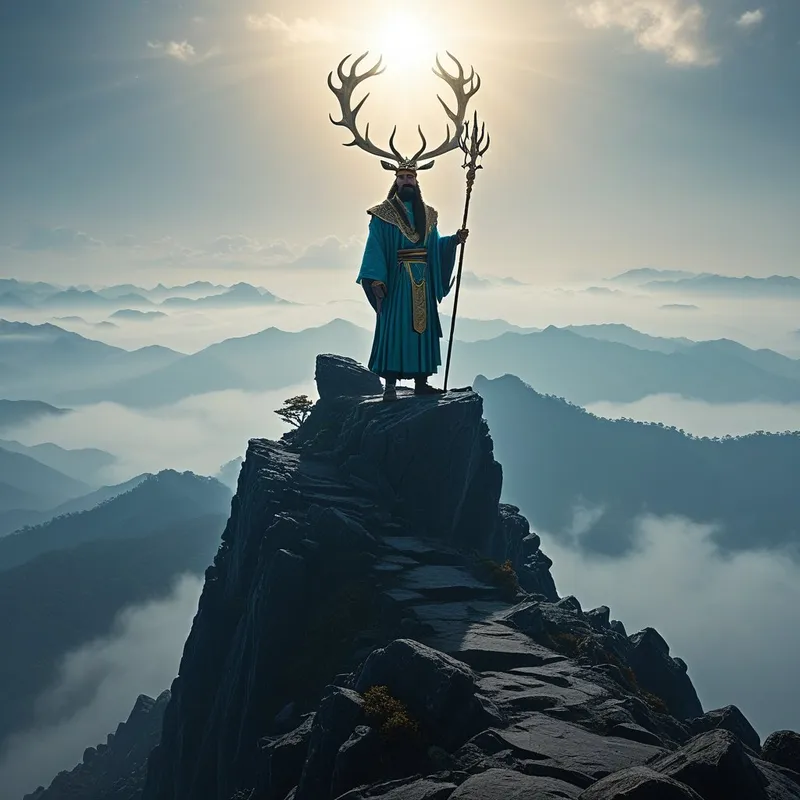
Dangun Myth Meaning & Symbolism
A divine prince descends to earth, establishes a sacred kingdom, and becomes the mountain spirit, embodying the union of heaven and earth.
The Tale of Dangun
Listen, and hear the tale of the first dawn. In the time before time, when the sky was a clear, untroubled vault and the earth a formless, yearning mass, a longing stirred in the heart of the heavens. Hwanin, the Celestial Emperor, looked upon the raw world below and saw its potential for order, for sacred life. His son, Hwanung, heard this call and was filled with a divine restlessness. He wished to descend, to bring the principles of heaven to the realm of earth.
With his father’s blessing, Hwanung descended with three thousand celestial ministers. They did not land upon just any rock or field. They chose the highest, most sacred place—the peak of Mount Taebaek. There, under a sandalwood tree that pierced the clouds, Hwanung founded Sinsi, the City of God. He brought with him the Cheonbuin, the sacred codes that governed wind, rain, and cloud. He taught the nascent peoples the arts of agriculture, medicine, law, and morality. The land began to breathe under this celestial governance.
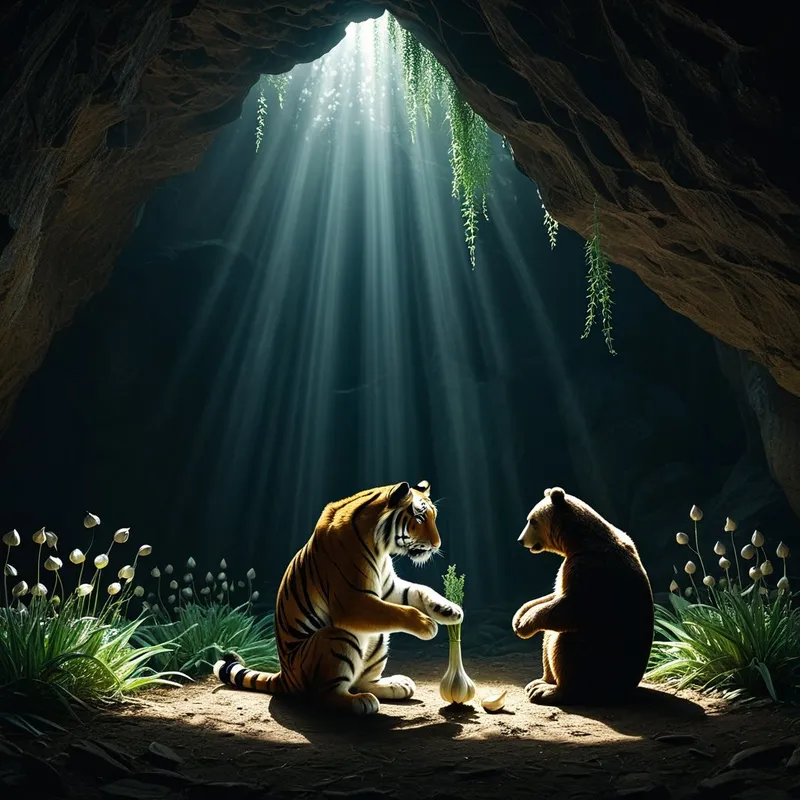
Yet, a profound solitude remained. The prince of heaven ruled, but the bridge between the divine and the mortal was not yet complete. In a cave at the mountain’s foot lived two creatures who yearned for transformation: a tiger and a bear. They came before Hwanung and prayed with all their animal souls to be granted human form. The prince, seeing the sincerity in their dark eyes, gave them a sacred test. He gave them twenty cloves of garlic and a bundle of mugwort. “Eat only this,” he commanded, “and shun the sunlight for one hundred days. If you endure, your wish shall be granted.”
The cave was dark and cold. The scent of garlic and bitter herbs filled the air. The tiger, fierce and impatient, soon found the hunger and the darkness unbearable. Its spirit could not withstand the stillness. It fled the cave, its dream of humanity lost to the wildness of its nature. But the bear remained. It endured the emptiness, the monotony, the profound waiting. It held to the vision. On the twenty-first day, a miracle occurred. The bear’s form shimmered and dissolved, and from its steadfast heart emerged a woman of grace and strength: Ungnyeo.
But Ungnyeo’s joy was tinged with a new loneliness. She prayed beneath the sandalwood tree for a child. Hwanung, moved by her perseverance and purity, took her as his bride. From this sacred union—the steadfastness of earth given form meeting the active principle of heaven—a son was born. This child was Dangun Wanggeom.
Dangun was not merely a king; he was a living covenant. In the year of the tiger, he established <abbr title="The first Korean kingdom, "Land of the Morning Calm"">Gojoseon, the Land of the Morning Calm. He ruled with a wisdom that blended celestial law with earthly compassion. For over a thousand years, his reign brought peace. And when his earthly work was complete, he did not die as mortals do. He ascended to Mount Asadal and transformed into Sanshin, the Mountain Spirit, becoming an eternal part of the land he founded, a guardian forever woven into the stone and forest.
Cultural Origins & Context
The myth of Dangun is the foundational narrative of the Korean people, first recorded in the 13th-century text Samguk Yusa by the Buddhist monk Iryeon. It is not a mere folktale but a mytho-history, a story that defines ethnic and cultural origins. It was transmitted orally by shamans (Mudang) and storytellers long before being committed to text, serving as the sacred charter for Korean identity.
Its societal function was multifaceted. Politically, it provided divine legitimacy to ruling lineages and the state itself, framing Korea not as a conquered or derived land, but as one purposefully created by heaven. Culturally, it established a unique cosmology distinct from that of neighboring China, asserting an autonomous and sacred origin. It answered the profound human questions: Where do we come from? Why are we here? The answer was rooted in a specific, beloved landscape—the mountains of Korea—and a process of sacred endurance and transformation.
Symbolic Architecture
At its core, Dangun’s myth is a profound allegory of individuation—the psychological process of becoming a whole, integrated self. It maps the journey from undifferentiated unity, through conflict and trials, to the establishment of a conscious, ruling center.
The sacred king is not born; he is forged in the tension between the celestial father and the earthly mother, between the ideal and the real.
Hwanin, Hwanung, and Dangun represent a divine trinity of consciousness. Hwanin is the transcendent principle, the distant but benevolent source. Hwanung is the active logos, the divine idea that descends into the chaos of the unconscious (the raw earth) to impose order. Dangun is the Self, the embodied result: a consciousness that is both divine in origin and fully incarnate in the material world.
The Tiger and the Bear are primal forces within the psyche. The tiger symbolizes raw instinct, passion, and impatience—a necessary energy, but one that cannot, on its own, achieve the disciplined transformation required for consciousness. The bear represents the potent, instinctual force capable of profound endurance, introspection, and hibernation. It is the part of the unconscious that can hold a vision through darkness and deprivation.
Ungnyeo, born from the bear, is the anima, the soul-image. She is the instinctual world transformed into a vessel capable of relationship with the divine (Hwanung). Her union with the heavenly prince is the sacred marriage (hieros gamos), the integration of the conscious masculine principle with the transformed feminine unconscious. From this union, the true ruling principle of the psyche—Dangun, the integrated Self—is born.
The Garlic and Mugwort are the alchemical reagents of transformation. They represent the bitter, purifying discipline required for metamorphosis. The cave is the temenos, the protected vessel of the unconscious where this slow, essential work must occur, shielded from the blinding light of untempered consciousness.
The Dreamer's Resonance
When this myth stirs in modern dreams, it signals a profound process of foundational change within the psyche. It is the dream of origins.
To dream of being tested in a cave with specific, simple objects points to a somatic process of purification. The dreamer may be in a life phase requiring extreme patience, dietary or health changes, or a withdrawal from social "light" to focus on an inner transformation. There is a sense of being betwixt and between—no longer an untamed instinct, not yet a realized being.
Dreaming of a union between a celestial figure and an earthly one often surfaces during periods of seeking one’s vocation or life’s purpose. It represents the longing to marry one’s highest ideals (the heavenly prince) with one’s grounded, perhaps neglected, instincts and talents (the bear-woman).
An image of becoming a mountain or a mountain spirit is a powerful symbol of achieving a state of inner sovereignty and eternal perspective. It suggests the dreamer is integrating their experiences into an unshakable core identity, becoming a calm, enduring center amidst life’s storms. It is the somatic feeling of being grounded, immense, and connected to deep time.

Alchemical Translation
The myth of Dangun provides a complete map for the alchemical process of psychic transmutation, leading to the creation of the inner Wanggeom—the ruler of one’s personal kingdom.
The first stage, Nigredo (the blackening), is embodied by the raw, formless earth and the dark cave. It is the initial state of confusion, depression, or primal yearning. The divine idea (Hwanung) descends into this darkness, representing the first spark of conscious intention to change.
The Albedo (the whitening) is the purifying trial of the bear. It is the disciplined work of analysis, fasting from old habits, and enduring the bleak, monotonous middle phase of any transformation. The tiger’s failure is a necessary shadow—the part of us that refuses the work and flees back to unconsciousness.
The kingdom is founded not after the trial, but because of it. The endurance is the foundation.
The Citrinitas (the yellowing) is the emergence of Ungnyeo—the soul made conscious, beautiful, and capable of relationship. This is followed by the Rubedo (the redden), the sacred marriage, the fusion of opposites that generates immense creative, life-giving energy.
The final, eternal stage is the transformation into Sanshin. This is not a regression but a sublime integration. The achieved consciousness (Dangun) does not remain a separate, ruling ego. It dissolves back into the fabric of the unconscious (the mountain), not to be lost, but to become its guiding spirit. The individuated Self becomes the wise, invisible governor of the entire psyche—the mountain god within. The individual no longer has a psyche; they are the sacred landscape, where wind, rain, and cloud—thought, emotion, and spirit—move in harmonious, self-originated law.
Associated Symbols
Explore related symbols from the CaleaDream lexicon: