Danaë's Bronze Chamber Myth Meaning & Symbolism
A king imprisons his daughter to thwart a prophecy, but divine gold finds her, birthing a hero and shattering the prison of fear.
The Tale of Danaë's Bronze Chamber
Hear now a tale of fear and gold, of a prison built not of stone, but of a father’s dread. In the sun-drenched land of Argos, King Acrisius ruled with a heart grown cold and heavy. An oracle of Phoebus Apollo had spoken, and its words were a curse upon his house: his own daughter, the radiant Danaë, would bear a son, and that son would be the death of him.
Terror seized the king. To defy the gods was folly, but to accept fate was unthinkable. So, he conceived a prison that would mock the very sky. Deep within his palace courtyard, he commanded the construction of a chamber with walls of bronze, its roof sealed tight. No man, no messenger, no breath of wind from the outside world could penetrate its seamless shell. Into this sunless, airless tomb, he placed his daughter, the innocent Danaë. Her world shrank to the cold, burnished glow of metal, a living soul entombed in a king’s cowardice. She was to be hidden from life, from love, from the future itself.
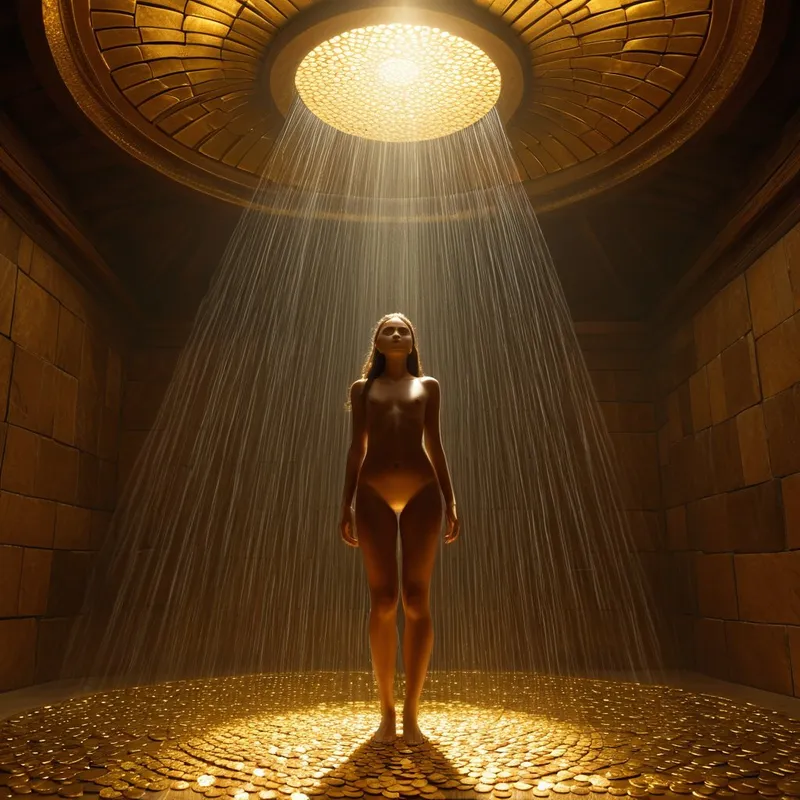
But what mortal king can build a wall high enough to keep out a god? Zeus, the cloud-gatherer, he who sees all, cast his gaze upon the beautiful prisoner in her bronze despair. His heart was moved, not with pity alone, but with a divine and irresistible desire. He would not shatter the walls with his thunderbolt, for that was the way of brute force. Instead, he chose a more subtle, more profound violation. He transformed himself into a shower of gold—liquid, radiant, incorporeal light.
Through a narrow vent in the roof, or so the poets say, or perhaps through the very substance of the bronze itself, the golden rain descended. It fell upon Danaë in her confinement, a divine and intimate visitation. In that impossible moment, the prison became a sanctuary, the instrument of isolation became the vessel for a sacred union. From this union, in the heart of the bronze chamber, a child was conceived: Perseus.
Years passed within that silent room. The infant grew into a boy, his laughter a secret echo against the metal walls. Discovery was inevitable. When Acrisius heard the sound of a child’s play from within his impregnable vault, his fear turned to a rage colder than bronze. Refusing the bloodguilt of direct murder, he sealed his daughter and her divine son into a great chest and cast them into the roaring, indifferent sea. The bronze chamber was exchanged for a wooden one, one prison for another, set adrift on the mercy of Poseidon’s realm. Yet, in this act of final abandonment, the king merely completed the prophecy’s first movement: he had not killed the future, he had launched it upon the waves, toward a destiny that would, in time, find its way back to him.
Cultural Origins & Context
The myth of Danaë is one of the foundational stories of the Perseus cycle, recorded most famously in the poetry of Simonides and Pindar, and later in the library of Ovid. It was not merely an entertaining fable but a narrative deeply embedded in the Greek understanding of fate, divine will, and the limits of human control. Told by bards and depicted on vases and in temple pediments, it served as a potent reminder of the futility of attempting to circumvent Moira.
The societal function was multifaceted. On one level, it explained the divine origin of a great heroic lineage (Perseus was the ancestor of Heracles). On another, it explored the tension between patriarchal authority (Acrisius) and the uncontrollable forces of fertility and destiny (Danaë and Zeus). The bronze chamber itself is a powerful symbol of the attempt to impose a sterile, human order upon the chaotic, life-giving processes of nature and the divine. The myth asserts that life, especially life touched by the gods, cannot be so contained.
Symbolic Architecture
The myth’s power lies in its stark, almost alchemical symbolism. The Bronze Chamber is the ultimate image of psychological confinement. It represents the complex we build out of fear—fear of the future, fear of loss, fear of our own potential or the potential of others. Its walls are forged from the alloy of anxiety and control, designed to keep the unknown at bay.
The prison we build to keep fate out becomes the crucible in which a new, more formidable fate is forged.
Danaë is the Innocent, the potential self locked away. She is not guilty, but she is punished; she is the creative, feminine principle walled in by a rigid, fearful masculine authority. The golden rain of Zeus is the numinous intrusion, the divine inspiration, the sudden insight or grace that penetrates the most fortified defenses of the ego. It is not a violent breaking, but a transformative permeation. It signifies that what we most need to be whole often arrives in a form we do not expect and cannot control, bypassing our logical defenses to impregnate the soul with new possibility.
Perseus, the child of this union, is the nascent consciousness born from the marriage of confined human potential (Danaë) and liberating divine force (Zeus). He is the heroic consciousness that must eventually confront the very monsters (like the Medusa) that the old king, Acrisius, in his fear, was trying to avoid.

The Dreamer's Resonance
When this myth pattern stirs in the modern dreamer, it often signals a profound experience of enclosure. One may dream of being in a room with no doors, a sealed pod, a submerged vessel, or a featureless metallic space. The somatic feeling is one of constriction, airlessness, and profound isolation. This is not necessarily a nightmare, but a stark depiction of a psychological reality.
The dreamer is encountering their own Bronze Chamber—a situation, a relationship, a belief system, or an internalized narrative that feels inescapable. It is the job they feel trapped in, the creative block they cannot bypass, the emotional pattern that repeats like an echo in a metal cell. The dream is presenting the architecture of their confinement. The crucial question the dream poses is: What is the nature of the gold that can reach me here? The resolution in the dream may not be an escape, but the sudden, inexplicable appearance of light, fluid metal, or a sense of sacred presence within the prison itself. This marks the beginning of an inner fertilization, the first stirring of the Perseus-self that will eventually demand a larger world.
Alchemical Translation
The journey from imprisonment in the bronze chamber to being cast adrift in the chest is the full alchemical cycle of psychic transmutation. Acrisius represents the ruling, tyrannical consciousness that seeks to preserve itself by rejecting any element that threatens its stability (the prophecy). Its method is separation and coagulation—walling off the soft, feminine, potential aspect (Danaë) in a hard, metallic shell.
The descent of the golden rain is the divine coniunctio, the sacred marriage of opposites that occurs in the most unlikely place. It is the moment when an insight, often from the unconscious (Zeus), infiltrates the fortress of the complex and unites with the trapped potential. This is the alchemical solutio—not a dissolving of the walls, but a spiritual liquefaction that creates something new within them.
Individuation often begins not by breaking down the walls of our prison, but by discovering the sacred purpose for which we were placed inside it.
The birth of Perseus and the subsequent casting into the sea represent the mortificatio and separatio of the old, isolated state. The wooden chest is a womb of a different order—organic, vulnerable, and subject to the rhythms of the greater unconscious (the sea). This is the necessary exile, the journey into the unknown where the newly conceived consciousness can gestate and grow strong. The final confrontation with Acrisius, which fulfills the prophecy, is the inevitable return of the transformed self to confront and dissolve the original, fear-based complex that created it. The myth thus models a complete arc: from sterile confinement, through divine impregnation and perilous incubation, to the emergence of a consciousness capable of navigating a world of monsters and miracles.
Associated Symbols
Explore related symbols from the CaleaDream lexicon: