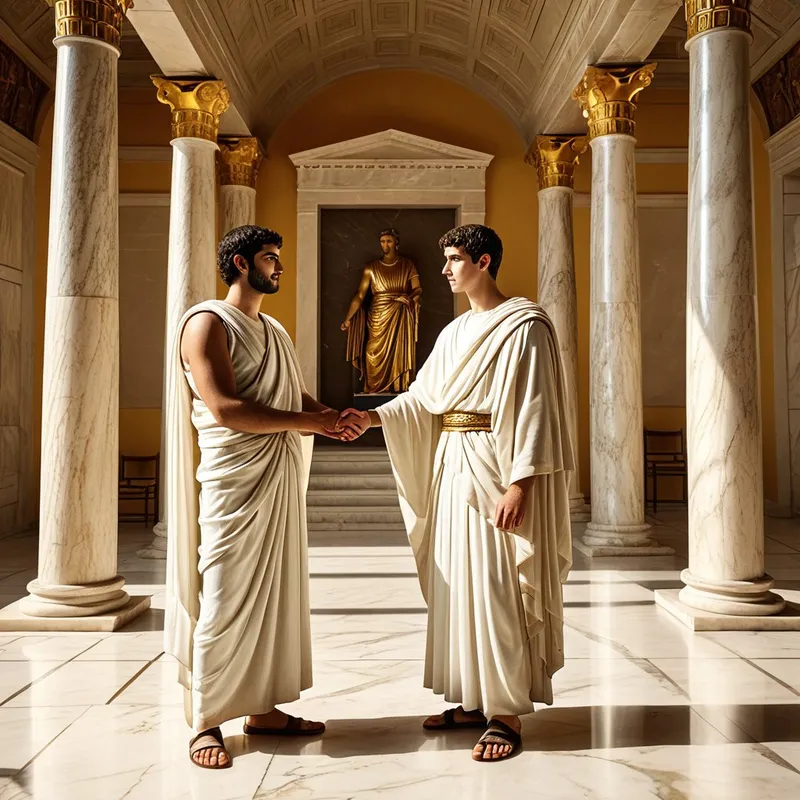
Damon and Pythias Myth Meaning & Symbolism
A story of two friends whose supreme loyalty and willingness to die for one another transforms a tyrant and redefines the meaning of trust.
The Tale of Damon and Pythias
Hear now a tale not of gods, but of men—a story that echoed through the sun-baked agora and the shaded porticos of Syracuse, a testament to a force that even the gods might envy. In that city, under the heavy, sceptred hand of the tyrant Dionysius I, the air tasted of fear and polished marble dust.
Among the citizens were two friends, Damon and Pythias. Their bond was not of blood, but of philosophy and a shared soul, forged in the pursuit of truth taught by the great Pythagoras. It was a quiet, profound thing, like the deep-rooted understanding between two ancient trees. But tyranny is a wind that tests all roots.
Pythias, bold in his convictions, was accused of plotting against the tyrant’s life. The evidence was whispers and the paranoid logic of power. Dionysius, his eyes cold as sea-worn pebbles, pronounced the sentence: death. The public execution would be a lesson, a spectacle to cauterize any further thoughts of rebellion.
Before the assembled, silent crowd, Pythias stood straight. He did not beg. Instead, he made a request that drew a scornful laugh from the throne. “Grant me a few days’ liberty,” he said, his voice steady. “I must journey to my home, set my affairs in order for my family, and bid them farewell. I give you my word I will return to meet my fate.”
Dionysius sneered. “Your word? A traitor’s word is smoke. Why would you return? You would flee and live.”
It was then that Damon stepped from the crowd. The atmosphere tightened. “I will be his pledge,” he declared, his words cutting the hot, still air. “Hold me here, in the darkest of your cells. If my friend Pythias does not return by the appointed hour, execute me in his stead.”
A murmur, like the sea drawing back, swept through the onlookers. The tyrant was intrigued, not by mercy, but by the spectacle of a fool’s gamble. He saw a chance to witness the inevitable failure of such idealism, to prove loyalty a phantom. He agreed.
Thus, Damon was chained and cast into the dungeon’s damp gloom. Pythias, with a last, weighted look at his friend, departed with the speed of Hermes himself. Days bled into one another. The sun rose and set on Damon in his chains. The court whispered—of course Pythias had fled, of Damon’s tragic naivete. Dionysius visited the cell, savoring the impending moral collapse. “Your friend has abandoned you,” he would say. “Your life is forfeit for his faithlessness.” Damon’s only reply was a calm certainty: “He will come.”
The final day dawned. The execution ground was prepared. The hour approached, then arrived. No Pythias. Damon was led to the place of death, his face serene. As the executioner raised his blade, a commotion撕裂 the solemn silence. A figure, ragged and breathless, clothes torn by travel, stumbled through the crowd. “Stop! I am here!” cried Pythias, his body broken by a journey of impossible haste, delayed by storm and bandit and shipwreck, but his spirit unbroken.
He embraced Damon, begging forgiveness for his lateness, urging the guards to release his friend and take him instead. He had kept his word.
In that moment, something in the stony heart of the tyrant cracked. He looked upon the two friends—one who had willingly faced death for a promise, the other who had raced toward it to save the one who trusted him. He saw a bond that rendered his power, his sceptre, his very throne, crude and meaningless. With a voice thickened by an emotion he had long forgotten, Dionysius spoke. “The sentence is revoked. Such friendship cannot be punished; it must be honored. I would beg a place as a third in your bond.”

Cultural Origins & Context
The story of Damon and Pythias is not a myth of the Olympian pantheon, but a philosophical legend, a paradeigma (example) from the later classical and Hellenistic periods. Its earliest known teller is the Aristoxenus, a pupil of Aristotle, who positioned it within the Pythagorean community. This is crucial: the tale is embedded in the soil of Pythagoreanism, a school that valued harmony, mathematical truth, and the sacred bond of fellowship (philia) above all.
It functioned as an ethical teaching story, circulating among philosophers and orators. The Roman writer Cicero and later Valerius Maximus popularized it in the Latin world as an exemplum of perfect friendship (amicitia perfecta). In a culture and subsequent empires built on patronage, clientage, and often-fickle political alliances, the story presented an idealized, almost impossible standard of selfless loyalty. It asked a piercing question of its audience: what is the true currency of a human life? Is it power, security, or the inviolable word given between two souls?
Symbolic Architecture
At its core, the myth is an alchemical vessel containing the pure essence of Trust and its shadow, the Test. Damon represents the one who holds the space—the conscious ego that submits to the darkness of uncertainty, imprisonment, and potential annihilation on faith alone. He is the anchored pole.
To be the pledge is to willingly enter the underworld, not as a hero seeking a boon, but as a sacrifice to the truth of a connection.
Pythias represents the journeying soul—the part of us that must venture into the chaotic world (storm, bandit, shipwreck) to resolve unfinished business, all while carrying the immense weight of another’s fate. His race against time is the psyche’s struggle to integrate and return to wholeness before a fatal dissociation occurs.
The tyrant Dionysius is the internal and external Skeptic, the cynical authority (parental, societal, or the inner critic) that believes only in power, transaction, and the inevitability of betrayal. He is the prison of literalism that cannot comprehend symbolic truth. His transformation is the myth’s ultimate goal: the redemption of the cynical principle through the undeniable evidence of authentic virtue.
The dungeon and the executioner’s blade are the liminal space and the deadline—the crucible of time and consequence where abstract ideals are forged into palpable, life-and-death reality.

The Dreamer's Resonance
When this myth stirs in the modern dreamer, it often manifests as somatic anxiety around a promise, a deadline, or a relationship of profound dependency. You may dream of being Damon: feeling trapped, waiting in a holding pattern (a doctor’s office, an airport, a empty house), carrying a calm dread that someone else’s actions will determine your fate. This speaks to a psychological state of suspended agency, where you have entrusted a crucial part of your life—your happiness, your security, your project—to another person or an external circumstance.
Conversely, to dream of being Pythias is to feel the frantic pressure of an impossible journey—missing trains, cars that won’t start, running through molasses—toward a critical appointment. This is the psyche signaling an unmet obligation to the Self, a part of your life or integrity you have left unresolved, and now the time for integration is perilously short. The bond between the two dream figures—the waiting self and the striving self—is the dream’s focal point. Its strain is the strain of individuation; its preservation is the ultimate goal.

Alchemical Translation
The psychic operation modeled here is the transmutation of the ego-bond into the Self-bond. Initially, Damon and Pythias are two separate individuals in a beautiful, yet untested, friendship. The tyrant’s decree is the catalyzing crisis, the nigredo that plunges the relationship into the darkness of absolute risk.
Damon’s voluntary imprisonment is the mortificatio—the ego’s willing death to its own self-preservation instinct for the sake of a higher principle (trust). Pythias’s harrowing journey is the separatio and circumambulatio—the necessary, chaotic work in the world to settle accounts (with family, with the past) that must be completed before a new state can be achieved.
The alchemical gold is not the sparing of their lives, but the creation of a third thing: a unified field of trust so potent it dissolves the tyrant’s cynicism.
Their triumphant reunion at the scaffold is the coniunctio—the sacred marriage of the one who stayed and the one who returned. This union produces the lapis philosophorum (philosopher’s stone): the transformative power of realized virtue. The tyrant’s change of heart represents the integration of the shadowy, cynical, authoritarian complex into the personality, now serving a new master: the awe inspired by authentic wholeness.
For the modern individual, the myth asks: What promise have you made to your own soul that remains unfulfilled? What part of you sits patiently in darkness, trusting that your striving, journeying self will return in time? And what internal tyrant—what voice of cynicism, doubt, or fear—waits to be dissolved not by force, but by the undeniable, lived proof of your own integrated loyalty to yourself? The friendship of Damon and Pythias, in the end, is the friendship between all the disparate parts of the psyche, vowed to return to each other, against all odds, to make the Self whole.
Associated Symbols
Explore related symbols from the CaleaDream lexicon: