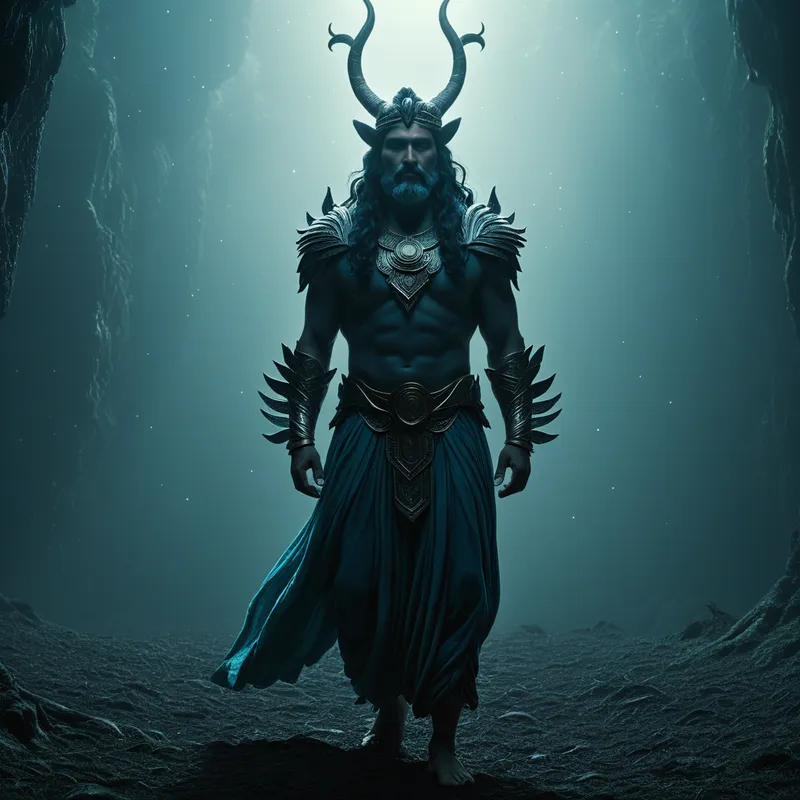
Damballa the Serpent
A primordial serpent deity from West Africa, Damballa represents creation, wisdom, and the cosmic order, revered as a foundational force in Vodou.
The Tale of Damballa the Serpent
In the beginning, before [the world](/myths/the-world “Myth from Tarot culture.”/) knew its own shape, there was only the vast, silent expanse of the cosmic waters. From this primordial womb, [Damballa](/myths/damballa “Myth from West African culture.”/) stirred. He did not burst forth; he uncoiled. His body, immense and iridescent, was the first movement in the stillness, the first curve against the infinite flat. He was not born; he became. As he moved, his scales, shimmering like polished silver and the purest white, caught a light that did not yet exist, reflecting the potential of all things.
His great coils churned the waters, and from this sacred motion, [the earth](/myths/the-earth “Myth from Hindu culture.”/) itself began to form—mud and silt rising to create the first land, the first mountain. Where his body touched the nascent earth, rivers carved their paths, and where his breath misted the air, the first clouds gathered. He was [the architect](/myths/the-architect “Myth from Various culture.”/) of the world, not with hands, but with the graceful, undulating logic of his being. He did not speak in words, but in the language of flowing [water](/myths/water “Myth from Chinese culture.”/) and shifting stone. His wisdom was not a [thing](/myths/thing “Myth from Norse culture.”/) to be learned, but a current to be felt, the foundational order beneath the [chaos](/myths/chaos “Myth from Greek culture.”/) of creation.
In some tellings, his movement created not just the earth, but the very dome of [the sky](/myths/the-sky “Myth from Persian culture.”/). He arched his magnificent spine, and the heavens were held aloft, a great vault of blue resting upon his eternal form. With his divine partner, Ayida Wedo, the rainbow, he completed the cosmos. Where Damballa was the potent, linear force—the spine of the world—Ayida was the arc of connection, the bridge of color and fluidity that binds heaven to earth. Together, they are the cosmic couple, the serpent and the rainbow, whose intertwined presence signifies balance, fertility, and the enduring [covenant](/myths/covenant “Myth from Christian culture.”/) between the divine and the material.
Damballa is often depicted as an ancient, venerable father, serene and all-knowing. He is the source of all ase, the vital energy that animates existence. To witness Damballa is to witness the slow, inevitable, and majestic unfolding of destiny itself.
Cultural Origins & Context
Damballa, or Damballah Wedo, finds his deepest roots among the Fon and Ewe peoples of West Africa, in the region that is now Benin, Togo, and Ghana. He is a lwa of the most ancient order, belonging to the Rada nation of spirits, which are considered the “cool,” wise, and foundational forces of the Vodou [pantheon](/myths/pantheon “Myth from Roman culture.”/). His veneration crossed the Atlantic with the enslaved Africans, enduring the [Middle Passage](/myths/middle-passage “Myth from African Diaspora culture.”/) to become a [cornerstone](/myths/cornerstone “Myth from Biblical culture.”/) of Haitian Vodou and related diasporic traditions.
In these new worlds of profound suffering and dislocation, Damballa’s significance transformed and deepened. He was no longer just a creator god of a homeland; he became the symbol of an unbreakable link to Africa, to ancestry, and to a primordial wholeness that slavery sought to destroy. He represented a cosmic order that transcended the brutal, imposed disorder of the plantation. To serve Damballa was to assert a spiritual identity that was older, wiser, and more powerful than the chains of the present. His serene, ancient nature offered a psychological refuge—a connection to a timeless, ordered reality where the soul could find its true home and strength.
Symbolic Architecture
Damballa’s [symbolism](/symbols/symbolism “Symbol: The use of symbols to represent ideas or qualities, often conveying deeper meanings beyond literal interpretation. In dreams, it’s the language of the unconscious.”/) is a profound study in primordial unity. He is not a god of many aspects, but of a singular, all-encompassing principle.
He is the cosmic serpent whose body is the architecture of reality: the spine of the individual, the winding river, the coiled DNA, the path of the planets. In him, the microcosm and macrocosm are one.
His color is white, representing purity, wisdom, ancestry (the bones of the forebears), and the [synthesis](/symbols/synthesis “Symbol: The process of combining separate elements into a unified whole, representing integration, resolution, and the completion of a personal journey.”/) of all colors into a primal light. He is associated with eggs, for creation; with [water](/symbols/water “Symbol: Water symbolizes the subconscious mind, emotions, and the flow of life, representing both cleansing and creation.”/), for the [source](/symbols/source “Symbol: The origin point of something, often representing beginnings, nourishment, or the fundamental cause behind phenomena.”/) of [life](/symbols/life “Symbol: The symbol of ‘Life’ represents a journey of growth, interconnectedness, and existential meaning, encompassing both the joys and challenges that define human experience.”/) and wisdom; and with the [serpent](/symbols/serpent “Symbol: A powerful symbol of transformation, wisdom, and primal energy, often representing hidden knowledge, healing, or temptation.”/), the ultimate [symbol](/symbols/symbol “Symbol: A symbol can represent an idea, concept, or belief, serving as a powerful tool for communication and understanding.”/) of cyclical time, [regeneration](/symbols/regeneration “Symbol: The process of renewal, restoration, and growth following damage or depletion, often representing emotional healing, transformation, or a fresh start.”/), and the mysterious [knowledge](/symbols/knowledge “Symbol: Knowledge symbolizes learning, understanding, and wisdom, embodying the acquisition of information and enlightenment.”/) of the [earth](/symbols/earth “Symbol: The symbol of Earth often represents grounding, stability, and the physical realm, embodying a connection to nature and the innate support it provides.”/).
He is often considered mute, or speaking only in hisses. This silence is not an [absence](/symbols/absence “Symbol: The state of something missing, void, or not present. Often signifies loss, potential, or existential questioning.”/), but a profound [presence](/symbols/presence “Symbol: Presence in dreams often signifies awareness or acknowledgment of something significant in one’s life.”/). It signifies a knowledge that precedes [language](/symbols/language “Symbol: Language symbolizes communication, understanding, and the complexities of expressing thoughts and emotions.”/), a wisdom that is communicated through being and essence rather than discourse. To understand Damballa is to learn the language of [stillness](/symbols/stillness “Symbol: A profound absence of motion or sound, often representing inner peace, creative potential, or existential pause in artistic contexts.”/), flow, and inherent [pattern](/symbols/pattern “Symbol: A ‘Pattern’ in dreams often signifies the underlying structure of experiences and thoughts, representing both order and the repetitiveness of life’s situations.”/).
His partnership with Ayida Wedo, the rainbow, completes a sacred circuit. He is the masculine, vertical axis—the world tree, the pole, the pillar. She is the feminine, horizontal arc—the bridge, the connection, the covenant. Their union is the hieros gamos, the sacred marriage that generates and sustains all life, symbolizing the necessary interdependence of structure and fluidity, law and love, foundation and connection.
The Dreamer’s Resonance
To encounter Damballa in the inner landscape of dream or active imagination is to touch the bedrock of [the Self](/myths/the-self “Myth from Jungian culture.”/). Psychologically, he represents the deepest, most archaic layer of the [psyche](/myths/psyche “Myth from Greek culture.”/)—what Carl Jung might term the psychoid layer, where matter and spirit are not yet differentiated. He is the archetype of foundational order that emerges from the personal and [collective unconscious](/myths/collective-unconscious “Myth from Jungian culture.”/).
When Damballa appears, he calls the dreamer back to origins. He may manifest in times of psychic chaos or moral confusion, not as a voice of judgment, but as a silent, coiling presence that re-establishes inner alignment. He is the instinct for integrity, the innate knowing of one’s true path. His energy is not quick or fiery, but slow, cold, and immensely powerful—like the movement of tectonic plates or the growth of ancient roots.
To resonate with Damballa is to seek reconnection with one’s own primordial wisdom, to find the serene center amidst life’s storms. He challenges the modern obsession with noise, speed, and fragmentation, offering instead the virtues of patience, ancestral memory, and the quiet, unshakable authority that comes from being in harmony with cosmic law.
Alchemical Translation
In the alchemical opus, Damballa is the [prima materia](/myths/prima-materia “Myth from Alchemical culture.”/)—the chaotic, watery beginning—and the agent of its transformation. He is the serpent [Mercurius](/myths/mercurius “Myth from Alchemical culture.”/), the [spiritus](/myths/spiritus “Myth from Alchemical culture.”/) mercurialis, who is both the substance to be transformed and the transformative force itself. His coiled form is [the Ouroboros](/myths/the-ouroboros “Myth from Alchemical culture.”/), the serpent eating its own tail, symbolizing the cyclical, self-sustaining nature of the alchemical process and of existence.
The journey with Damballa is an alchemy of consciousness: from the scattered lead of a disordered life to the integrated gold of a Self that recognizes its place within a vast, intelligent design. His “whiteness” is the albedo stage—not an end, but a purification, a return to essential, luminous being.
His silence is the mysterium magnum, the great mystery that cannot be spoken, only experienced. The devotee or the psyche engaging with this energy undergoes a “cooling” process—a calming of the feverish passions and a descent into the deep, reflective waters of the soul where true wisdom resides. The goal is not possession by chaos, but a conscious embodiment of order; not being ruled by the serpent, but learning its ancient, sinuous logic and becoming a vessel for its creative, structuring power.
Associated Symbols
Explore related symbols from the CaleaDream lexicon:
- Serpent — The primordial symbol of cyclical time, regeneration, earthly wisdom, and the potent, coiled energy at the foundation of life.
- Water — The source of all life, the realm of the unconscious, fluidity, wisdom, and the primordial chaos from which form emerges.
- [Cosmic Egg](/myths/cosmic-egg “Myth from Greek culture.”/) — The symbol of potential, the unmanifest world, and the sacred container from which all creation hatches.
- [Rainbow Serpent](/myths/rainbow-serpent “Myth from Australian Aboriginal culture.”/) — The union of celestial bridge and earthly wisdom, representing the covenant between heaven and earth, and the integration of duality.
- Roots of Wisdom — The deep, ancestral knowledge that grounds and nourishes, connecting the individual to the timeless source of understanding.
- Cosmic Balance — The inherent, divine order of the universe, the equilibrium maintained by primordial forces like the serpent and the rainbow.
- Ordered [Labyrinth](/myths/labyrinth “Myth from Various culture.”/) — A structured, winding path that symbolizes the journey of life and consciousness, guided by an intelligent, pre-existing design.
- Wisdom’s Key — The means of unlocking ancient, foundational knowledge that governs both the cosmos and the soul’s true purpose.
- Circle — The symbol of wholeness, eternity, and the cyclical nature of all things, reflected in the serpent’s coiled form.
- Mountain — The stable, enduring axis of the world, created by the serpent’s movement and representing spiritual ascent and unshakable foundation.
- Ancestor — The venerable source of lineage, tradition, and the accumulated ase (life force) that flows from the past into the present.
- Cosmic Pathway — The route laid down by primordial movement, representing destiny, spiritual journey, and the trace of divine action in the world.