
Dali's Melting Clocks Myth Meaning & Symbolism
A surrealist myth where time, personified as rigid clocks, melts under the gaze of the unconscious, dissolving the tyranny of the rational world.
The Tale of Dali's Melting Clocks
Listen, and let your mind’s eye soften. This is not a story of the world you know, but of the world that knows you—the world behind the curtain of waking.
In the beginning, there was the Plain of Paranoia. It was a land of stark, sharp angles and a sun that cast shadows too long and too still. Here, The Chrono-Sentinels reigned supreme. They were not creatures of flesh, but of brass and glass, with stern, numbered faces and hands that marched in a perfect, pitiless circle. They were the keepers of “When,” the jailers of “Now,” and they hammered the fluid dream of existence into countable, manageable seconds. The air was thin with logic, and the earth was hard with certainty.
But beneath this plain, in the deep, warm marrow of the world, slept the Great Unconscious. It dreamed in colors that had no names and in shapes that flowed like water. Its dreams were a silent pressure, a slow, persistent heat rising through the cracks in reality’s floor.
One day, under a sun that hung in the sky like a blind, white eye, the heat became a gaze. The Great Unconscious turned its attention upward. It did not attack; it merely looked. And where its attention fell, the fabric of the known world began to waver.
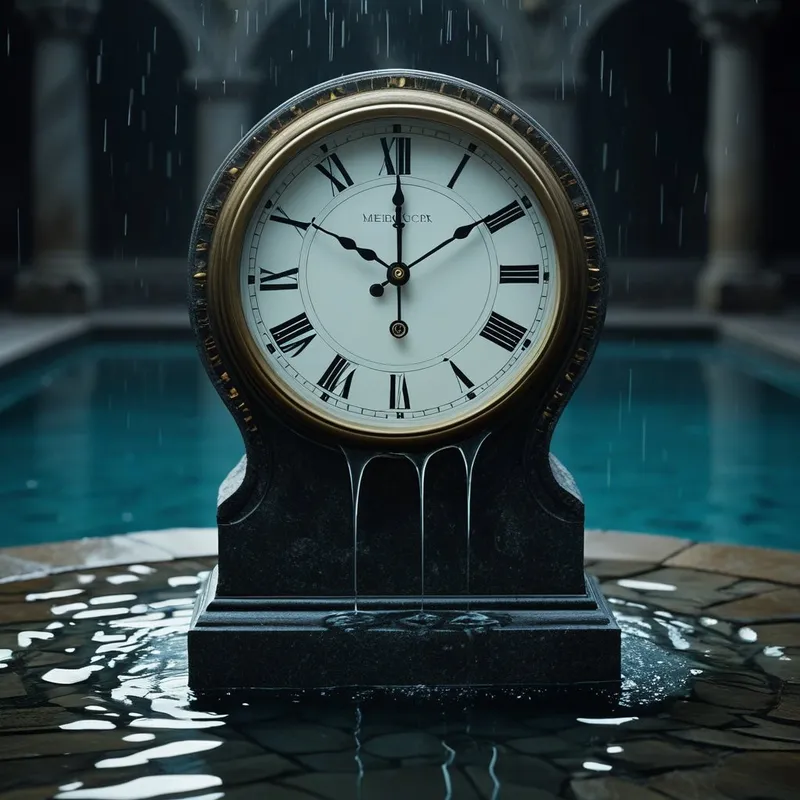
The first of the Chrono-Sentinels to feel it was the one perched on the Bone-Tree of Reason. Its precise tick faltered. A strange languor seeped into its gears. Its rigid brass spine softened, then bowed. Its once-sharp edges blurred, and it began to flow, draping itself over the branch like a sleepy cat, its numbers melting into illegible whispers. Time was not breaking; it was relaxing into a deeper truth.
Panic, a cold and angular thing, shot through the other Sentinels. One, standing guard on a barren wall, felt its foundation become as soft as cheese. It slid downward in a graceful, despairing slump, its hands pointing nowhere and everywhere at once. Another, laid upon the naked earth, became a pool of silvery essence, reflecting not the harsh sun, but the endless, star-dusted sky of the inner world.
The conflict was silent, profound. It was the war between the tick and the sigh, the grid and the wave. The Chrono-Sentinels fought with their last ticks, trying to hold their form, but the gaze of the Great Unconscious was a gentle, irresistible gravity. One by one, they surrendered to their own liquidity. The resolution was not a victory, but a homecoming. The Plain of Paranoia was transformed. The air grew thick with possibility. The shadows moved with a life of their own. Time had not been destroyed; it had been liberated from its own tyranny, allowed to exist in its true, fluid state. The world was no longer a clock to be read, but a dream to be experienced.
Cultural Origins & Context
This myth did not emerge from an ancient temple, but from the ateliers and cafés of 20th-century Europe, born from the Surrealist revolt. Its primary bard was the painter Salvador Dalí, who gave it its most iconic visual form in his 1931 work The Persistence of Memory. The myth was passed down not through oral epic, but through manifestos, paintings, and automatic writings—the sacred texts of a culture that worshipped the irrational.
The societal function of this myth was radical critique. In a world increasingly dominated by industrial time, Freudian rationality, and political rigidity, the Surrealists wielded the image of the melting clock like a weapon. It was a direct assault on the "reality principle," a deliberate invocation of the Freudian unconscious and, later, the Jungian collective unconscious. The myth served to destabilize, to question the very foundations of perceived order, and to propose a new, more authentic reality sourced from the depths of the psyche. It was a shared cultural dream meant to awaken the dreamer.
Symbolic Architecture
At its core, the myth is a profound symbolic map of a psychic coup. The Chrono-Sentinels represent the tyrannical rule of the conscious, rational ego—the part of the psyche that insists on order, sequence, and measurable progress. They are linear time, deadlines, schedules, and the entire superstructure of "civilized" life that denies the fluid, cyclical nature of inner experience.
The melting is not destruction, but the revelation of a more fundamental state of being.
The Great Unconscious is the mythic representation of everything the ego represses: instinct, memory, dream, intuition, and timeless archetypal patterns. Its "gaze" is the moment of insight, when the contents of the unconscious break through into awareness. The resulting melting is the dissolution of rigid ego-boundaries and cognitive frameworks. The Bone-Tree of Reason perfectly symbolizes a mode of thought that, devoid of the sap of intuition and emotion, is ultimately sterile and lifeless.
The Plain of Paranoia itself is the psychological state of existing solely in the conscious mind—a flat, anxious, and hyper-vigilant territory where everything must be controlled and interpreted. The transformation of this plain signifies the psyche’s reintegration, where the unconscious is allowed to irrigate the deserts of rationality.
The Dreamer's Resonance
When this myth appears in modern dreams—through images of wilting watches, dissolving phones, or meetings that never begin—it signals a critical somatic and psychological process: the ego’s necessary surrender. The dreamer is likely experiencing extreme pressure from the rigid structures of their waking life—a punishing work schedule, a stifling routine, or an intellectual dogma that has left their emotional life barren.
The somatic feeling is often one of relief mixed with anxiety: the deep, bodily sigh of releasing a long-held tension, coupled with the vertigo of losing a familiar framework. Psychologically, this is the unconscious advocating for its own reality. It is a call to stop "keeping time" in the external sense and start "inhabiting time" in an internal, qualitative sense. The dream is an invitation to let the psychic muscles that grip reality so tightly finally relax, to allow a more organic, intuitive, and creative sense of self to emerge from the meltdown.
Alchemical Translation
The alchemical process modeled here is the solutio—the dissolution. In the work of individuation, the seeker must first allow the hardened, leaden aspects of their persona (the rigidly constructed self) to be dissolved in the aqua permanens, the eternal waters of the unconscious. The Chrono-Sentinels are that leaden persona, the "false gold" of a life lived solely by the clock and the rulebook.
The triumph is not in building a new clock, but in discovering you are the landscape upon which all times flow.
The core struggle is the ego's resistance to this liquefaction, its fear of madness, formlessness, and irrelevance. The triumph is the acceptance that true consciousness is not about maintaining rigid control, but about developing the capacity to hold paradox—to be both formed and formless, timely and timeless. The melted clocks do not vanish; they persist in a new, more truthful state. This is the alchemical gold: a self that can navigate between the rational and the irrational, the temporal and the eternal, without being enslaved by either. The modern individual undergoes this transmutation whenever they choose creativity over routine, introspection over productivity, or dream-logic over spreadsheet-logic, thereby reclaiming their psyche from the dictatorship of the tick.
Associated Symbols
Explore related symbols from the CaleaDream lexicon: