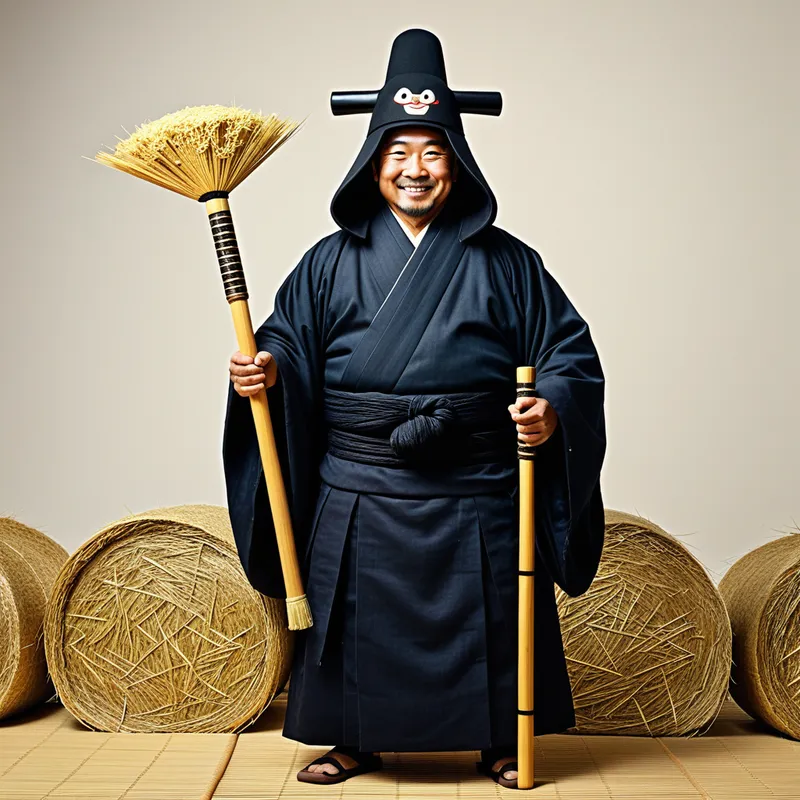
Daikokuten Myth Meaning & Symbolism
The story of a deity of darkness who becomes a god of wealth, holding a mallet that shakes hidden fortune from the world's unseen roots.
The Tale of Daikokuten
Listen. In the time before time was measured, in the spaces between the kami of the high sun and the deep sea, there dwelled a presence of profound darkness. Not a darkness of malice, but of the unformed, the potential, the rich and silent soil from which all life must first push its head. His name was Daikokuten.
He was not born of light, but emerged from the world’s fundament, his form as sturdy and enduring as the mountains, his smile as enigmatic as a moonless night. Where he walked, the earth did not tremble in fear, but sighed in recognition, for he was its hidden keeper. He carried a great sack, not empty, but swollen with the weight of all things not yet seen—the promise in the seed, the fortune in the stone, the song in the silent bird’s egg. In his right hand, he held a mallet, carved from the heartwood of the world-tree, its surface worn smooth by the grip of possibility.
For ages, he moved through the unseen realms, a guardian of thresholds. The other kami danced in the celestial fields or rode the storm winds, but Daikokuten remained, seated upon twin bales of the first rice, watching the roots of things. People knew of him only as a whisper, a shape at the corner of vision when the hearth fire guttered low. They felt his presence in the full granary, in the weight of a coin in the palm, but they could not name him. He was the secret of the soil, the luck that arrives unlooked-for.
Then came a time of great scarcity. The skies were like brass, the rivers thin silver threads. The people’s prayers to the sun and rain kami rose like smoke and scattered. In their desperation, they turned their minds inward, to the dark, to the ground beneath their feet. They offered not grand words, but the quiet labor of their hands, the care for their humble tools. And in that silence, Daikokuten heard his call.
He did not descend from a cloud. He arose. From the very floor of the poorest farmhouse, from the shadowed corner of the marketplace, his form solidified. He raised his mallet high, not in threat, but in a gesture of profound attention. With a laugh that was like stones tumbling in a deep stream, he brought the mallet down. It did not strike an anvil, but the very air, the concept of lack. And with a sound like a mountain sighing, fortune shook loose. Rice grains, plump and golden, pattered from the rafters. Coins, warm as if from a pocket, rolled across the floor. The sack on his shoulder bulged, and from its mouth spilled not gold, but the tangible spirit of perseverance, of hidden resource.
From that day, he was seen. No longer just a shadow, but a smiling, robust god, seated firmly upon the bounty he protected. He became the god of the farmer’s hidden store, the merchant’s lucky chance, the household’s protected wealth. He taught that abundance is not only a gift from above, but a treasure summoned from within, from the dark, fertile ground of our own effort and attention.

Cultural Origins & Context
The figure of Daikokuten presents a fascinating case of cultural and religious alchemy. His origins are not purely in the native Shinto pantheon, but arrive through the complex process of Shinbutsu-shūgō. He is the Japanese interpretation of the Hindu Buddhist deity Mahakala, a wrathful, dark-skinned protector. As Buddhism traveled the Silk Road and settled in Japan, its deities were often harmonized with local kami to ease acceptance and create a cohesive spiritual landscape.
Daikokuten’s transformation is profound. The fierce, warrior-like Mahakala, often depicted in a garland of skulls, was translated into a benevolent, jovial god of wealth and the household. This was not a dilution, but a profound cultural reinterpretation. His darkness was retained not as a symbol of destruction, but of fertile earth and hidden potential. His worship was passed down not by priests in grand temples alone, but by merchants, farmers, and householders. His image—standing on rice bales, mallet in hand, rat (a symbol of abundance and shrewdness) often at his feet—became a common fixture in kitchens and shops. The myth was lived daily; his "story" was the act of filling the rice jar, of saving the first coin of a venture, of acknowledging the wealth of the earth itself.
Symbolic Architecture
Daikokuten is a master symbol of the alchemy of the shadow. He represents the immense value and generative power hidden within what a culture—or an individual—might initially perceive as dark, foreign, or "other."
The true treasure is never in the full light of day; it is buried, awaiting the strike of the willing hand that knows where to dig.
His darkness is not evil, but the fecund unknown, the unconscious psyche teeming with unlived potentials and unacknowledged resources. The mallet is the instrument of revelation, the focused act of will or attention that "strikes" the unconscious, causing its hidden contents—ideas, talents, fortunes—to manifest. The sack is the boundless container of potential, the Self that can hold and integrate these disparate elements. Sitting upon rice bales, he symbolizes wealth that is grounded, nourishing, and fundamental, not abstract or speculative. He is the archetype of the Self as the source of inner wealth, teaching that prosperity is first an internal condition of recognizing one's own hidden resources.
The Dreamer's Resonance
When the pattern of Daikokuten stirs in the modern dreamscape, it often signals a psychological process of discovering inner resource in a time of perceived scarcity or shadow-work. The dreamer may find themselves in a cellar, an attic, or a forgotten room—psychic spaces representing the unconscious. There, they might discover a hidden hoard of coins, a full granary in a barren land, or a simple, sturdy tool that feels immensely potent.
Somatically, this can feel like a grounding, a solidifying. There is a shift from anxiety (the fear of lack) to a sense of embodied fullness. The figure in the dream may not be a traditional Daikokuten, but a shadowy yet benevolent presence, a smiling stranger, or even one's own reflection in a dark window, holding an object of power. The process is one of the ego, feeling impoverished, turning to the shadow—not to fight it, but to petition it—and receiving from that dark soil the very sustenance it needed. It is the psyche’s innate corrective to a one-sided life lived only in the "light" of conscious striving, ignoring the fertile darkness within.

Alchemical Translation
For the individual on the path of individuation, Daikokuten models a critical stage of psychic transmutation. The "base material" here is the lead of the neglected shadow—those traits, talents, and histories we deem unworthy, dark, or shameful. The conscious mind, in a state of spiritual or creative poverty, must first acknowledge this dark, inner "deity."
The mallet is the courage to engage with your own depth. The fortune that falls is the Self paying its dividends.
The alchemical operation is sublimation: transforming the raw, primal energy of the shadow (the fierce Mahakala) into a life-giving, sustaining force (the benevolent Daikokuten). This requires the "strike" of honest self-reflection, the discipline of journaling, therapy, or creative expression that taps the unconscious. The resulting "gold" is not necessarily material wealth, but the wealth of character: resilience drawn from past wounds, creativity sourced from repressed passions, and a profound sense of inner security that cannot be shaken by external circumstance. One learns to sit, like Daikokuten, upon the bounty of one’s own fully integrated being, a ruler of the inner kingdom, whose wealth is inexhaustible because it is rooted in the eternal dark soil of the soul.
Associated Symbols
Explore related symbols from the CaleaDream lexicon:
- Earth — The foundational symbol of Daikokuten's domain, representing the fertile darkness, the unconscious, and the grounded, material source of all abundance.
- Shadow — The core psychological substance Daikokuten embodies and transmutes, representing the hidden, potent, and often undervalued aspects of the self.
- Ritual — The act of striking with the mallet is a sacred ritual, a focused gesture that bridges the conscious will and the unconscious source to manifest change.
- Wealth — The direct manifestation of Daikokuten's power, symbolizing not just material fortune, but the inner riches of integrated potential and self-sufficiency.
- Goddess — While male in form, Daikokuten's function is deeply connected to the fertile, generative, and nourishing principle often embodied by goddess figures.
- Granary — The stored bounty, representing the accumulated resources of the psyche and the importance of preserving and valuing what one cultivates.
- Threshold — Daikokuten is a guardian of the boundary between the seen and unseen worlds, between conscious lack and unconscious plenty.
- Tool — The mallet is the ultimate tool, an extension of intent that allows humanity to interact with and shape the raw potential of the unseen realm.
- Fortune — The sudden, unexpected manifestation of resource, symbolizing the psyche's ability to provide solutions from depths the conscious mind cannot fathom.
- Harvest — The result of the sacred strike, representing the tangible outcomes of engaging with one's inner darkness and labor.