Daedalus designing the Labyrin Myth Meaning & Symbolism
A master artisan, bound by a king's command, designs an inescapable prison to hold a monstrous secret, weaving his own genius into a cage.
The Tale of Daedalus designing the Labyrin
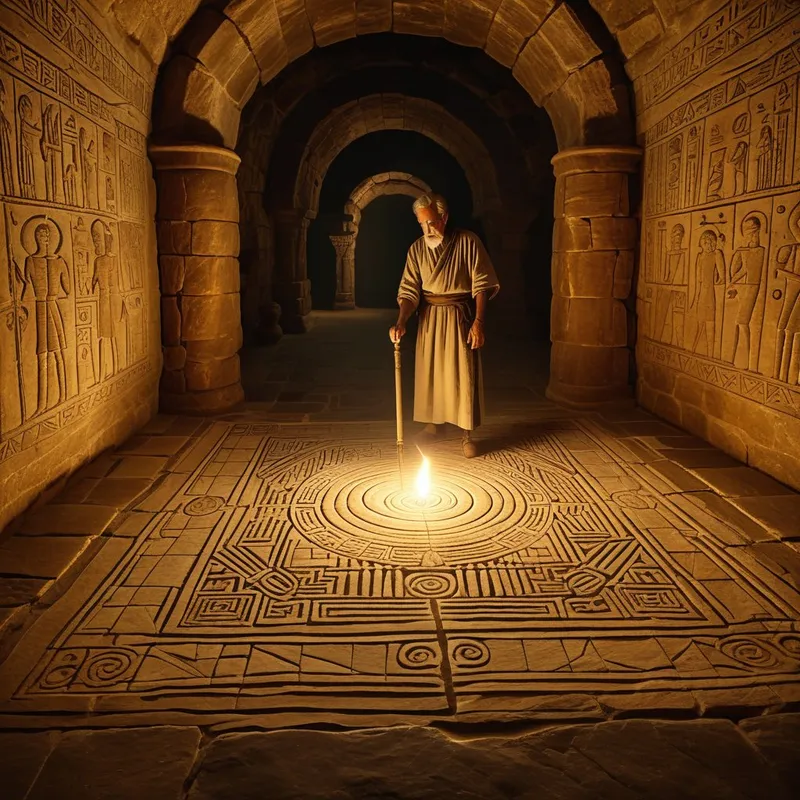
Hear now the tale of the maker and the maze, a story not of stone, but of the soul’s own architecture. The air in the great palace of Minos was thick with salt and shame. A secret grew in the queen’s chambers, a monstrous child born of a god’s cruel jest and a king’s broken oath. This was the Minotaur, a creature of rage and sorrow, whose bellow echoed the disgrace of the house of Minos.
The king’s fury was a cold, sharp thing. He looked upon Daedalus, the master artisan who had fled to his court, a man whose mind held the blueprints for wings and walking statues. “You, who can make the impossible real,” Minos commanded, his voice echoing in the marble hall. “Build me a prison. Not a cage of bars, but a confinement of confusion. A place from which this… reminder can never emerge. A place where the very walls are a sentence.”
Daedalus, his spirit already in exile, felt the weight of the command. It was not just a task; it was a corruption. His genius, meant to defy the heavens and animate stone, was to be bent inward, to design not liberation, but perfect captivity. He withdrew to a high chamber, the sea wind carrying the distant cries of the beast. He took up his stylus, not on papyrus, but on a great slab of polished obsidian. There, under the guttering light of oil lamps, he began to draw.
He did not design a fortress, but a fallacy. The lines he etched were a single, unbroken path that doubled back upon itself, a river of stone that flowed only into its own source. He conceived of corridors that mirrored each other yet led to different hearts of darkness, of stairs that ascended only to deposit the climber deeper into the earth. He designed the Labyrinth not as a structure, but as a state of being—a place where the mind, confronted with its own endless reflection, would surrender hope. The final design was a sealed tablet, a spiral of such perfect, malicious logic that to see it was to feel a vertigo of the spirit. Minos accepted it with a grim nod, and the digging began. The sound of chisels on Cretan stone became the heartbeat of the monster’s new world, a world dreamed into existence by the most brilliant mind of the age, now the jailer of his own creation.
Cultural Origins & Context
This core fragment of the Daedalus cycle originates from the rich tapestry of Greek mythology, most comprehensively compiled in later Roman sources like Ovid’s Metamorphoses. It is a myth born at the crossroads of the Minoan and Mycenaean worlds, echoing the awe felt by later Greeks for the vast, ruinous palace complexes of Crete, which seemed like mazes to outsiders. The story functioned as an aetiological myth for the concept of the inescapable trap and as a profound commentary on the moral responsibility of the creator.
Passed down by bards and later recorded by poets and playwrights, it was never merely a fantastical anecdote. It served as a societal warning about the perils of unchecked power (Minos), the dangerous alliance of genius and tyranny, and the existential truth that every act of creation carries within it the potential for destruction. Daedalus, the archetypal artist and engineer, embodies the eternal human dilemma: to what ends shall our greatest gifts be employed?
Symbolic Architecture
The Labyrinth is the central symbol, and it is fundamentally distinct from a mere maze. A maze offers choices, dead ends, and the potential for error and correction. The Labyrinth, in its mythic perfection, is a unicursal path—a single, winding, but inevitable route to the center. Its terror lies not in choice, but in the utter absence of it. It represents the inescapable confines of a fate, a psychological complex, or a sin one must confront.
The Labyrinth is not a puzzle to be solved, but a condition to be endured. It is the architecture of a trapped consciousness.
Daedalus represents the creative intellect divorced from moral navigation. He can design the path, but he cannot walk it for another. His genius builds the prison, making him complicit. The Minotaur within is the monstrous "shadow" born of unnatural union and hidden shame—the unspeakable secret that power tries to bury but must eventually feed. King Minos is the ruling ego, attempting to use cleverness (Daedalus) to imprison the unacceptable parts of the self (the Minotaur), an endeavor that is ultimately self-defeating and requires continual, bloody tribute.
The Dreamer's Resonance
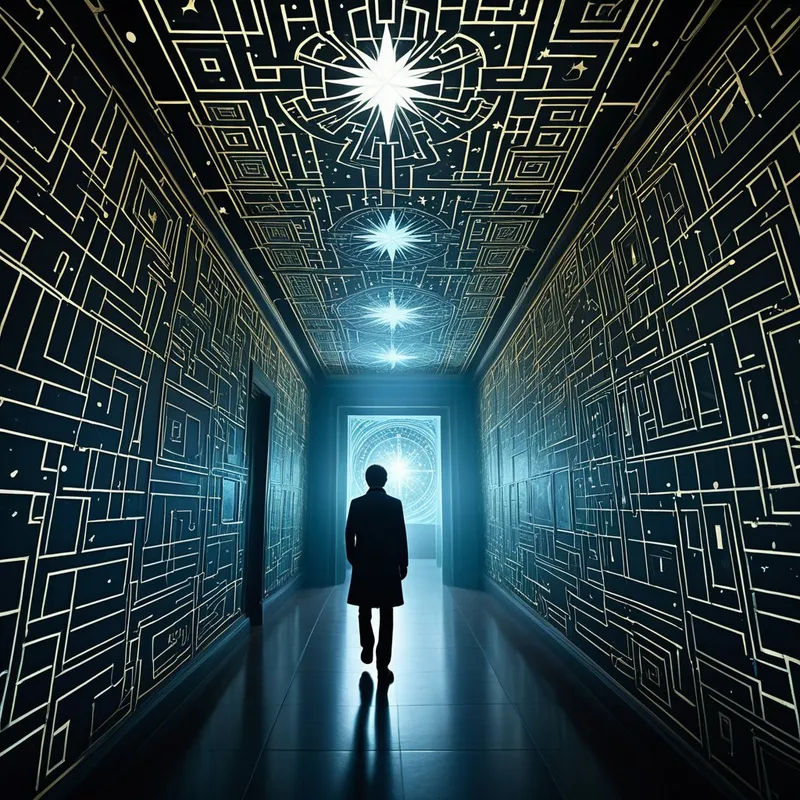
When this myth pattern arises in modern dreams, it seldom appears as a literal stone maze. Instead, the dreamer may find themselves in an endless, repetitive office corridor, a shifting house with rooms that lead back to where they started, or a forest path that circles a terrifying, unseen center. The somatic feeling is one of profound frustration, claustrophobia, and a draining fatigue—the psyche’s energy being consumed by navigating its own defensive structures.
This dream signals that the conscious ego is caught in a self-made system of avoidance. The dreamer has, like Daedalus, used their own ingenuity to design a life-path or a pattern of thinking that keeps a core pain, trauma, or unacceptable desire (the Minotaur) safely "contained." But the cost is imprisonment within that very structure. The dream is a call from the Self, indicating that the maintenance of the labyrinth is becoming more burdensome than facing what lies at its center.
Alchemical Translation
The alchemical process modeled here is the nigredo—the blackening, the descent into the chaotic, imprisoned matter of the soul. Daedalus’s act of designing the Labyrinth is the conscious mind’s brilliant, misguided attempt to organize and contain the prima materia of the unconscious. It is a necessary, if tragic, first step: one must recognize and map the confines of one’s prison before one can escape it.
The individuation journey requires becoming both Daedalus and the one who enters the maze. One must first acknowledge with sober honesty how one has architect-ed one’s own neuroses, defenses, and life-traps. Then, one must voluntarily enter that confusion, not to fight the monster, but to first meet the psychopomp that the monster guards. In later parts of the myth, this is Theseus, aided by Ariadne’s thread (the connecting principle of love or insight).
The transmutation occurs when the creator realizes he is also the prisoner, and the thread that leads out is spun from the same genius that built the walls.
The ultimate "flight" of Daedalus and Icarus comes only after the Labyrinth has done its work and been transcended. It is the final, perilous ascent after the deepest descent, a warning that liberation requires not just escaping the maze below, but navigating the dangerous expanses of the sky above—the realm of spirit, inflation, and hubris. The myth, in its entirety, charts the full arc: from the intellectual creation of one’s prison, through the necessary confrontation with what is imprisoned, to the fraught, glorious, and often tragic attempt at ultimate freedom.
Associated Symbols
Explore related symbols from the CaleaDream lexicon: