Daebyeol and Sobyeol Sun and Moon Myth Meaning & Symbolism
A myth of sibling sacrifice where a mother's grief transforms her children into the eternal Sun and Moon, establishing cosmic order from primal chaos.
The Tale of Daebyeol and Sobyeol Sun and Moon
In the time before time, when the world was a canvas of shadow and the sky had not yet learned to hold light, there lived a woman. She was a woman of the earth, her hands calloused from tilling the soil, her heart a deep well of love for her two children. Her son was Daebyeol, a boy whose laughter was like the first crack of dawn. Her daughter was Sobyeol, a girl whose quiet gaze held the patience of the deep night.
One day, the mother had to journey to the village beyond the dark, whispering pines. "Stay here," she told them, her voice a soft thread against the growing gloom. "Do not open the door for anyone but the sound of my voice." She left them in their humble home, a single lamp casting long, dancing shadows that seemed to breathe with the house.
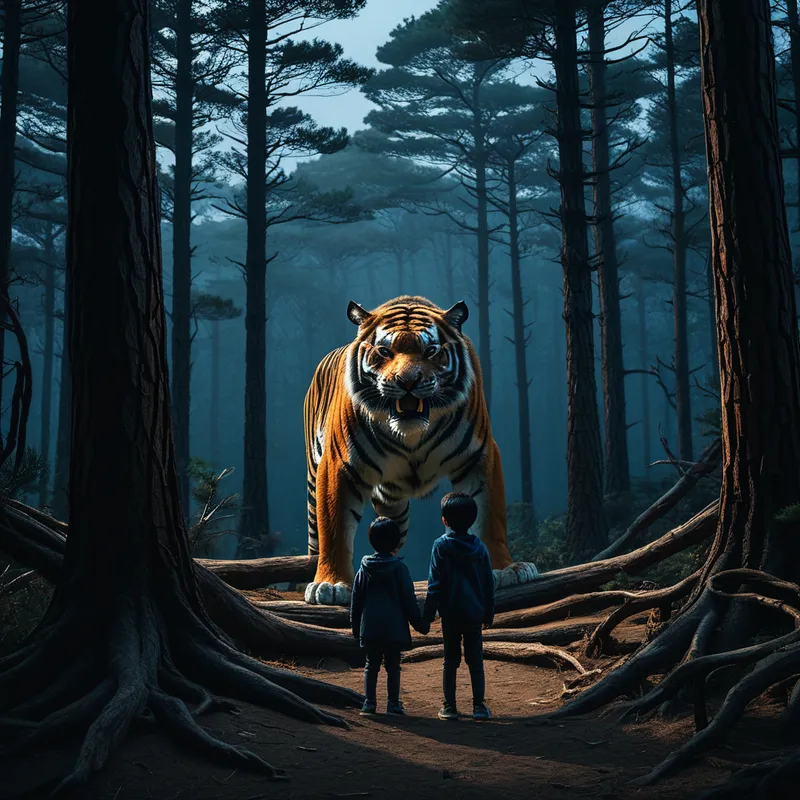
But the forest was listening. A great Tiger, its coat the color of burnt amber and its eyes like smoldering coals, had watched her leave. It crept to the door and, in a voice that scraped like stone on stone, called out, "Children, open the door. Your mother has returned."
Sobyeol, ever cautious, whispered to her brother, "That is not our mother's voice. It is too rough, too hungry." The tiger, thwarted, slunk away to the stream. It drank until its throat was slick and smooth, then returned. This time, its call was a liquid mimicry, a chilling echo of maternal warmth. "My darlings, it is I. Open the door."
Believing the familiar cadence, Daebyeol drew back the wooden latch.
The door swung open to reveal not their mother's loving face, but the gaping maw of chaos itself. Terror, cold and absolute, seized them. With a cry that was swallowed by the forest's throat, they turned and fled. Out of the house, into the tangled wilderness, two small hearts pounding a frantic rhythm against their ribs. The tiger gave chase, its breath hot on their heels, the world narrowing to the thunder of pursuit and the desperate gasps for air.
They ran until their lungs burned, until they saw a figure ahead—an old man tending a field of lush Lettuce. "Grandfather, save us!" they pleaded, their voices thin with fear. The old man pointed to a towering Bamboo stalk. "Climb!" he urged.
They scrambled up, their small hands gripping the smooth, segmented stalks, climbing high into the green canopy. The tiger arrived in a fury, snarling at the base. It began to climb, its claws digging deep into the bamboo. Seeing this, the old man took his axe and with a mighty swing, cut the stalk. The tiger fell with a roar, but as it fell, it lashed out with a terrible claw, and the children, their refuge severed, tumbled from the sky.
It was then their mother returned. She found not her home, but silence. She followed the trail of crushed grass and dread to the field, where the old man could only bow his head. Her world shattered. A grief so vast it had its own gravity welled up from the Earth beneath her feet. This was not an end she could accept. Her love was a force older than the forest, deeper than the tiger's hunger.
She prayed to the heavens, to the spirits of the mountain and stream. She offered her own life, her own breath, in exchange. "Take me," her soul cried out. "But let my children live. Let them be safe forever."
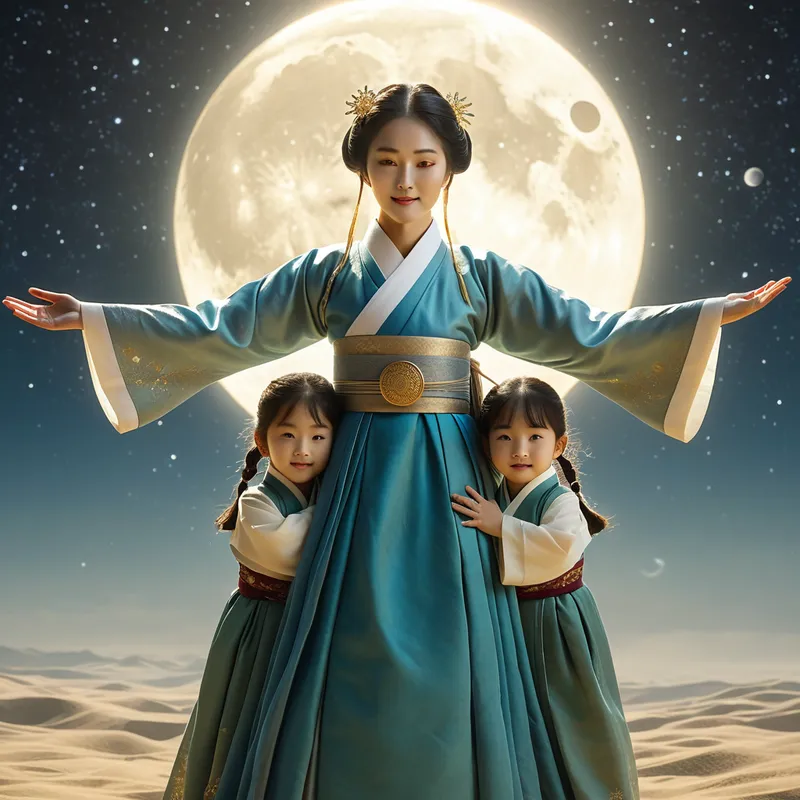
The cosmos heard. A great wind, silent and powerful, swept down. It did not take her life, but it transmuted her plea. Before her tear-blurred eyes, her son Daebyeol began to glow, his form dissolving into a sphere of pure, radiant, warming light. He rose into the vast, empty sky and became the Sun. Her daughter Sobyeol shimmered, her essence cooling into a soft, silvery luminescence. She too ascended, taking her place as the Moon.
The tiger, still raging below, was lifted next—but into a pale, cold copy of the moon, a blotch of eternal frustration. And the mother, her heart now a celestial engine of love, was given a place among the stars, to watch over her children for all eternity. Where there was chaos and devouring darkness, there was now order: the sun for day, the moon for night, and a mother's love woven into the fabric of the sky itself.
Cultural Origins & Context
This myth, known as "The Sun and the Moon," is a foundational Soseol passed down through oral tradition long before being recorded in texts like the Samguk Yusa (Memorabilia of the Three Kingdoms). It belongs to the rich tapestry of Korean etiological narratives—stories that explain the origins of natural phenomena. Unlike state-sanctioned foundation myths, this tale was likely told by mothers and grandmothers in the intimate space of the home, around the hearth's glow. Its primary function was twofold: to explain the celestial bodies in a relatable, human way, and to impart core cultural values. It served as a powerful pedagogical tool, teaching children about obedience, the dangers of the wild, and the ultimate, transformative power of familial love and sacrifice. The setting—a forest, a humble home, a field—is not a royal court but the landscape of common agrarian life, grounding the cosmic drama in the lived experience of the Korean people.
Symbolic Architecture
At its heart, this myth is a profound allegory for the establishment of Order from Chaos. The tiger is not merely a predator; it is the embodiment of the untamed, devouring aspect of nature and the unconscious—pure, amoral appetite. The children represent vulnerable human consciousness, naive and susceptible to deception (the tiger's disguised voice).
The central alchemy of the myth is not the children's flight, but the mother's grief. Her profound sorrow acts as the catalyst that forces a quantum leap from a terrestrial tragedy to a cosmic resolution.
The Sacrifice offered by the mother is not of blood, but of her entire emotional and spiritual being. She offers her own existence to a higher order. This act of self-negation for the sake of her children triggers the transmutation. Daebyeol and Sobyeol are not simply placed in the sky; their very essences are changed. They become archetypal principles: the active, masculine, illuminating principle (Sun) and the receptive, feminine, reflective principle (Moon). Their eternal separation—one ruling the day, the other the night—is the price of this new order, a poignant symbol of the necessary differentiation that follows trauma and healing.
The Dreamer's Resonance
When this myth pattern stirs in the modern Dream, it often signals a profound process of psychic integration following a "devouring" experience. The dreamer may not dream of tigers, but of being pursued by a relentless force—a deadline, a fear, a past mistake. The feeling is one of primal terror and helpless flight.
Dreaming of the transformative ascent, of becoming light or watching a loved one transform into a celestial body, points to a somatic shift. The psyche is attempting to translate a traumatic or chaotic event (the tiger) into a meaningful structure (the cosmic order). It is the soul's innate movement toward finding a "place in the cosmos" for a painful experience, to elevate it from a meaningless wound to a defining, orienting part of one's personal mythology. The body may register this as a release of tension, a feeling of expansion, or awe upon waking.
Alchemical Translation
For the individual on the path of Individuation, the myth models the critical transition from identifying as the victim (the fleeing children) to recognizing and integrating the power of the Caregiver within. Our personal "tigers"—addictions, neuroses, complexes—chase us. We often try to outrun them or hide in fragile, external structures (the bamboo stalk).
The breakthrough occurs when we stop fleeing and turn to face the devastation with the full force of our conscious grief and love. This is the mother's prayer: the ego's surrender to a process larger than itself.
This surrender is not defeat, but the beginning of psychic alchemy. The "children"—our vulnerable, injured parts—are not destroyed but transmuted. The fiery anxiety becomes the focused will of the personal sun (conscious identity). The reflective sorrow becomes the intuitive wisdom of the personal moon (the unconscious connection). The devouring complex, like the tiger, is not eliminated but placed in a contained, visible space (the moon's marks), integrated as a remembered but powerless aspect of our history. We establish an inner cosmos, a regulated rhythm between our light and dark, our action and reflection, born from the courageous acceptance and transformation of our deepest wounds.
Associated Symbols
Explore related symbols from the CaleaDream lexicon:
- Sun — The radiant, conscious identity born from sacrifice, representing active will, clarity, and the illuminating principle that orders the day of the psyche.
- Moon — The reflective, unconscious wisdom born from sacrifice, representing intuition, cycles, and the receptive principle that governs the night of the soul.
- Tiger — The primal force of chaos, the devouring complex or untamed fear that catalyzes the entire journey toward transformation and order.
- Sacrifice — The mother's offering of her own grief and being, which is the essential catalyst that transmutes personal tragedy into eternal, cosmic structure.
- Mother — The archetypal force of unconditional love and nurturing that, when faced with ultimate loss, becomes the agent of profound psychic alchemy.
- Forest — The dark, unknown realm of the unconscious where the primal chase occurs, representing the wild and untamed aspects of the psyche.
- Door — The threshold of safety and vulnerability; its opening to the disguised voice symbolizes the moment naive consciousness is breached by deceptive unconscious content.
- Earth — The grounding, maternal foundation from which the transformative grief arises and which receives the promise of the new celestial order.
- Light — The ultimate product of the alchemical process, representing consciousness, understanding, and the eternal presence forged from love and loss.
- Order — The cosmic and psychic structure established by the myth's resolution, representing the harmony and rhythm that replaces primal chaos.
- Grief — The raw, transformative emotion that acts as the fuel for the prayer of sacrifice, without which no elevation or transmutation is possible.
- Sky — The new, ordered domain of the transformed self, where previously terrestrial struggles are now held as eternal, guiding principles.