Día de los Muertos Myth Meaning & Symbolism
A mythic journey where love breaches the underworld, creating a sacred bridge for the dead to return, celebrated with marigolds, altars, and remembrance.
The Tale of Día de los Muertos
Listen, and let the scent of cempasúchil carry you back. Before there were days on a calendar, before there were cities of stone, there was a love that cracked the world in two. It was not a love of passion, but of pure, unyielding grief.
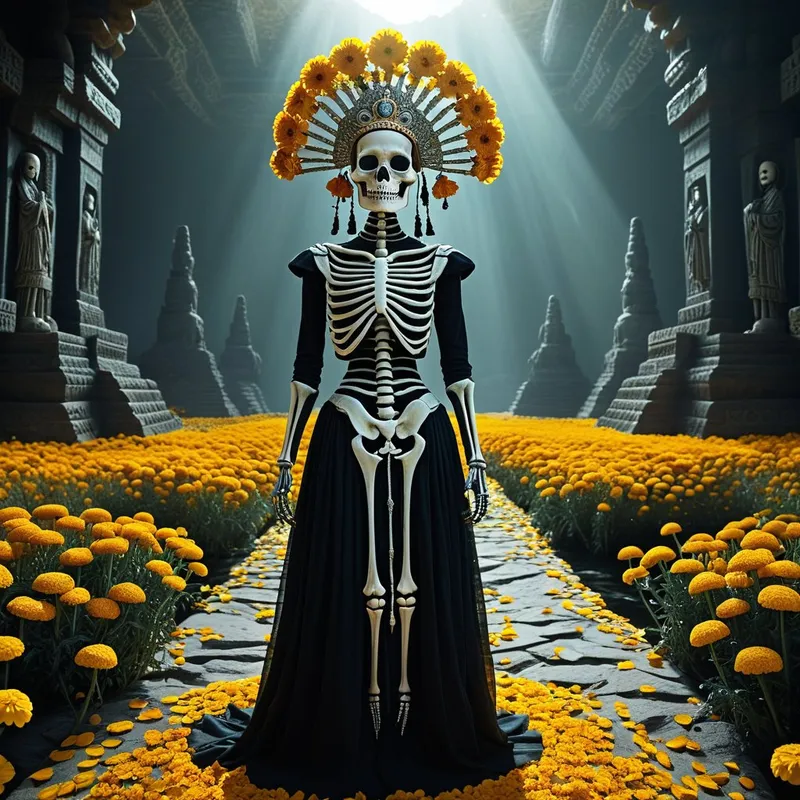
There was a young woman, whose name is lost to the wind but whose sorrow is not. Her heart was a bird that had flown into the dark cave of Mictlán. Her beloved had been taken by the Lord of that place, Mictlantecuhtli, and his queen, the formidable Mictecacíhuatl. The world of the living became a pale, tasteless thing to her. The sun was ash, food was dust. Her tears watered the hard earth, and from that salted ground, a single, stubborn flower grew—a bloom of the most vibrant, impossible orange, the color of the sun’s own heart. She called it the cempasúchil.
Driven by a love that was stronger than fear, she gathered her courage and her flowers. She descended. Not with weapons, but with an offering woven from her memory. The path to Mictlán was nine layers of deepening shadow, a journey of years through chilling winds, clashing mountains, and obsidian-bladed deserts. She walked, guided only by the faint, sweet scent of her marigolds and the echo of a remembered laugh.
When she finally stood before the bone-throne of Mictlantecuhtli, she was not a warrior but a supplicant. She laid her crown of flowers at his feet. The Lord of Bones was silent, a monument to finality. But the Queen, Mictecacíhuatl, who knew the weight of an eternal reign, looked upon this living girl, this vessel of raw, aching love, and felt a stir in her stony heart. Here was a force not even death could fully erase.
The Queen spoke, her voice like stones grinding deep in the earth. “Your love has carved a path where none should be. But the dead cannot return to the sun. Their journey is one-way. Yet… a memory, when it is this fierce, has its own light.” A pact was struck. Not a return, but a visitation. Once a year, when the veil between worlds grew thin as a petal, the souls of the departed could journey back. They would not walk on mortal roads, but on paths laid by love—paths of cempasúchil petals, guided by the light of candles and the smoke of copal, nourished by the essence of their favorite foods and the music of their names spoken aloud.
The woman returned to the world, not with her beloved’s hand in hers, but with a sacred duty. She taught her people to build not tombs, but welcome tables—ofrendas—laden with water, pan de muerto, salt, photographs, and laughter. She taught them that on these nights, the air would hum with the joyful, whispering return of those who had gone before. And so, the deepest loss gave birth to the most vibrant celebration. Death was not conquered, but invited to dinner.
Cultural Origins & Context
This mythic core is the ancient root from which the modern Día de los Muertos grows, a profound syncretism spanning millennia. Its deepest taproots reach into the cosmovision of the Mexica (Aztec) and other Mesoamerican peoples, for whom death was not an end but a phase in a cyclical continuum. The goddess Mictecacíhuatl presided over the month-long festival of Miccailhuitontli. Life and death were intertwined, like the dual figures of the Coatlicue statue, which embodies both creation and destruction.
The Spanish arrival in the 16th century brought Catholicism and its observances of All Saints’ and All Souls’ Days. Rather than erasing indigenous belief, a powerful alchemy occurred. The indigenous veneration of the dead and the Catholic commemoration of the faithful departed fused. The Mictecacíhuatl evolved, some scholars suggest, into the iconic Catrina. The myth was not written in books but inscribed in community practice—passed down by grandmothers building ofrendas, by fathers telling stories of ancestors, by entire towns cleaning cemeteries and turning them into sites of luminous, communal memory. Its societal function was, and remains, therapeutic: it provides a culturally sanctioned container for grief, transforming paralyzing sorrow into active, creative remembrance, thereby strengthening the fabric of family and community across generations.
Symbolic Architecture
At its heart, this is not a myth about cheating death, but about transforming our relationship to loss. The underworld, Mictlán, is not a hell of punishment, but a realm of rest and integration. The journey of the soul through its nine levels mirrors the psychological process of letting go, layer by layer.
The ofrenda is not a shrine to absence, but a portal built by presence. Each element is a symbolic bridge: the water for thirst, the salt for purification, the food for sustenance, the photograph for identity, the candle for guidance.
The cempasúchil, born from tears, is the ultimate symbol of this alchemy. It represents how profound grief, when fully engaged, can blossom into a guiding beauty. The beloved in the underworld symbolizes all we have lost—people, dreams, phases of life. The myth asserts that these are not gone; they have simply journeyed to a different layer of our psychic reality. The “return” is the act of conscious recollection, where memory is animated by love and ritual, allowing the past to nourish the present.
The Dreamer's Resonance
When this mythic pattern stirs in the modern dreamer, it often signals a necessary confrontation with the realm of personal shadow and loss. To dream of following a path of marigold petals through a familiar yet altered landscape suggests the psyche is ready to revisit a buried grief, a forgotten aspect of the self, or an ancestral memory.
Somatically, one might feel a pulling sensation in the chest or a deep, resonant warmth—not the heat of anxiety, but the glow of a welcoming hearth. Psychologically, this is the process of re-membering: gathering the dis-membered parts of one’s history or identity. A dream of setting a table with specific foods for invisible guests, or of cleaning a neglected, overgrown space that suddenly becomes a beautiful courtyard, reflects this ritualistic, preparatory work of the soul. The psyche is building its own internal ofrenda, creating a sacred space to honor and integrate what has been lost, thereby making it accessible once more.

Alchemical Translation
For the individual on the path of individuation, the myth of Día de los Muertos models a critical transmutation: the conversion of attachment into connection. Our modern ego often relates to loss through denial or clinging—either pretending the underworld doesn’t exist or trying to drag the dead back into the full light of day, unchanged. Both are forms of resistance that halt the soul’s journey.
The alchemy lies in becoming the woman and the goddess: to feel the human grief so deeply that it creates a flower, and then to cultivate the divine compassion to grant that flower the power to guide.
The ritual act is the crucible. To consciously create an ofrenda—whether literal or metaphorical—for a lost love, a faded dream, or an old version of oneself, is to perform this psychic alchemy. You acknowledge the reality of the “death” (the end, the change). You honor its journey. You offer it sustenance and light. And in doing so, you change your relationship to it. It is no longer a haunting ghost in the basement of your psyche; it becomes an honored ancestor, a source of wisdom and continuity. You build a living bridge between your conscious life and your personal Mictlán, the rich, shadowy depths of your own history. In this way, the myth teaches that wholeness is not achieved by living only in the light, but by learning to welcome, nourish, and dance with the sacred shadows.
Associated Symbols
Explore related symbols from the CaleaDream lexicon: