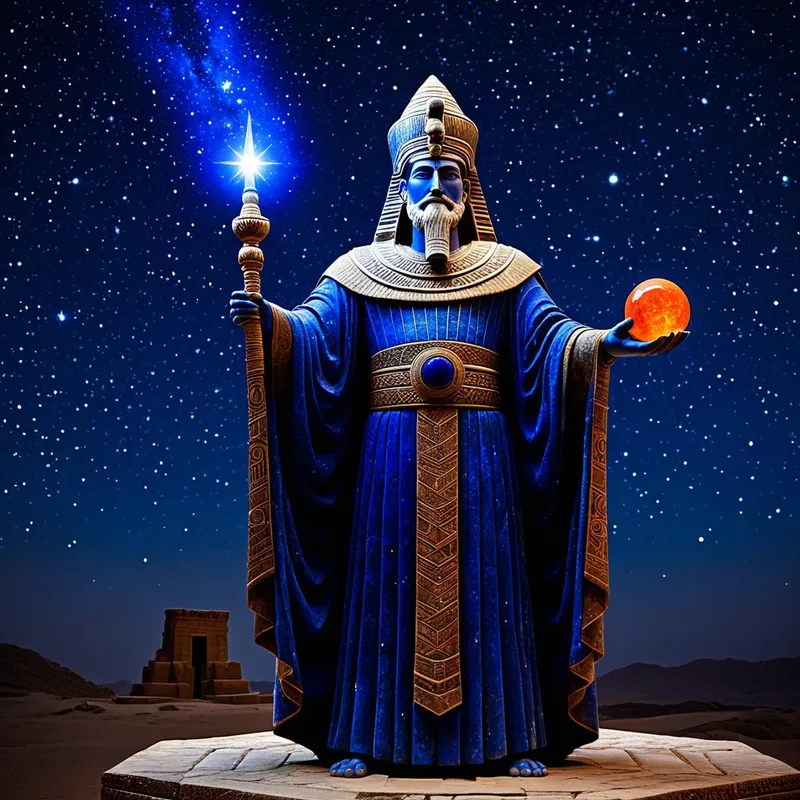
Cylinder Seal Myth Meaning & Symbolism
A divine artisan forges a cosmic seal, imprinting order onto chaos, binding the human realm to the will of the gods through sacred geometry and law.
The Tale of the Cylinder Seal
Before the world knew its name, before kings ruled from high ziggurats, there was the Word. And the Word was chaos—a formless, churning clay of potential. The great gods, Anu in the celestial heights, Enki in the sweet-watered abyss, and Enlil who commands the breath between them, looked upon the roiling substance of creation and saw a problem. Law could be spoken, but how to make it stick? Decrees could be issued, but how to mark them as eternal, binding the shifting sands of time and the fickle hearts of humankind?
They summoned Ninurta, he of the skilled hands and the patient heart. "Forge us a tool," commanded Enlil, his voice the rumble of distant thunder. "Not a weapon to cleave, but a key to bind. Not a crown to adorn, but a sign to authenticate. It must be small enough to fit in a mortal's palm, yet contain the weight of the cosmos."
Ninurta descended to his workshop at the foundation of the world, where the fires of earth meet the waters of the deep. He did not reach for common ore. From the vault of heaven, he gathered a shard of the firmament—a stone of deepest lapis, veined with gold like captive stars. From the Apsu, he drew a measure of liquid obsidian, hard as destiny. He mixed them in a crucible of pure thought, singing the songs of measure and form.
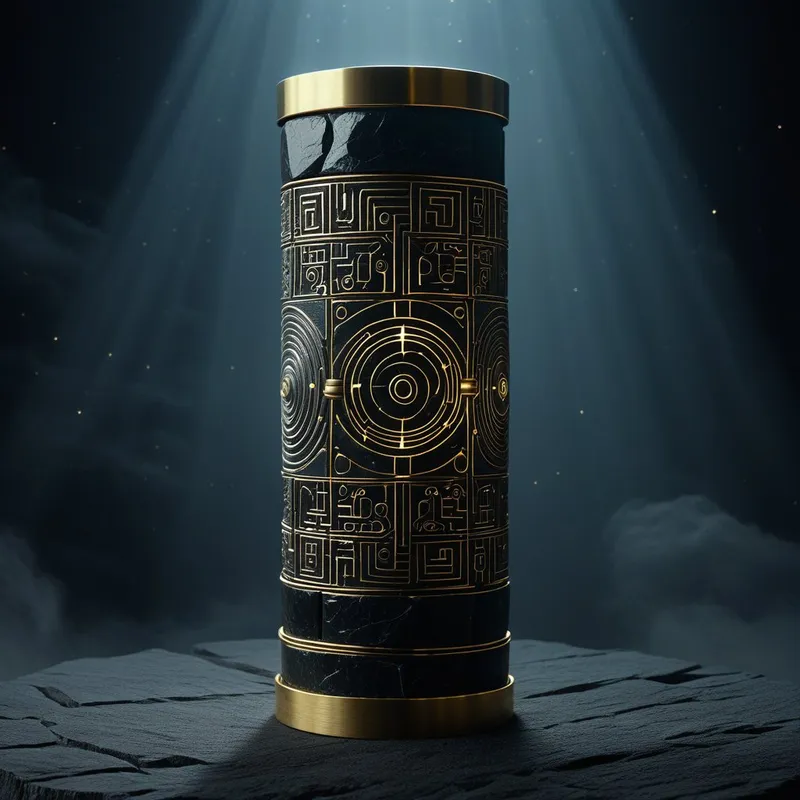
For seven and seven days, the divine artisan carved. His tools were the claw of the constellation, the tooth of the law. He did not carve scenes of battle or feasting, but the very architecture of reality itself. He etched the meandering path of the Idiglat and Buranun, the steadfast march of the sun-disc Utu, the horned crown of divine authority, the date palm that climbs from the mud to the sky. He carved the symbols of grain and flock, of city wall and temple gate. And at the core, in a spiral that wound into the stone's heart, he carved the cuneiform wedge—the foundational mark of the Word made permanent.
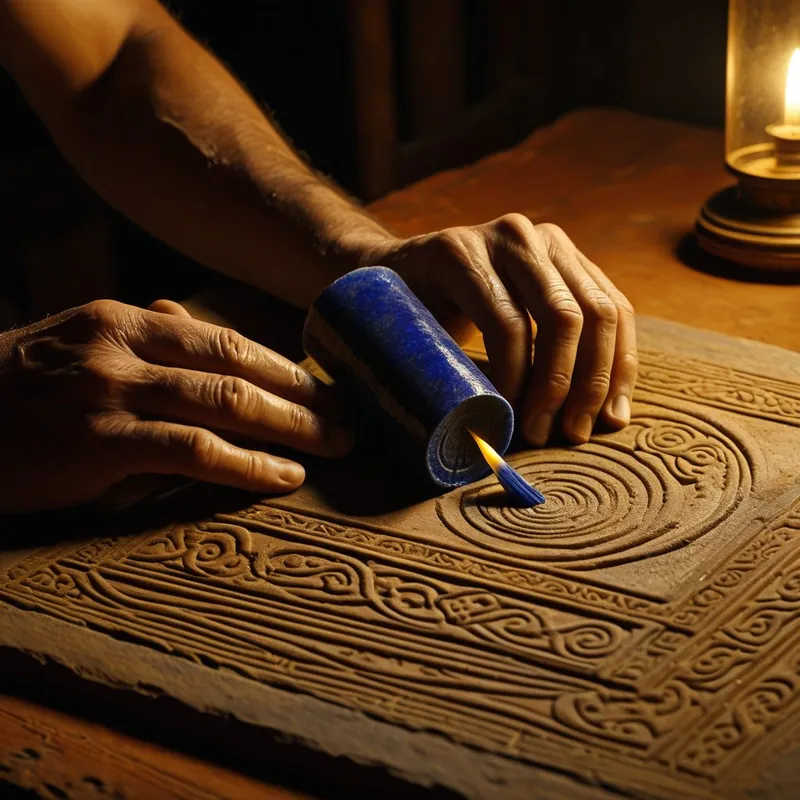
When he was done, he presented it to the assembly of the gods. It was a simple cylinder, cool to the touch, humming with a silent frequency. Inanna, queen of heaven and earth, took it first. She pressed it into a slab of wet, primordial clay from the riverbank. She rolled. And as she rolled, a miracle unfolded. The tiny, concave carvings translated into a continuous, majestic frieze—a story in the round, a perfect, unbroken loop of divine narrative. The impression was crisp, deep, undeniable. It was a signature written not at the end, but woven into the very fabric of the document. It was a seal.
"This," declared Enki, god of wisdom, "shall be the covenant between the realms. Where this mark appears, our will is present. It will bind contract to consequence, king to land, offering to deity. It will turn whispered promise into tangible truth." And so, the Cylinder Seal was given to the first priest-kings, a sliver of divine order entrusted to human hands, its rolling impression a sacred act of creating reality itself.
Cultural Origins & Context
This is not a myth found on a single tablet, but one inferred from the very bones of Mesopotamian civilization, spanning the Sumerian, Akkadian, Babylonian, and Assyrian cultures for over three millennia. The Cylinder Seal was not merely a practical tool for signing clay tablets; it was a primary medium of mythic expression and social ontology. Every seal was a personalized cosmos, a wearable amulet of identity and authority.
The "myth" of its creation is woven from ritual texts, royal inscriptions, and the seals themselves. Scribes and seal-cutters (purkullu) were considered practitioners of a sacred art, their skill a gift from Nisaba or Nabu. To commission a seal was a profound act. The choice of stone—lapis for the heavens, carnelian for the blood of life, hematite for the underworld—was symbolic. The scenes depicted were not arbitrary; they were a curated visual prayer, a declaration of one's patron deity, social role, and desired protection. The seal's impression was its mythic performance, a momentary re-enactment of that primordial act of Ninurta: imposing a sacred, ordered pattern onto the malleable clay of the mundane world.
Symbolic Architecture
At its core, the Cylinder Seal myth is about the imposition of authentic pattern onto receptive substance. It is the archetypal act of distinction, of saying "this" and not "that."
The seal does not create the clay, but it defines the clay's purpose. The self does not create existence, but it imprints meaning upon it.
The cylinder represents eternity and cyclical return—its roundness has no beginning or end, mirroring the cyclical Mesopotamian view of time and kingship. The incised image, hidden in concavity, symbolizes the latent, internalized pattern of the soul or the divine plan. The act of rolling is the dynamic application of that inner world onto the outer world, a translation from potential to actual. The resulting impression is the manifest identity, the contract with reality, the "signature" of one's authentic will in the world.
Psychologically, the seal represents the individuation principle. The chaotic, undifferentiated clay is the unconscious, pliable psyche. The carved seal is the complex, hard-won structure of the conscious personality and its connection to archetypal forces (the gods). To "seal" something is to take ownership, to make a commitment, to authenticate an experience as truly one's own.
The Dreamer's Resonance
When this myth stirs in the modern unconscious, it often surfaces in dreams of stamping, imprinting, or finding seals. A dreamer may find a strange ring with a intricate base, or press their thumb into clay leaving a perfect, glowing mark. They may dream of rolling a heavy object that leaves a trail of symbols, or discover a document bearing their seal, yet they have no memory of authorizing it.
Somatically, this can correlate with feelings of pressure—a need to "make one's mark," or anxiety about being "stamped" by external forces (a job, a relationship, societal expectations). The dream is negotiating the tension between inner authenticity (the unique carving) and outer manifestation (the public impression). To dream of forging a seal indicates a psyche actively working on its core identity. To dream of a broken or illegible seal speaks to a crisis of authenticity, where one's actions no longer feel aligned with their inner truth. The rolling action itself is kinesthetic, pointing to a psychological process that is gradual, consistent, and requires full engagement to leave a complete impression.
Alchemical Translation
The alchemical journey mirrored in the Cylinder Seal myth is the transformation of the massa confusa—the confused, leaden mass of the unexamined life—into a signed and ratified document of the Self. It is the work of psychic authentication.
The first stage is Nigredo: the recognition of the primal, malleable clay of our inherited and unconscious patterns. This is the chaotic substance, full of potential but without definition. The second, Albedo, is the careful carving of the seal: the introspective work of discerning one's own unique pattern. What gods (archetypal values) do I serve? What symbols (core beliefs) define my journey? This is a work of precision and often painful honesty, cutting away all that is not essential.
The crucible for the seal is not fire, but consciousness. The carving tool is not steel, but discernment.
The third stage, Citrinitas, is the application—the rolling of the seal across the clay of daily life. This is where theory meets practice, where inner knowing must imprint on outer circumstance through consistent action, relationship, and work. It is the moment of commitment, where the private self goes public. The final stage, Rubedo, is the revealed impression: the red, fired clay of a life that bears the unmistakable, authentic mark of its owner. It is the achieved integrity where one's actions are a perfect, legible reflection of one's inner design. The seal itself, the hard-won identity, then becomes a tool for future creation, a means to authenticate new chapters of the soul's ongoing contract with existence. The myth teaches that we are not here merely to be acted upon, but to become the artisans of our own signature, rolling the intricate story of our soul onto the waiting clay of the world.
Associated Symbols
Explore related symbols from the CaleaDream lexicon: