Cybele's Drums Myth Meaning & Symbolism
A myth of the Great Mother's sacred, frenzied music, born from the sacrifice of her divine lover to restore the wild, creative pulse of the world.
The Tale of Cybele's Drums
Listen, and hear the rhythm that birthed the world. Not the measured cadence of the lyre, but the wild, throbbing pulse that shakes the soil and stirs the sap in the trees. This is the story of that rhythm, born not from harmony, but from a sacred, shattering love.
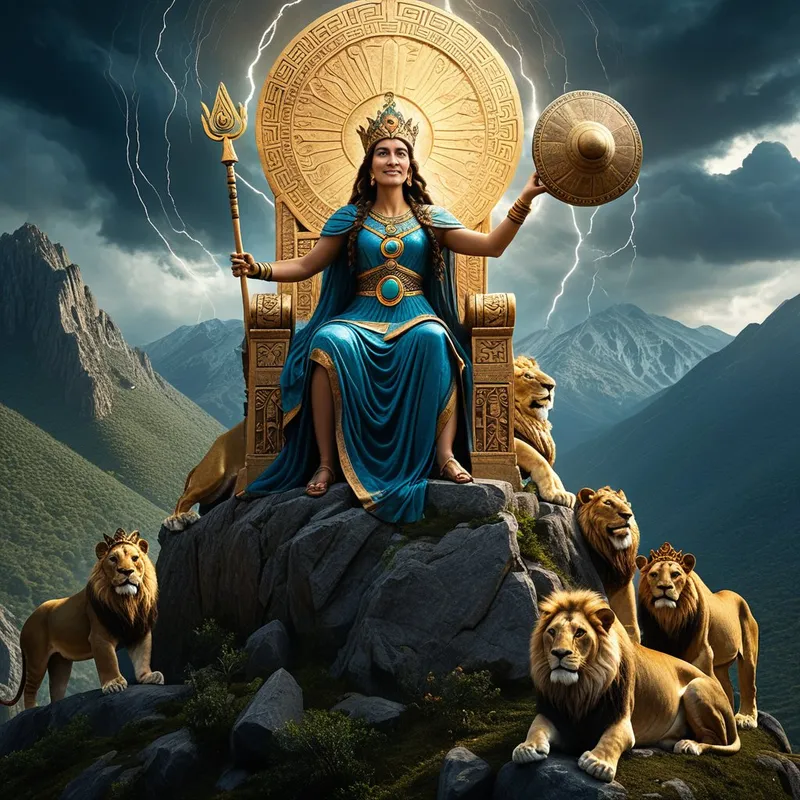
In the high, wind-scoured peaks of Mount Ida, the Great Mother Cybele reigned. She was the mountain herself, the cave that gives birth, the lioness that protects. Her breath was the wind in the pines; her heartbeat was the tremor in the deep earth. Yet, for all her power, a profound solitude echoed in her cavernous heart. The world was ordered, but it was silent. It lacked the ecstatic cry, the abandon that makes creation truly alive.
Then came Attis, a shepherd of unearthly beauty, with eyes like spring pools and a grace that made the flowers turn their heads. Cybele saw him, and in that seeing, the timeless mountain felt the piercing arrow of time. She loved him with the ferocity of a storm, making him her priest, her companion, the lord of her sacred rites. For a time, the slopes of Ida rang with a new music—the laughter of the god and the deep, contented sigh of the Goddess.
But the Fates weave a tangled thread. Whether through divine madness, a broken oath, or the cruel intervention of another, a shadow fell upon Attis. In a frenzy under the unforgiving sun, driven by a power he could not name, the young god fled to the pine forests. There, in a clearing dappled with light and despair, he was seized by a terrible, transformative ecstasy. With a cry that silenced the birds, he took a sharp stone and castrated himself beneath the branches of a towering pine, dedicating his life-force back to the Goddess.
His lifeblood soaked into the roots, and as his spirit fled, Cybele’s grief was not a whimper, but a seismic roar. The mountain shook. Lions tore at their manes in sympathy. Yet, from this ultimate sacrifice—this willing return of creative power to its source—something new was forged. Cybele did not let Attis pass fully into the gloom of Hades. She transformed his shed blood into the first violets. She commanded that his pine tree be forever sacred, brought into her temples, adorned and mourned.
And from the raw energy of this sacrifice, from the union of her eternal power and his mortal passion, she took the very essence of the act—the pulse, the rhythm, the frenzied beat of life surrendering to create new life. She fashioned the first drums. They were not instruments of war or mere celebration. They were the captured heartbeat of Attis, the throbbing memory of sacred union and sacred loss. When her priests, the Galli, beat these drums in their wild rites, they did not play music. They summoned the presence of the god within the Goddess; they called back the ecstatic moment of creative destruction. The drums became the voice of the untamed world, the rhythm that dissolves the individual into the churning, creative whole.

Cultural Origins & Context
This is not a purely "Greek" tale in its genesis. It is a deep, rumbling echo from Anatolia, the myth of Magna Mater and her consort, which crashed upon the shores of Greece like a tidal wave in the 5th century BCE. The Greeks, with their ordered pantheon of Olympians, met this raw, ecstatic worship with a mixture of fascination and terror. They adopted Cybele, syncretizing her with Rhea, but her rites remained profoundly foreign.
The myth was not primarily passed down in the polished verses of epic poets like Homer, but in the throbbing, nocturnal rituals of her cult. It was enacted, not just recited. Her priests, the Galli, were living embodiments of the myth—eunuchs who, in a state of divine mania, would perform the act of Attis in symbolic or literal dedication, becoming one with the god. The story was told through the clashing of cymbals, the wild flute melodies of the aulos, and, above all, the deep, hypnotic pounding of the tympanon—the frame drum. This was populist, visceral religion, offering liberation through ecstatic surrender, a stark contrast to the civic, sacrificial cults of the Olympians. Its societal function was to provide a sanctioned outlet for chaos, for the dissolution of the bounded self, and to channel that chaotic energy into a connection with the fertile, if terrifying, power of nature itself.
Symbolic Architecture
At its core, this myth is not about literal mutilation, but about the necessary sacrifice required for authentic creation. Attis represents the youthful, singular creative impulse—beautiful, potent, but ultimately transient and ego-bound. His castration is the ultimate act of surrendering that individual potency back to the source.
The drum is born where the self ends. Its skin is stretched across the void left by sacrifice, and the beat is the sound of the Whole breathing through that wound.
Cybele is the archetypal container, the Great Mother who is both womb and tomb. She does not prevent the sacrifice; she transmutes it. The pine tree, evergreen and perennial, becomes the symbol of the spirit that does not die but is preserved, eternally mourned and eternally renewed. The violets and anemones blooming from blood are the beautiful, fragile creations that can only emerge from a broken heart.
The drums, therefore, are the central symbol of alchemical synthesis. They are the tangible result of the union between eternal, cyclical nature (Cybele) and finite, passionate sacrifice (Attis). They symbolize the rhythm that emerges when personal desire is offered up to a transpersonal power. To beat the drum is to participate in this mystery—to rhythmically shatter the isolated self to reconnect with the creative pulse of the universe.

The Dreamer's Resonance
When this myth stirs in the modern unconscious, it rarely appears as a literal scene of antiquity. Instead, it manifests as a somatic and emotional pattern. One might dream of a frantic, irresistible rhythm heard from deep within the earth, compelling the dreamer to dance until they collapse. They may dream of a cherished personal project or talent (a painting, a business, a relationship) suddenly withering or being violently taken, only to find a strange, new, and more primal form of expression emerging from the loss—perhaps the discovery of their voice, or a connection to community.
Somatically, this can feel like a buildup of chaotic, creative energy with no outlet—a frenetic tension in the hands and chest. The psychological process is one of confronting the "Attis complex": the part of us that clings to a beautiful, but ultimately limiting, form of self-expression or identity. The dream invites a sacred surrender. It is the psyche’s way of orchestrating a necessary sparagmos—a ritual tearing apart—so that our creative life-force can be reclaimed by the larger, wiser Self (the inner Cybele) and redistributed in a more authentic, resonant form.

Alchemical Translation
For the individual on the path of individuation, the myth of Cybele’s Drums models the critical stage of mortificatio and subsequent vivificatio—the alchemical dying and revivifying. Our conscious ego, like Attis, often falls in love with its own creative capacities. We identify with our roles, our outputs, our "beautiful" accomplishments. This myth warns that such identification is a dead end; it leads to sterility and madness.
The alchemical work is to willingly offer that ego-bound creativity upon the "pine tree" of the Self. This is the sacrifice: to stop creating for the ego (for recognition, for security, for a perfected identity) and to begin creating from the Self, from the deep, often chaotic, wellspring of the unconscious. This feels like a loss, a castration of the old motives.
The first beat of the true drum is always the sound of something precious breaking. What follows is not a melody you control, but a rhythm you serve.
From that surrender, the "drums" are fashioned. These are the new, authentic modes of being and creating that have rhythm, resonance, and power because they are connected to the core. The individual no longer "plays" creativity; they become an instrument for it. They channel the wild, ecstatic, and sometimes frightening pulse of the deeper psyche, finding that within that sacred chaos lies not annihilation, but their most potent and genuine form of creation. The myth thus maps the journey from being a solitary creator to becoming a vessel for the creative principle itself.
Associated Symbols
Explore related symbols from the CaleaDream lexicon: