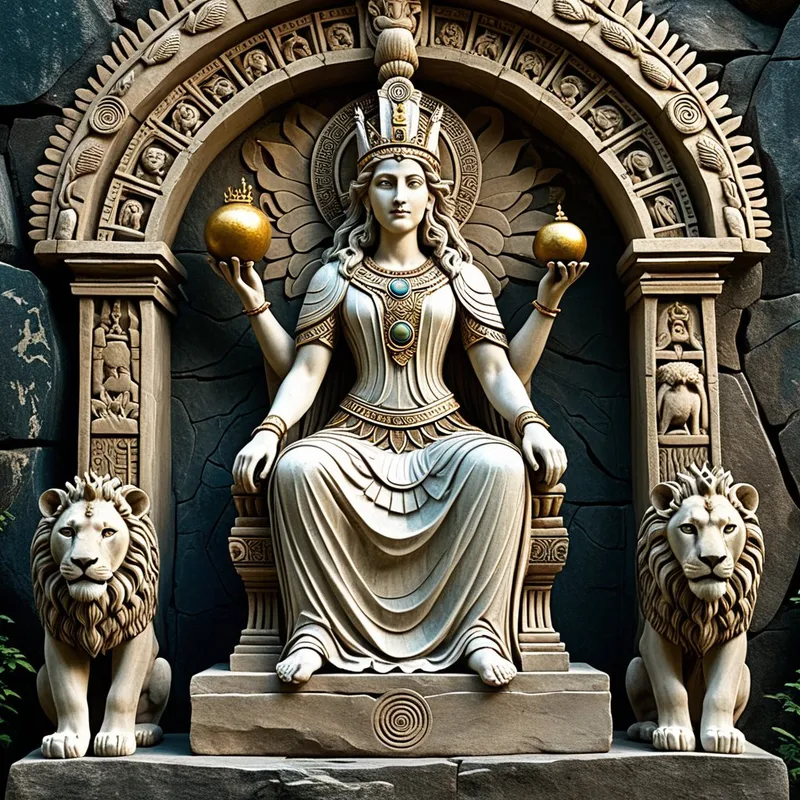
Cybele Myth Meaning & Symbolism
The myth of the Phrygian Mother Goddess, whose sacred rites involved ecstatic devotion and the tragic, transformative love of her divine consort, Attis.
The Tale of Cybele
Hear now the tale that echoes from the wild, stony heart of Phrygia, carried on the wind that howls through mountain passes. It begins not with a birth, but with a discovery. On the slopes of Mount Dindymon, where eagles nest and lions make their dens, a shepherd found a child. But this was no ordinary babe. She lay in the moss, radiant, and the very earth seemed to sigh around her. The wild beasts did not harm her; they bowed. This was Cybele, the Mother of the Mountains, the Mistress of Beasts, born not of woman but of the primeval stone itself.
She grew in power and solitude, her laughter making springs burst forth, her sorrow causing landslides. She desired a companion, a consort to mirror her wildness. The gods fashioned for her a beautiful youth named Attis, whose beauty was like the first green shoot of spring. Their love was a tempest, a union of the untamed earth and the fleeting, vibrant life upon it. But a mortal passion, a promise to another, stirred in Attis’s heart. Driven by a divine madness—some say sent by Cybele herself in a fit of jealous rage, others whisper it was the cruel fate of all who love the eternal—Attis fled into the pine forests of the high peaks.
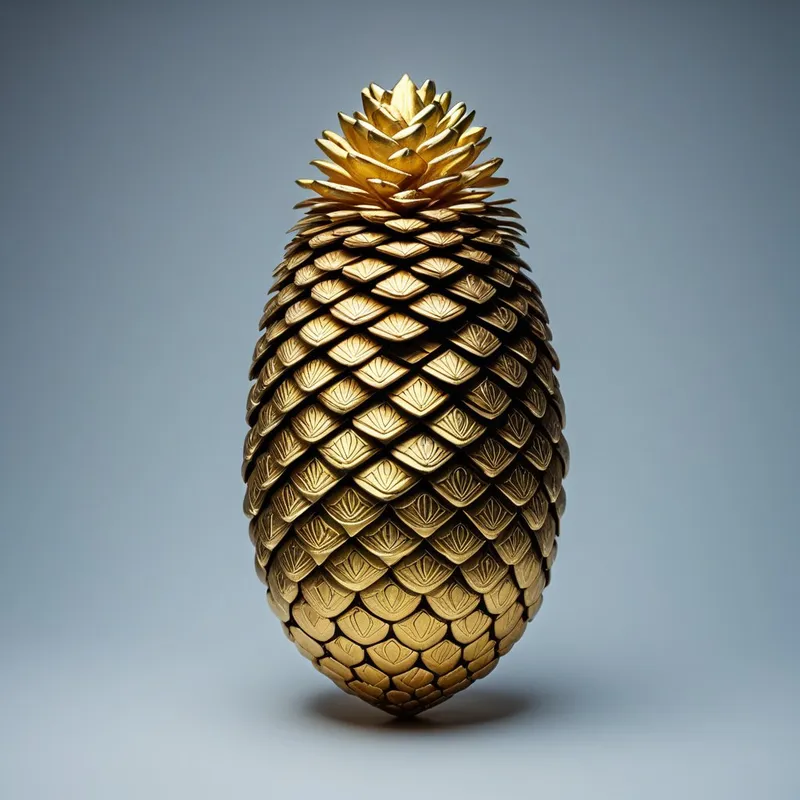
There, beneath a towering pine, the frenzy took him wholly. The ecstasy of the Goddess became a searing fire in his blood. In a final, terrible act of devotion and despair, he took a sharp flint and castrated himself, his lifeblood soaking into the roots of the tree. Where each drop fell, violets sprang from the snow. The great pine tree shuddered and became eternal, its trunk forever stained with his sacrifice.
Cybele found him thus. Her wrath turned to an ocean of grief. She did not let him die. Instead, she lifted his spirit into the tree, making his body incorruptible, his hair continue to grow. She wept, and her tears became the rivers. She commanded that henceforth, her priests, the Galli, would mirror Attis’s ultimate offering, and that every spring, the pine would be cut, wrapped like a corpse, and then celebrated in wild, drumming, frenzied rites, for death is but a pause before the green return.

Cultural Origins & Context
The myth of Cybele is a powerful stranger at the gates of Hellenic culture. Her origins are firmly Anatolian, where she was worshipped as Mātār Kubileya, the Mountain Mother, a deity of caverns, wild nature, and sovereignty over all life and death. Her introduction to the Greek world was not a gentle assimilation but a state-sanctioned adoption born of crisis. In 204 BCE, during the depths of the Second Punic War, the Roman Republic, following a cryptic prophecy in the Sibylline Books, formally brought her sacred black stone from Pessinus to Rome. She became Magna Mater, the Great Mother.
Her myths were passed down not in the polished hexameters of Homer but in the fragments of poets like Callimachus and the later narratives of Roman authors like Ovid. The telling was always charged with a mix of awe and anxiety. Her rites, the Megalensia, were profoundly foreign to the classical mind: characterized by the ecstatic music of the tympanum and aulos, wild dancing, and the voluntary self-castration of her devoted Galli. This was religion experienced in the body, in frenzy (enthousiasmos), not in the cool rationality of the philosopher’s porch. Her societal function was dual: she was a protector of the city (symbolized by her mural crown), yet her worship provided a sanctioned outlet for the chaotic, non-rational, and deeply transformative energies that civilization necessarily represses.
Symbolic Architecture
At its core, the myth of Cybele and Attis is a profound symbolic drama of the relationship between the Eternal, Unchanging Ground of Being and the Mortal, Cyclical Life that springs from it. Cybele represents the Magna Mater archetype in its rawest form: the womb and the tomb, the fertile soil and the barren mountain peak, the nurturing breast and the devouring lion. She is not a domesticated fertility goddess but the wild, all-encompassing matrix of nature itself, prior to and indifferent to human moral codes.
The Great Mother does not love as humans love; she consumes and regenerates in a single, eternal gesture.
Attis symbolizes the spirit of vegetation—beautiful, vibrant, and tragically ephemeral. His self-castration is the ultimate symbolic act: the severing of individual, generative desire to be wholly subsumed into the divine source. It is not merely a death, but a sacrificial offering that transforms. The pine tree, evergreen, becomes his immortal body; the violets, his spilled blood turned to beauty. This is the alchemy of sacrifice: a violent end that seeds a different, sacred order of existence. The Galli, through their ritual emulation, enact a permanent state of sacred androgyny, belonging neither to the mundane world of procreation nor to ordinary masculinity, but existing as living bridges to the Goddess’s transcendent, all-containing nature.
The Dreamer's Resonance
When this myth stirs in the modern dreamer’s psyche, it often signals a profound encounter with the archetypal Great Mother in her transformative, and potentially terrifying, aspect. To dream of Cybele is to dream of an overwhelming natural force—a tidal wave, a seismic event, a consuming forest. It may feel both awe-inspiring and annihilating.
Dreams of the Attis figure often involve themes of sudden, radical sacrifice or loss of a cherished identity, role, or creative potential (symbolized by the castration). This is not necessarily literal, but psychological: the dreamer may be undergoing a process where an old way of being, especially one tied to a rigid ego-identity or a compulsive drive, must be “cut off” for a deeper integration to occur. The somatic feeling can be one of piercing loss followed by a strange, hollow peace. Dreaming of the sacred pine or the violets points to the nascent growth emerging from this sacrifice—a new, more resilient structure of self (the evergreen pine) and moments of unexpected, poignant beauty (the violets) arising from what was mourned.

Alchemical Translation
For the individual on the path of individuation, the Cybele-Attis myth models the most severe and necessary phase of psychic transmutation: the nigredo. This is the confrontation with the primal, impersonal psyche—the Cybele within. It is the recognition that the conscious ego is not the master of its own house, but a temporary manifestation subject to far greater, often ruthless, archetypal currents.
The conscious mind (Attis), in love with its own vitality and attachments, must ultimately surrender its autonomy in a sacred madness—the dissolution of the ego’s central complex. This “castration” is the alchemical mortificatio: the killing of a literal, biological, or ego-driven attitude to make way for a spiritualized one. The goal is not annihilation, but transformation into a more enduring form. The pine tree is the symbol of the new psychic structure that results—a Self rooted in the eternal, capable of weathering all seasons. The violets are the gifts of this process: compassion, humility, and a connection to beauty that is born directly from acknowledged suffering.
The ultimate alchemy is not of turning lead to gold, but of turning personal tragedy into transpersonal symbol. What is sacrificed to the wild God is returned by the Great Mother in the currency of the soul.
To integrate this myth is to make peace with the necessary destructions within one’s own life, understanding them not as meaningless cruelty, but as the fierce, loving gestures of a psyche striving for wholeness, demanding that we trade our mortal attachments for an immortal connection to the source itself.
Associated Symbols
Explore related symbols from the CaleaDream lexicon: