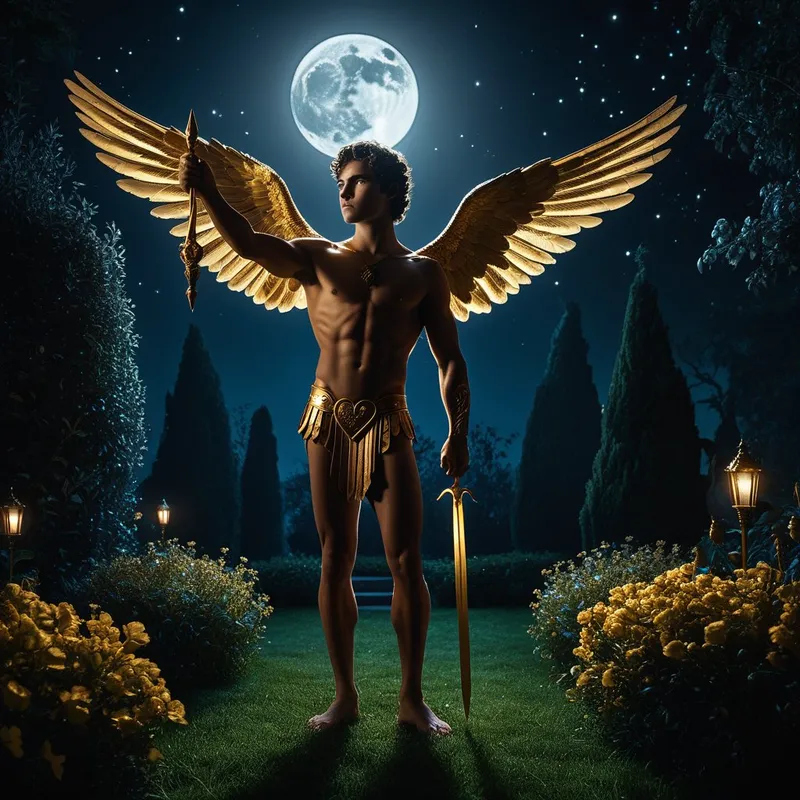
Cupid Myth Meaning & Symbolism
A soul's journey to reclaim love, facing impossible trials to prove her devotion to a god she cannot see, revealing the union of love and psyche.
The Tale of Cupid
Listen, and hear a tale not of a simple cherub, but of a god whose arrows split the world in two, and of the mortal soul who dared to love him.
In a time when gods walked just beyond the veil of mortal sight, there lived a princess named Psyche. Her beauty was so profound it became a curse. Temples to Venus stood empty, for men worshipped the mortal girl instead. Consumed by a goddess’s envy, Venus summoned her son, Cupid. “Use your gold-tipped arrow,” she commanded, her voice like cold marble. “Make her fall in love with the most vile, wretched creature you can find.”
Cupid descended, a shadow with wings, bow in hand. But as he drew near to enact his mother’s vengeance, he beheld Psyche in the lamplight. In that moment, a tremor passed through the divine. Perhaps he pricked himself, perhaps his own power turned upon its master—the stories whisper both. The god of desire was himself ensnared.
Psyche’s fate, ordained by a cryptic oracle, was a horror: she was to be left on a windswept cliff as a bride for a monstrous, winged serpent. Her family wept as the West Wind, Zephyrus, caught her trembling form and carried her not to death, but to a hidden valley. There stood a palace wrought of light and melody, with invisible servants attending her every whim. When night fell, a presence entered her chamber—a voice of honey and shadow, a touch in the darkness. “I am your husband,” the voice said. “But you must never seek to see my face. Trust in the night, and you will know only bliss. Break this trust, and you will know only despair.”
For a time, Psyche lived in a paradise of sensual night. But loneliness, that slow poison, seeped in. Whispers from her jealous sisters reached her: “Your husband is the serpent of the oracle! He will devour you!” Tormented by doubt, Psyche took a dagger and a lamp one fateful night. As her divine husband slept, she raised the light.
The flame did not reveal a monster. It fell upon the most beautiful being imaginable: Cupid himself, his golden hair spilled across the pillow, his powerful wings folded at rest, the very bow and arrows of desire lying beside the bed. In her awe, her hand trembled. A single drop of scalding oil fell upon the god’s shoulder.
He awoke. His eyes, now visible, held not anger, but a bottomless sorrow. “You chose doubt over faith,” he said, his voice breaking the silence of the palace. “Love cannot live where trust is dead.” With those words, he was gone, and the palace of light dissolved into mist, leaving Psyche alone on the cold grass.
Her journey then began—not to find a god, but to reclaim her own soul. She faced the wrath of Venus, who set before her four impossible tasks: to sort a mountain of mixed grains, to gather wool from deadly golden sheep, to fetch water from the river of the underworld, and finally, to descend into Hades itself and retrieve a casket of beauty from Proserpina. Aided by ants, a whispering reed, and the tower of destiny itself, Psyche completed each task through humility, cunning, and desperate courage. On her final return, human weakness overcame her; she opened the casket, hoping for a drop of divine beauty to win back her love, and fell into a deathlike sleep.
It was Cupid, his wound healed, who found her. His love, tempered by her trials, was now stronger than any command from Olympus. He flew to Jupiter, who granted Psyche immortality. In the great hall of the gods, Jupiter himself handed her the cup of ambrosia. “Drink, Psyche,” he said. “And be forever joined to Cupid.” From their union was born a daughter named Voluptas.

Cultural Origins & Context
The myth of Cupid and Psyche is not a folk tale, but a sophisticated literary creation. It appears in its most complete form in the 2nd century CE novel The Golden Ass by Apuleius. While Cupid (Eros in Greek) was an ancient deity of desire, this particular narrative was crafted within a Roman world steeped in Greek philosophy and mystery religions. It was a story for the educated, told as an allegory within a larger narrative about spiritual awakening.
Its societal function was multifaceted. On one level, it was a captivating romance. On another, it served as a profound philosophical and religious metaphor, reflecting contemporary ideas about the soul’s (Psyche) journey through trials to achieve sacred union with the divine principle of love (Eros). This resonated with the initiatory rituals of mystery cults, which promised personal salvation and direct experience of the divine. The myth thus acted as a cultural bridge, weaving together popular entertainment, Platonic thought, and the yearning for personal transcendence that characterized the late classical era.
Symbolic Architecture
At its core, this is not a story about a god punishing a mortal. It is the soul’s odyssey toward consciousness.
Cupid represents the primal, autonomous force of Eros—not mere romance, but the fundamental drive toward connection, creativity, and life itself. He is blind not because love is foolish, but because its initial attraction operates beneath the level of sight and reason, in the realm of instinct and the unconscious. His arrows cause a "divine madness," a possession by a power greater than the individual ego.
Love, in its truest form, is an archetypal force that arrives unbidden, shattering our carefully constructed worlds to make way for a new, more authentic life.
Psyche is the human soul—beautiful, curious, and prone to the fatal error of the developing consciousness: doubt. Her act of raising the lamp is the ego’s desperate need to see, to control, to bring the mysterious numinosity of the unconscious into the harsh light of rational understanding. This act inevitably wounds the divine connection, forcing the soul out of passive paradise and into the active, painful work of individuation.
Her four labors are alchemical operations of the psyche: ordering chaos (sorting seeds), harnessing dangerous, creative energies (the golden sheep), integrating the waters of the deep unconscious (Styx), and finally, facing the ultimate shadow—mortality itself (the descent to Hades). Each task requires her to surrender her willfulness and listen to the helping voices of the natural world (ants, reed), symbolizing an alignment with the Self beyond the ego.

The Dreamer's Resonance
When this myth stirs in the modern dreamer, it signals a profound crisis and calling in the realm of relationship and selfhood. To dream of an invisible, beloved presence signifies a deep connection to an aspect of the Self or a relationship that exists primarily on an unconscious, soulful level. The dreamer may feel profoundly loved and guided, yet frustrated by a lack of tangible form or understanding.
Dreaming of the moment with the lamp—the temptation to look, to know, to possess—often coincides with a waking-life act of suspicion, interrogation, or an attempt to forcibly analyze a fragile, intuitive process (like early love, creative inspiration, or a spiritual feeling). The subsequent dream imagery of loss, abandonment, and wandering through a desolate landscape mirrors the psychological state of the ego after it has severed its connection to the nourishing unconscious. The soul feels exiled.
Conversely, dreams featuring impossible, meticulous tasks (sorting, climbing, fetching) reflect the somatic reality of the individuation process: it feels like relentless, often tedious, inner work assigned by an unseen authority (the Self or the animus/animus). The body may feel heavy, burdened. The emergence of helpful animals or guides in the dream points to the awakening of instinctual wisdom and the support of the psyche’s innate healing intelligence.

Alchemical Translation
The myth of Cupid and Psyche is a perfect map for the alchemical process of coniunctio, the sacred marriage. This is not a literal union with another person, but the internal integration of opposites within the psyche.
The first stage, nigredo, is the darkening: Psyche’s exile and despair after losing Cupid. This is the necessary dissolution of the old personality, the death of the naive ego that believed it could possess love without being transformed by it. Her labors represent the albedo, the whitening or purification—the arduous, step-by-step work of confronting shadows, integrating complexes, and developing humility.
The soul does not win the god through perfection, but through the courage to be imperfect, to face its tasks, and to endure its failures.
The final descent and sleep is the citrinitas, the yellowing or mortification, where the last vestige of egoic desire (to steal beauty for herself) must "die." Only from this state of complete surrender can the rubedo, the reddening or final union, occur. Cupid’s return is not a rescue by an external savior, but the symbol of the Self’s wholeness reasserting itself. The healed god awakens the purified soul.
For the modern individual, this translates to any profound journey of the heart that demands psychological transformation. It begins with the irresistible, often disruptive, call of Eros—to a person, a vocation, a creative pursuit. The "falling in love" stage is the hidden palace. The crisis comes when we try to control it, name it, or force it into our existing framework (lighting the lamp). The resulting "labors" are the real work of relationship: communication, vulnerability, facing fears, and sacrificing ego demands. The ultimate goal is the birth of Voluptas—not fleeting pleasure, but the deep, abiding joy that is the offspring of a conscious union between our human striving (Psyche) and the transcendent, life-giving force of Love (Cupid) within us.
Associated Symbols
Explore related symbols from the CaleaDream lexicon: