Crossroads Myth Meaning & Symbolism
A tale of the liminal god who waits at the crossroads, offering a choice between paths and the fate that follows.
The Tale of Crossroads
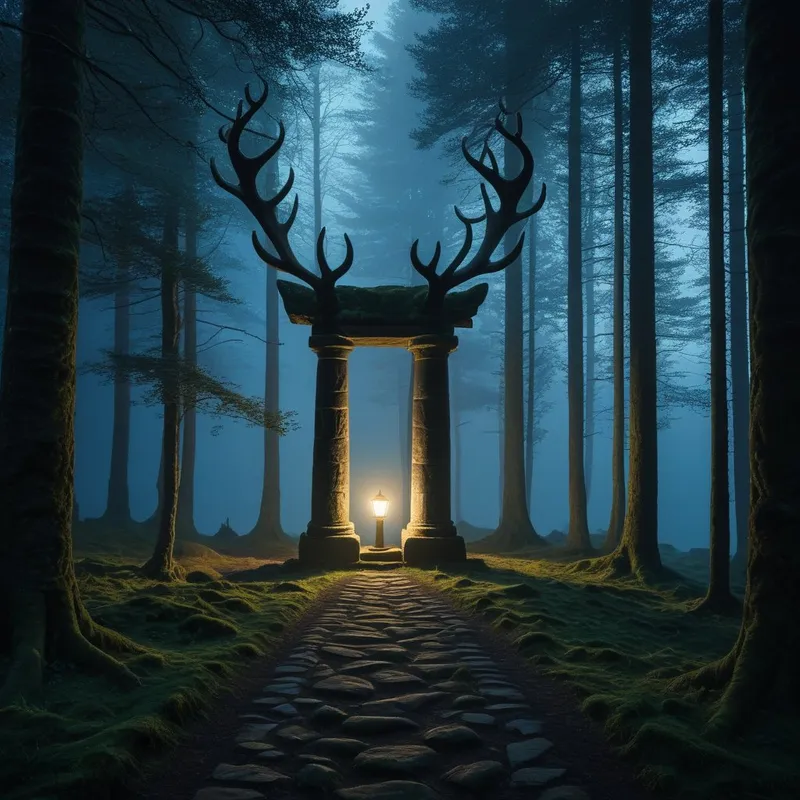
Listen. The air grows still when the sun drowns in the west and the world holds its breath between day and night. This is the hour of the threshold, the time of the in-between. In the deep woods, where the moss grows thick on forgotten stones, three paths converge. This is no mere junction of dirt and root; this is a place where worlds touch.
Here he waits. You do not find him; he is simply there when you arrive, as if he had been standing since the first oak took root. He is the Cernunnos, the Antlered One, but in this place he is the Keeper of the Ways. His form is of the forest—antlers like bare branches against the twilight sky, eyes that hold the patience of stone and the quickness of a stag. In one hand, he holds a lantern that burns with a cool, silver flame, casting long, dancing shadows. At his feet lies a simple cloth, and upon it, three small tokens: a smooth river stone, a fresh-cut sprig of hawthorn, and a raven’s feather black as a moonless night.
A traveler, weary and lost, stumbles into the clearing. The weight of a wrong choice hangs heavy on his shoulders; the path behind him is closed by thorns of regret. He sees the god and freezes, his breath a pale ghost in the chill air.
“You have reached the place of choosing,” the god’s voice is not a sound but a feeling, like the deep hum of the earth. “The path that bore you here is spent. You must choose again.”
The traveler looks at the three tokens. “What do they mean?” he whispers.
“The stone is the path of endurance, of becoming the mountain. Your sorrow will harden into wisdom, but your heart may turn to cold flint. The hawthorn is the path of protection, of weaving a hedge of thorns around your life. You will be safe, but alone. The feather is the path of the unseen, of following the whispers on the wind. You will know many secrets, but you may never find a home.”
The god falls silent. The forest holds its breath. The traveler feels the immensity of the moment—this is not a choice of direction, but of being. To choose is to define the very substance of his soul. He thinks of his worn hands, his tired heart, the memory of laughter now distant. His hand hovers, trembling, over the tokens. He does not look to the paths, for they are invisible until the choice is made. He looks only at the small, potent objects that hold entire destinies within them.
Finally, with a sigh that seems to come from the roots of the world, his fingers close around the raven’s feather. It is light, almost insubstantial.
At once, the silver flame in the god’s lantern flares. The path to the traveler’s left, which was shrouded in mist, clears to reveal a narrow track winding up into the star-dusted hills. The god nods, a slow, grave gesture. “You have chosen the path of the Fili. Walk with open eyes. See what others cannot. And remember,” the god adds, as the traveler takes his first step onto the new path, “all roads meet again, in a place beyond my keeping.”
The traveler walks on, the feather warm in his hand. Behind him, the god and the crossroads fade back into the twilight, waiting for the next soul who has walked their first life to its end.
Cultural Origins & Context
The crossroads myth is not a single, standardized tale but a potent archetype woven through the fabric of Celtic spiritual and everyday life. It emerges from a culture that perceived the world as inherently animate and intersected by numinous power at specific, charged locations. The crossroads—Trì Cheann—was perhaps the most powerful of these liminal zones. It was where three territories, and by extension three tribal jurisdictions, met. It was physically between here and there, but spiritually between this world and the Sídhe.
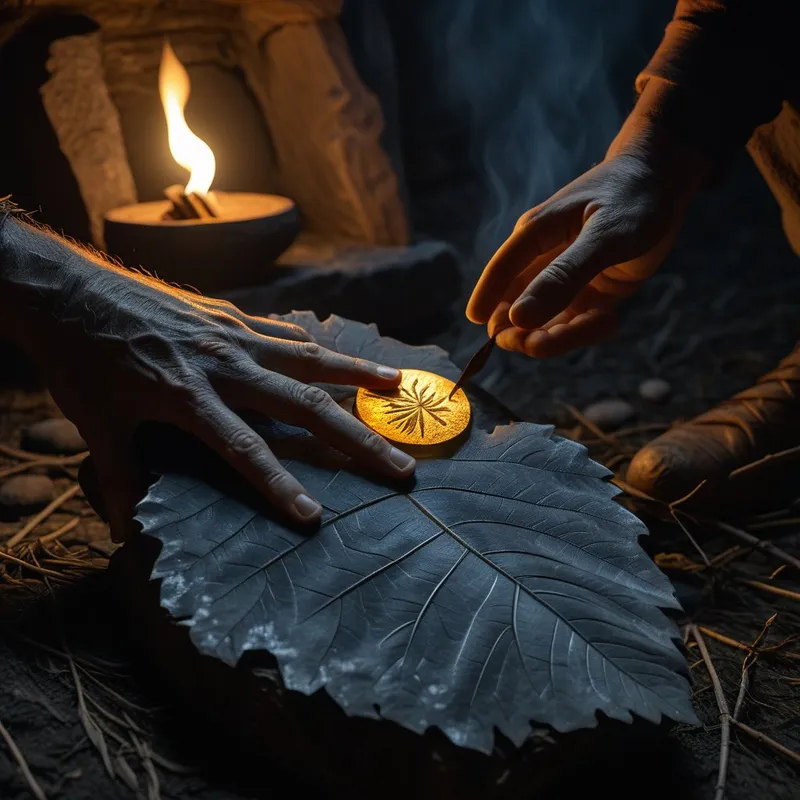
These stories were not preserved in grand epics but in folklore, proverbs, and ritual practices passed down through generations by seanchaí. Their function was deeply pragmatic and psychological. They served as a map for navigating life’s critical junctures. The myth codified the terrifying reality of choice into a structured encounter with the divine. It taught that major decisions were not merely personal but were witnessed by the cosmos, and that guidance, in the form of cryptic signs or a daunting presence, was available to those who approached the threshold with respect. Ritual offerings—coins, food, small carvings—found at ancient boundary markers testify to the lived reality of this mythic framework.
Symbolic Architecture
At its core, the crossroads myth is a master symbol of liminality—the transformative state of being betwixt and between. It represents the critical point where one state of being ends, but the new one has not yet begun. This is a state of pure potential, but also of profound vulnerability and disorientation.
The crossroads is not a place on a map, but a condition of the soul: the suspended moment when the past has died but the future has not yet been born.
The three roads are rarely about simple geographic alternatives. They symbolize the triadic nature of Celtic cosmology and the fundamental choices of existence: the path of Sovereignty (rule, order, the stone), the path of Sacrifice (protection, service, the hawthorn), and the path of Inspiration (vision, chaos, the feather). The Cernunnos figure is the archetypal guardian of this threshold. He does not choose for us, but he makes the weight of choice conscious and sacred. He is the embodiment of the Self in its totality—containing both the wild, untamed nature (the stag) and the ancient, guiding wisdom (the elder). His presence forces the traveler to confront the fact that to avoid choice is to remain eternally lost.
The Dreamer’s Resonance
When the crossroads appears in a modern dream, it signals that the dreamer’s psyche is at a critical inflection point. This is not about choosing a job or a relationship on a surface level, but about a deeper, archetypal orientation of the personality. The somatic experience is often one of paralysis, anxiety, or awe-struck stillness—the body knows it is on sacred ground.
The different paths in the dream may be populated by shadowy figures, animals, or symbolic objects that represent unlived lives or rejected aspects of the self. A path shrouded in fog might indicate a future the conscious mind refuses to see. A path that appears bright and inviting but is blocked by the antlered god suggests an appealing but inauthentic destiny. The dreamwork here is the psyche’s attempt to stage the internal conflict externally, to give form to the formless pressure of necessary change. The dreamer is undergoing a process of naming their possible destinies, often feeling the profound grief of letting go of the path not taken, even as they step onto the new one.
Alchemical Translation
Psychic individuation is the long journey of becoming whole, distinct, and authentic. The crossroads myth models a crucial, recurring phase in this process: the nigredo, or dark night of the soul, where old identities and patterns break down, leading to the albedo, the washing pure at the threshold.
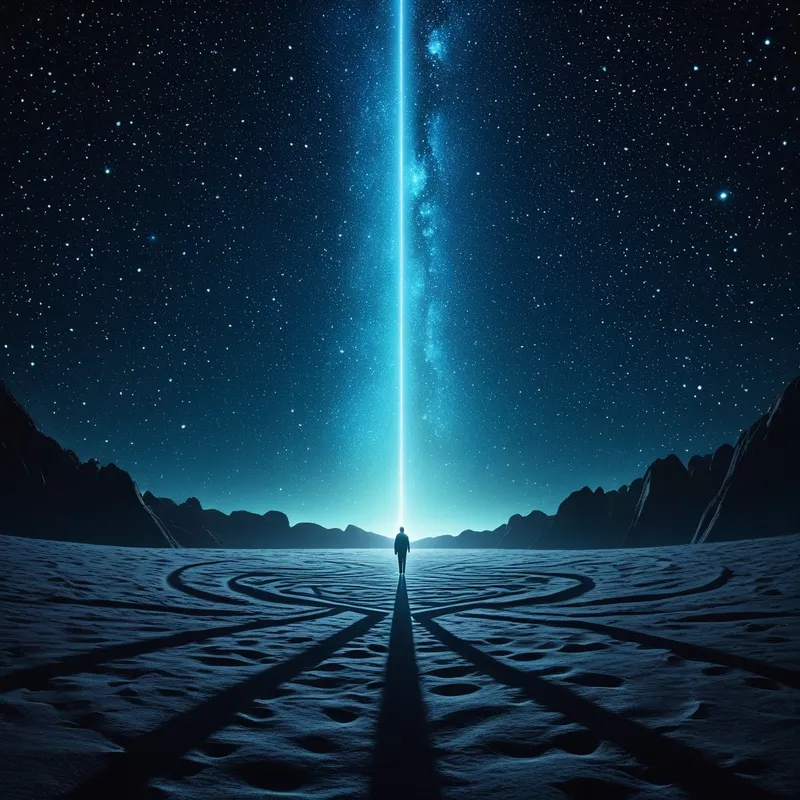
The alchemy happens not in the walking of the chosen path, but in the terrifying, luminous moment of choice itself. There, at the center, the ego is dissolved in the face of the Self.
The modern individual faces countless crossroads—not in misty forests, but in moments of crisis, depression, creative block, or spiritual awakening. The myth teaches that these are not interruptions to our journey but its very essence. The “antlered god” we encounter is the emergent voice of our own deeper wisdom, which often feels alien and daunting. The “choice” is the act of committing to a new psychic attitude, of sacrificing the comfortable, known self for the promise of a more complete one.
The three tokens—stone, hawthorn, feather—represent core aspects of the psyche that must be integrated: the enduring strength of the body and tradition (stone), the protective boundaries and values of the heart (hawthorn), and the liberating intuition and vision of the spirit (feather). To choose one is not to reject the others forever, but to consciously lead with that principle for a stage of the journey, with the understanding that at the next great crossroads, a different aspect may need to take the lead. Thus, the myth guides us through the spiral of individuation, where we return to the same symbolic place again and again, each time making a choice from a slightly more conscious and whole position, until the paths are no longer separate, but recognized as threads in the single, intricate tapestry of the Self.
Associated Symbols
Explore related symbols from the CaleaDream lexicon: