Cross Finial Myth Meaning & Symbolism
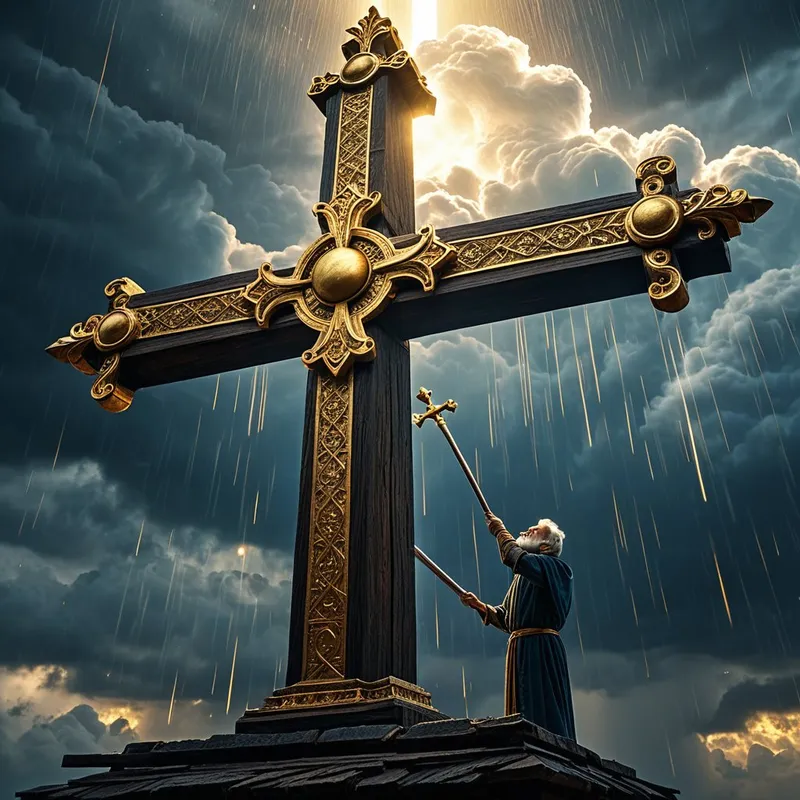
A sacred craftsman transforms the raw wood of the cross into a golden finial, bridging the earthly agony of sacrifice with the celestial promise of transcendence.
The Tale of Cross Finial
Listen. The story begins not in a palace or a temple, but in the quiet, resin-scented dark of a woodworker’s shed. The air is thick with the dust of cedar and sorrow. The man—we know him only as the Artifex—works by the guttering light of a single lamp. His tools are simple: adze, plane, saw. But his task is of a weight that bends the soul.
He has been commissioned to fashion the instrument. The wood is rough, hewn from a tree that knew wind and sun. As his plane curls away the bark, the shavings fall like tears. He feels the grain, not as pattern, but as a story—a story of growth, of rings marking years, now to be cut short. He shapes the beams, the joinery. With every stroke, he feels not the creation of a thing, but the preparation of a threshold. This wood will bear the unthinkable. It will drink the salt of sweat and the iron of blood. It will become the axis where heaven and earth are wrenched apart.
When the grim work is done, and the bare cross stands stark against the dawn, a silence falls upon the Artifex. It is a silence of completion, and of profound incompleteness. The tool of sacrifice is made, but where is the sign of hope? Where is the marker for the eye to travel upward, beyond the agony of the moment?
Then, a vision comes. Not in fire, but in the quiet certainty of the craftsman’s heart. He sees the apex of the cross not as an end, but as a beginning. From his humble stores, he takes not more wood, but a small, dense ingot of gold. He fires his crucible. The gold surrenders, becoming liquid sun. With tongs and hammer, with a patience born of devotion, he begins to work. He is no longer just a carpenter; he is an alchemist of form.
He forges a finial. Not an ornament, but a covenant. It spirals upward, a golden vine seeking the light. It is woven with the Chi-Rho, with the Alpha and Omega. It is a crown for a king of sorrows, a beacon for a resurrection dawn. When it is cool, he carries it to the place of the skull. The cross stands there, a stark silhouette of finality. With reverence, he ascends a ladder, and at the very summit, he fixes the golden finial.
The moment it is seated, the story changes. The eye is drawn up. The terrible verticality of the cross is now capped not with emptiness, but with a promise. The finial catches the first and last light of day. It transforms the instrument of death into a compass needle, pointing eternally from the rootedness of suffering to the boundless sky of grace. The Artifex descends, his work complete. He has built the ladder, and he has forged its final, guiding rung.
Cultural Origins & Context
The myth of the Cross Finial is not found in scripture, but in the fertile ground of Christian para-scriptural tradition and liturgical artistry. It emerged from the workshops of medieval craftsmen—goldsmiths, carvers, and illuminators—who sought to imbue sacred objects with layers of meaning beyond their functional use. These artisans were the unsung theologians of their age, speaking in the language of symbol and form.
The story was passed down in guildhalls and monasteries, a whispered testament to the sacred nature of craftsmanship. It served a crucial societal function: to dignify all labor, especially the manual labor of creating objects for worship, as a participation in the divine act of creation and redemption. The Artifex is every believer who takes the raw, often painful material of human experience and works to point it toward transcendence. The myth justified the stunning beauty of crucifix finials in cathedrals, transforming them from mere decoration into essential narrative components—the necessary conclusion to the story of the cross.
Symbolic Architecture
At its heart, the myth is a profound map of psychic transformation. The cross represents the unavoidable crucible of experience—the suffering, limitations, and contradictions inherent in life. It is the raw, unadorned truth of our condition.
The finial represents the conscious act of meaning-making. It is the psyche’s refusal to let suffering be the final word. Gold, the metal of the sun and of incorruptibility, symbolizes the highest value of the Self, the psychic totality achieved through integration.
The raw wood of fate must be met by the forged gold of interpretation. The vertical beam is the given; the finial is the chosen.
The Artifex embodies the directed conscious function. He does not avoid the grim task of fashioning the cross (confronting reality), but he completes it by adding the element that re-contextualizes the entire structure. He is the mediating principle between the earthly/material (wood) and the spiritual/celestial (gold).
The Dreamer's Resonance
When this myth stirs in the modern unconscious, it often manifests in dreams of architecture, crafting, or pivotal additions. To dream of laboring on a great, somber structure—a tower, a post, a spine—speaks to the somatic process of building one’s life around a core burden or duty. There is a weight, a responsibility felt in the bones.
The transformative moment comes when the dreamer discovers or forges a small, brilliant object—a jewel, a key, a capstone—and instinctively knows it belongs at the top of this structure. This is the psyche signaling a critical shift from identification with the burden to the conscious act of crowning it with meaning. The dream may carry a profound sense of relief and rightness upon placing this finial. It indicates the somatic release of tension, as if the nervous system itself has found a new orientation, moving from a state of compression (bearing the cross) to one of aspiration (guided by the finial).

Alchemical Translation
The myth is a perfect allegory for the Jungian process of individuation. The initial stage, nigredo, is represented by the felling of the tree and the shaping of the cross—the confrontation with the shadow, with suffering, and with one’s own flawed nature. This is the necessary descent.
The albedo, the washing and purifying, is the Artifex's careful, reverent work. It is the conscious analysis and acceptance of this dark material. The rubedo, the reddening and final transformation, is the firing of the crucible and the forging of the golden finial. Here, the base metal of ego-driven desire is transmuted into the gold of the Self.
Individuation is not the avoidance of the cross, but the alchemical art of forging its crown.
For the modern individual, the struggle is the integration of life’s painful contradictions. The triumph is not in escaping them, but in developing the "artifex consciousness"—the creative, disciplined capacity to take that very pain and, through reflection, art, relationship, or service, fashion it into a pointing gesture. The finial is that gesture. It says: "This happened. And from its highest point, I now see a direction, a purpose, a connection to something that transcends it." The myth teaches that our deepest wounds, when consciously worked with, can become the sacred ground from which our most guiding symbols arise. We do not erase the cross; we complete its meaning.
Associated Symbols
Explore related symbols from the CaleaDream lexicon: