Council Fire Myth Meaning & Symbolism
A myth of the sacred fire that gathers all beings, teaching that true wisdom and power are born from the circle of shared breath and listening.
The Tale of Council Fire
In the time before time, when the world was still soft from dreaming, there was no voice that could speak to all things. The Great Mystery breathed, and the creatures were born—Bear with his strength, Eagle with his far sight, Wolf with his loyalty, and Human with their clever hands. But each lived in its own world, speaking a language only its own kind could hear. A great loneliness settled upon the land. It was a silence not of peace, but of separation.
This loneliness grew so deep it became a cold wind that threatened to extinguish the very spark of life. The creatures turned inward, suspicious and afraid. Seeing this, the Spirit of the Land knew a remedy was needed, not for the body, but for the soul of the world itself. It called to the four wisest beings: the ancient Grandmother Turtle, who carried the weight of time; the keen-eyed Hawk, messenger between realms; the deep-rooted Cedar Tree, who remembered every story; and the first Human Elder, whose heart was not yet hardened.
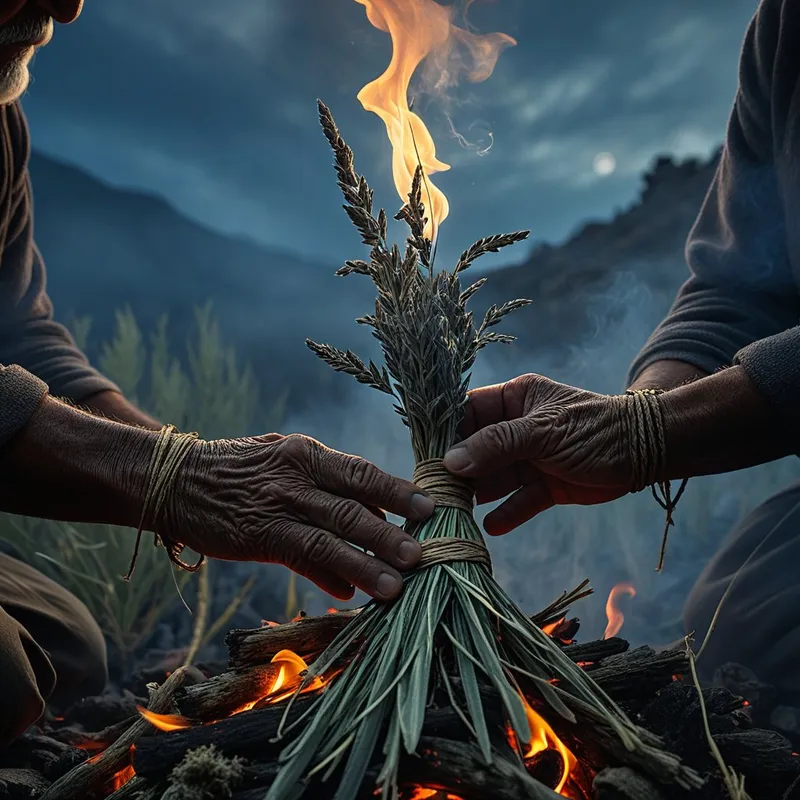
To each, the Spirit gave an impossible task: to bring a piece of the world’s original, unbroken light. Grandmother Turtle dove to the darkest mud of the lakebed, where the first spark had cooled. Hawk flew to the highest crack of thundercloud, where lightning slept. Cedar Tree drew up from its deepest root a memory of the sun’s first warmth. The Human Elder, with empty hands, was told only to listen—to the wind’s sigh, the river’s song, the crack of frost.
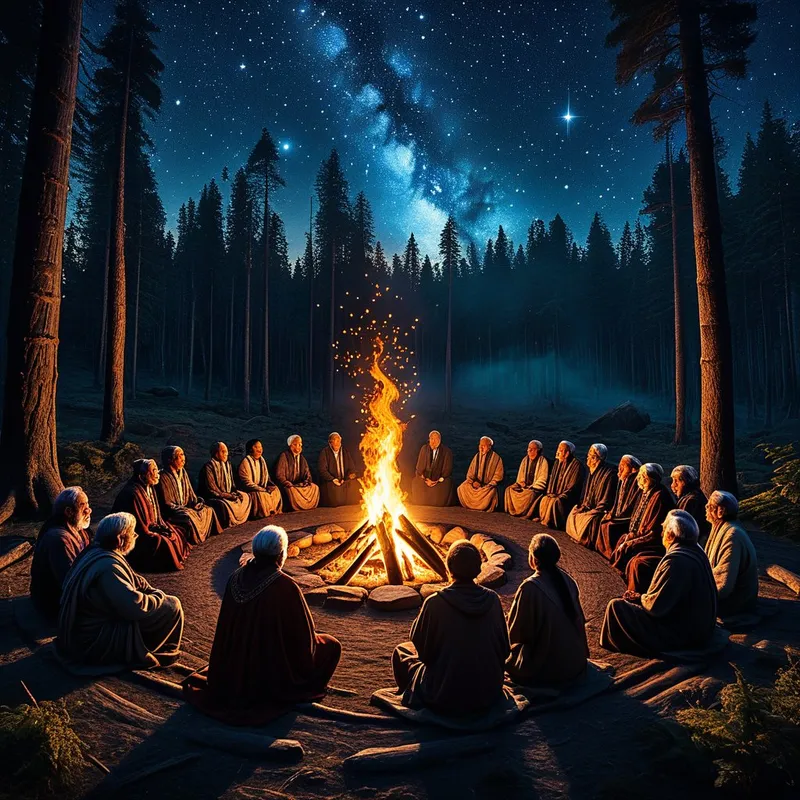
They returned to a bare clearing, a bowl of earth under a blanket of stars. One by one, they placed their offerings in the center: the cold clay, the silent air, the hidden warmth, the gathered silence. They sat, forming the first circle. For a long time, nothing happened. The wind still blew cold. Doubt crept in.
Then, the Human Elder began to speak. Not with words of their own, but with the sounds they had gathered—the whisper, the rush, the crack. As they breathed these sounds into the circle, Hawk tilted its head, understanding the language of the storm in the human’s breath. Cedar Tree shivered its leaves, recognizing the song of the deep earth. Grandmother Turtle let out a slow sigh that was the very sound of patience.
And in that moment, as the breath of all four beings met over the gathered offerings, a miracle kindled. A single, tiny flame awoke in the clay. It was not the hungry fire of destruction, but a steady, golden eye. It was the Council Fire. Its light did not push back the night; instead, it drew the night in, making the stars above shine brighter. Its warmth did not burn; it invited. One by one, other creatures, drawn by the strange, pulling light, emerged from the forest—Bear, Deer, Rabbit, Fox. They did not speak, yet as they sat in the growing circle, listening to the fire’s soft voice, they understood. The fire itself was the translator, the heart of the world made visible, beating in time with their own.
Cultural Origins & Context
The Council Fire is not a single, fixed myth from one nation, but a profound, pan-tribal concept and practice woven into the ceremonial life of many Indigenous peoples across North America. Its stories are held by elders and knowledge keepers of nations like the Haudenosaunee (Iroquois), the Lakota, the Coastal Salish, and countless others. It was passed down not merely as a tale, but as a lived, experiential truth during actual councils.
The fire was the literal and symbolic center of governance, diplomacy, and spiritual ceremony. Stories of its origin were recounted at the beginnings of great gatherings, setting the sacred space and reminding all present of the protocol: to speak with honesty, to listen with the intent to understand, and to remember their shared connection to something greater than any individual perspective. Its societal function was foundational—it was the engine of democracy, the crucible of law, the school of ethics, and the altar of prayer, all in one. It taught that wise decisions could only emerge from a circle where every voice, from the eldest chief to the youngest member, had a place and where the goal was not to win, but to find a path forward for the entire community.
Symbolic Architecture
The Council Fire is a master symbol of integrated consciousness. It represents the sacred center where disparate elements—earth, air, water, and the spirit of life (represented by the human breath)—are alchemized into a unifying light. It is not a symbol of a lone hero, but of the Council itself as the hero.
The fire is not the voice of one, but the listening ear of all. It burns not on what is given, but on the space between what is given.
The offerings are crucial: the cold clay (earth, body, foundation), the captured air (mind, intellect, message), the root-warmth (memory, tradition, ancestry), and the gathered sounds (attention, empathy, relationship). Alone, they are inert. Combined in the vessel of the circle and animated by shared intention, they become transformative. The fire symbolizes the emergent property of true community—a wisdom and power that exists in the collective field, not in any individual. Psychologically, it represents the ego’s submission to a greater, transpersonal intelligence that arises from deep dialogue between all parts of the self—the instincts (animal nations), the ancestral patterns (Cedar Tree), the connecting function (Hawk), and the conscious mind (Human Elder).
The Dreamer's Resonance
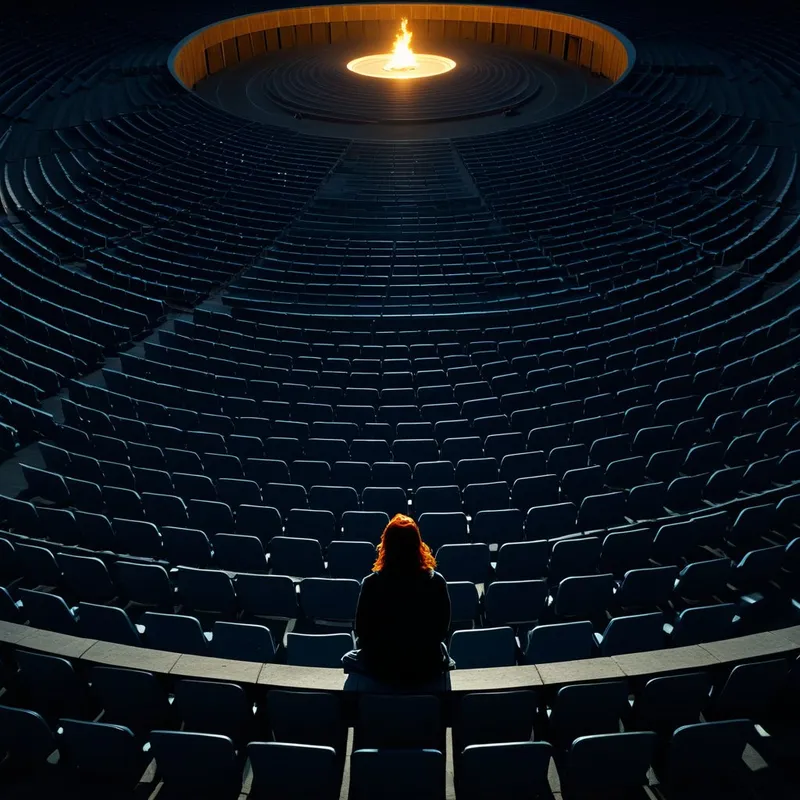
When the Council Fire appears in modern dreams, it often signals a profound internal process of reconciliation and integration. The dreamer may find themselves sitting at such a fire, perhaps with unfamiliar figures or even aspects of themselves (an angry child, a critical parent, an ignored creative impulse). The somatic feeling is often one of tense anticipation moving toward deep calm, or a burning need to speak that is tempered by a compulsion to listen.
This dream motif arises when the psyche is struggling with fragmentation—a conflict between career and family, logic and intuition, personal desire and communal responsibility. The fire in the dream is the psyche’s own attempt to create a sacred, neutral ground where these warring "tribes" of the inner world can convene. The process underway is one of moving from inner conflict (the cold wind of loneliness) to inner council. The dream asks: What parts of you have not been given a seat at your own fire? What offering have you withheld? The resolution in the dream, if it comes, is rarely a shouted verdict, but a quiet, unanimous understanding that emanates from the fire itself, a felt sense of wholeness.
Alchemical Translation
The myth of the Council Fire provides a precise model for the Jungian process of individuation—the journey toward becoming an integrated, whole Self. This is not the alchemy of a solitary wizard, but of a sovereign who convenes their own internal parliament.
The first step is the recognition of the "cold wind"—the feeling of inner alienation, where parts of the self are silenced or at war. The alchemical work begins with the gathering of the "four offerings": confronting the shadow (the cold clay of what we’ve buried), elevating our thoughts (capturing the clear air of perspective), connecting to our inner history (the root-warmth of personal and archetypal memory), and, most crucially, cultivating deep inner listening (the gathered sounds). We must sit in the circle with our own inner Bear of strength, Fox of cunning, and Deer of vulnerability.
Individuation is not about becoming a single, monolithic flame, but about becoming the skilled keeper of the fire where all one's complexities can safely gather and be transmuted into light.
The "fire" that ignites is the transcendent function, the birth of a new, guiding attitude that reconciles opposites. It is the moment when we stop trying to decide from a place of ego and instead learn to listen for the emergent wisdom that arises from the totality of our being. The ongoing practice is to tend this inner Council Fire—to ensure all voices are heard, to feed it with respect and honesty, and to let its light guide actions in the outer world. In doing so, the modern individual does not just solve problems; they transform their very psyche into a vessel for a more conscious, connected, and compassionate way of being.
Associated Symbols
Explore related symbols from the CaleaDream lexicon: