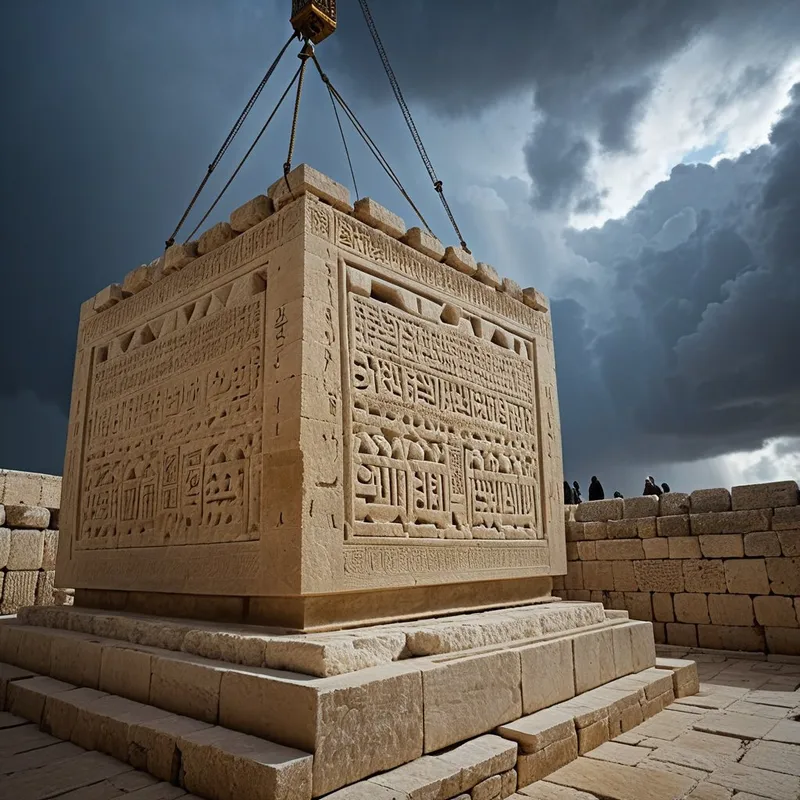
Cornerstone Myth Meaning & Symbolism
A stone, rejected by the master builders, is chosen by God to become the essential, unifying foundation of a new spiritual and psychological edifice.
The Tale of the Cornerstone
Listen. In the days when kings dreamed of temples and prophets spoke in riddles, there was a building. Not just any building, but a dwelling meant for the Divine, a structure to touch the heavens. The air was thick with the dust of ambition and the sweat of a thousand masons. The sound was a symphony of chisels biting stone, of ropes straining, of foremen shouting measurements to the sky.
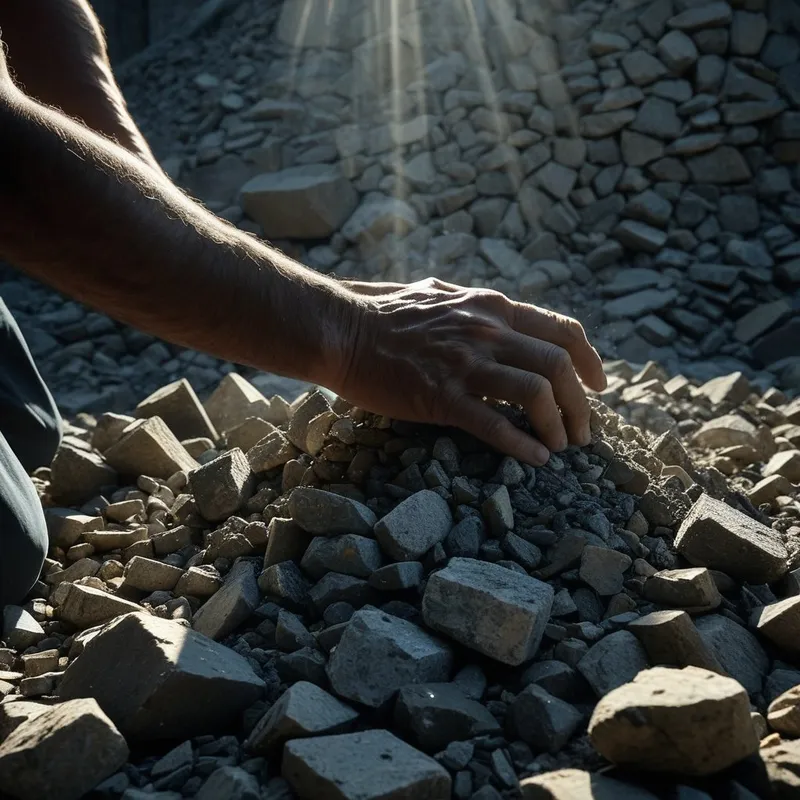
The master builders moved among the quarried blocks, their eyes sharp, their hands knowing. They sought perfection—smooth faces, right angles, stones that fit without a whisper of a gap. They passed by one stone. It was not like the others. Perhaps its grain was wild, its shape born of an ancient fracture, its color a shade too humble. It did not conform. It did not please the eye trained for symmetry. With a grunt of dismissal, it was cast aside, rolled to the perimeter of the sacred site, destined for the forgotten pile, for the rubble of things deemed useless.
Seasons turned. The walls rose, proud and straight, but a disquiet grew. The builders, for all their skill, could not find the key. The structure was impressive, yet it lacked a soul of alignment; it was a collection of parts, not a unified whole. There was a silence at its heart where there should have been a song. The architects consulted their scrolls, the priests their rituals, but the temple remained incomplete, a beautiful body waiting for a spine.
Then, a voice, not from the foreman or the king, but from the scroll of the prophet, echoed in the stillness: “The stone which the builders refused is become the head stone of the corner.” The words hung in the air, a divine contradiction. A search began, not for a new quarry, but among the rejects. And there it was, covered in the dust of disregard. When they measured it, when they sought to understand its strange angles, a miracle of geometry revealed itself. This stone, this refused one, was the only stone whose unique shape could bind two walls together. It was not meant for the showy pinnacle, but for the crucial, hidden junction at the base. With great ceremony, it was lifted—not to the heights, but to the depths of the foundation. As it settled into the earth, a shudder passed through the entire construction. Walls straightened. Stresses dissolved. The temple found its true north in the stone everyone had overlooked. The rejected had become the essential. The foundation was now sure.
Cultural Origins & Context
This narrative is not a single story from one book, but a resonant motif woven through the tapestry of Biblical literature, most prominently in the Psalms (118:22) and the prophetic writings of Isaiah (28:16). It was a metaphor employed by poets and prophets to address the collective psyche of a people often feeling small, besieged, and rejected by the empires of the world. The "builders" represented the established powers—political, religious, and social—who operated on conventional wisdom and visible strength.
The myth was a form of theological and psychological subversion. It was told to remind the community that YHWH's criteria for value radically differed from human criteria. It functioned as a theodicy for suffering and a promise of future vindication. By the time of the early Jesus movement, this motif was explosively reinterpreted. The writers of the New Testament epistles and the Gospels seized upon it as the perfect archetype to explain the crucifixion and resurrection of Jesus—rejected by the religious and political authorities yet, in their view, installed by God as the foundational principle of a new spiritual reality. Thus, the myth moved from a national metaphor to a cosmic and personal one, passed down through sermons, letters, and liturgical readings.
Symbolic Architecture
At its core, the Cornerstone myth is about the paradox of value and the geometry of the soul. The "builders" symbolize the conscious ego and its attendant cultural complexes: the part of us (and our society) that judges based on surface appearance, utility, and conformity. The rejected stone represents what those complexes discard: the awkward, the wounded, the unconventional, the seemingly unproductive aspects of the self—what Carl Jung would term the shadow, and what in spiritual terms might be called the "foolishness" of God.
The foundation of the true self is not laid with the stones of perfect reputation, but with the rejected fragments of authentic experience.
The "corner" is the crucial symbol. It is the point of tension and union where two different directions meet. Psychologically, this represents the integration of opposites—conscious and unconscious, strength and vulnerability, persona and shadow. The stone isn't chosen to be a solitary monument; its purpose is relational. It exists to hold disparate parts together, to create stability through its very uniqueness. Its placement is low and foundational, indicating that this integration is not a crowning achievement of the ego, but the necessary, often hidden, groundwork upon which a coherent life is built.

The Dreamer's Resonance
When this myth stirs in the modern unconscious, it often manifests in dreams of being overlooked, of having one's crucial contribution ignored at work or in a family. One might dream of searching through a junkyard or rubble pile for a lost, vital object. Somaticly, this can feel like a persistent, low-grade ache of insignificance, a sense of being fundamentally "out of square" with the world.
The psychological process at work is the psyche's attempt to reclaim its disowned parts. The dream-ego, playing the role of the short-sighted builder, has cast aside some essential quality—perhaps raw creativity, deep vulnerability, or righteous anger—deeming it unfit for the "structure" of one's acceptable identity. The dreaming culture.") process begins the search for this cornerstone. The anxiety in such dreams is the tension of an incomplete self, a life built on a foundation that lacks its key stabilizing element. The resolution, when it comes, is not a triumphal parade, but a profound, quiet sense of alignment and embodied rightness, as if an invisible burden has been lifted from the shoulders.

Alchemical Translation
The alchemical journey mirrored in the Cornerstone myth is the opus contra naturam—the work against nature, or more precisely, against the ego's natural preferences. The first matter, the prima materia, is always the rejected, the worthless, the lapis exilis (the humble stone). For the individual, this is the starting point of individuation: not one's talents and accolades, but one's wounds, failures, and embarrassments.
The "builders' rejection" is the necessary stage of negrido, the blackening, where the material is humiliated and reduced to ash. One must feel the full weight of being discarded, both by outer circumstances and by one's own inner critic. The divine choice—the moment the stone is selected—symbolizes the awakening of the Self, a voice from beyond the ego that recognizes potential where the ego sees only flaw.
The alchemy of the soul begins in the rubble heap of what we have been taught to despise in ourselves.
Finally, the "setting in place" is the stage of coagulatio—fixing and embodying. This is the slow, patient work of integration. The rejected quality is not merely excavated; it is given a function. One's deep sensitivity becomes the cornerstone for empathy. One's stubbornness becomes the foundation for integrity. One's fractured experience becomes the binding agent for wisdom. The individual discovers that their wholeness, their stability in the world, depends entirely on incorporating the very stone they once spent a lifetime trying to bury. The temple that rises thereafter is not a monument to perfection, but a living, resilient structure grounded in the paradoxical strength of its own redeemed weakness.
Associated Symbols
Explore related symbols from the CaleaDream lexicon: