Corn Mother Myth Meaning & Symbolism
A sacred being sacrifices her body to become the first corn, teaching humanity that life is sustained through sacred generosity and transformation.
The Tale of Corn Mother
In the time before time, when the world was young and people were new, there was a great hunger. The people wandered, their bellies hollow, their spirits growing thin as the winter wind. They knew only to hunt and gather what scant berries the land offered, and their children cried through the long, cold nights.
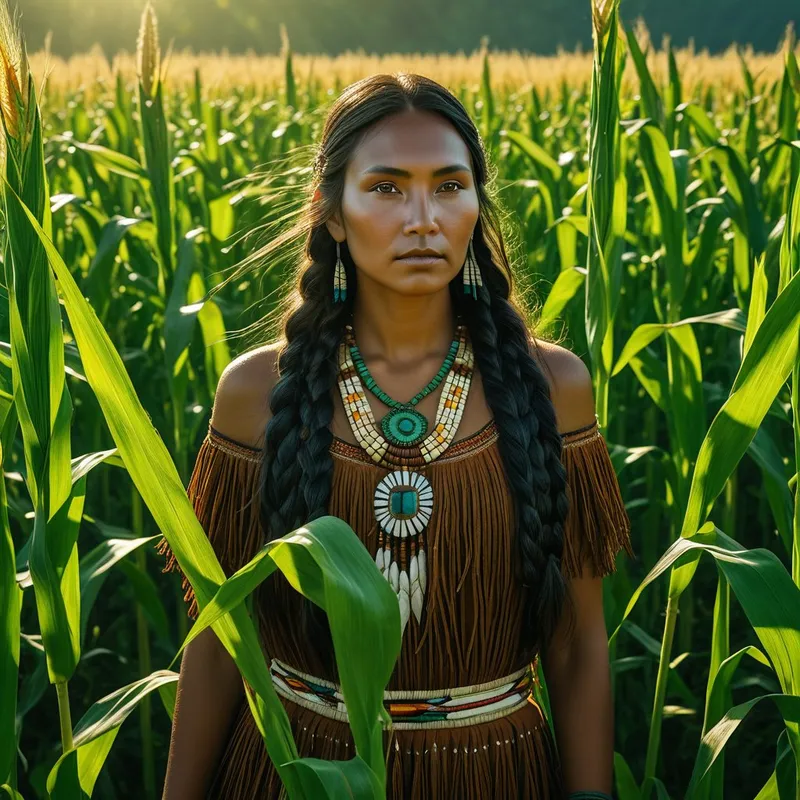
Among them was a sacred being, a woman of profound spirit. Some say she was a goddess who walked with them; others whisper she was the first grandmother, her heart as deep as the earth. She was known as the Corn Mother. Where she walked, the grass seemed greener, and a feeling of potential, like the quiet before the rain, followed her.
She watched her people suffer, and her own spirit ached with a hunger greater than any in the belly. One day, as the sun bled into the western hills, she called the people to her. Her voice was soft but carried like river sound. "My children," she said, "the old ways are not enough. You must learn a new way of being with the world."
She instructed the people to clear a wide, open space of earth. With doubt in their hearts but trust in her eyes, they did so. She then asked them to make a great fire, a blazing heart in the center of the cleared ground. The flames leapt high, painting their worried faces in orange and shadow.
Then, the Corn Mother began to walk. She walked around the fire, singing a low, rolling song that seemed to come from the stones beneath their feet. She walked once, and a strange warmth filled the air. She walked a second time, and the soil itself began to tremble softly. With the third circuit, she stopped before the two strongest men of the village.
"Now," she said, her eyes holding the light of the fire and something infinitely older, "you must do as I say. For the new life to come, the old form must go. You must drag your bodies over me. You must cover me with the soil of this clearing."
A gasp went through the people. Horror and refusal rose in their throats. But her gaze was unwavering, a command of pure love. Tears streaming down their faces, the men, with the utmost reverence and trembling hands, did as she asked. As they dragged their implements over her, a miracle unfolded. Where her flesh was scoured, a rich, dark liquid like the finest soil seeped into the earth. Where her blood fell, it did not pool but sank deep, humming with life.
The people, weeping, covered her with the sacred earth, burying their greatest love beneath a blanket of soil. For four days, a profound silence held the village. On the morning of the fifth day, a green mist seemed to hover over the place of her sacrifice. The people approached, their hearts pounding like drums.
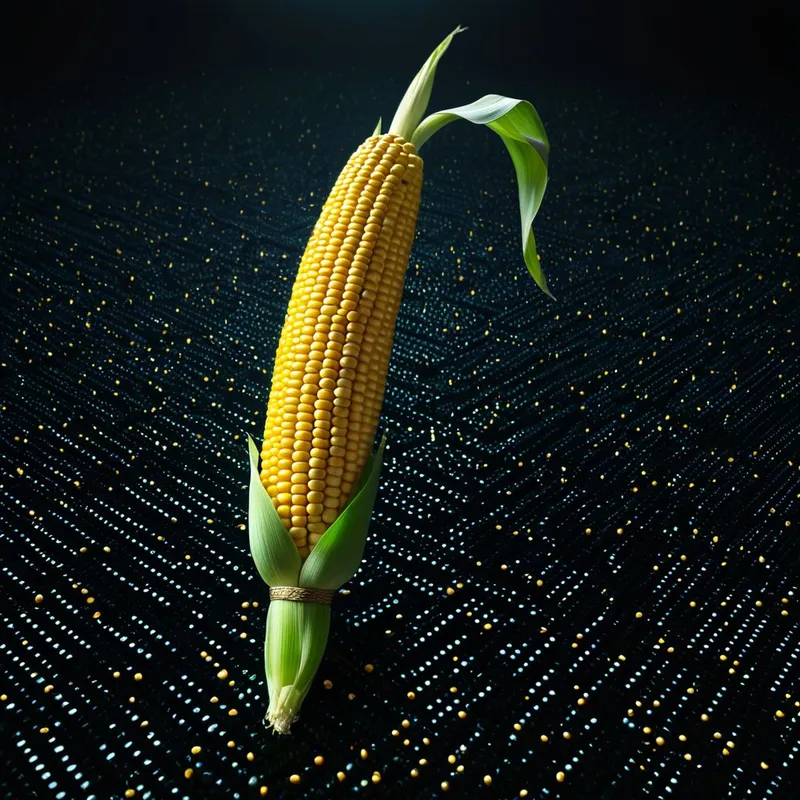
From the very spot where she had given herself, tender green shoots pierced the dark soil. They grew with a visible quickness, stretching toward the sun, forming strong stalks. From these stalks, silken hair emerged, and from that, plump ears swelled, wrapped in protective husks. When the people peeled back the husk, they found rows upon rows of golden kernels, the very flesh of the Corn Mother, transformed. She had given her body so that they might never hunger again. She had taught them that true nourishment requires a sacred exchange: a giving of the self for the life of the whole.
Cultural Origins & Context
The myth of the Corn Mother is not a single, monolithic story but a profound archetypal narrative found across many Native American cultures, particularly among the agricultural peoples of the Eastern Woodlands and Southwest, such as the Cherokee, Iroquois, Hopi, and Pueblo nations. Known by many names—Selu (Cherokee), Iyatiku (Pueblo), or simply the Gift-Giver—her story is the bedrock of a worldview.
This was not a tale told merely for entertainment; it was a sacred narrative recited during key ceremonies, particularly at planting and harvest times. Elders and spiritual leaders were its custodians. Its function was multifaceted: it was a cosmological explanation for the origin of corn, the staple of life; a moral and spiritual guide teaching the ethics of reciprocity, sacrifice, and gratitude; and a practical agricultural allegory (clearing the land, covering the seed). The myth established corn not as a mere crop, but as a sacred relative, a physical manifestation of a divine sacrifice that demanded respect and ritual in return. It wove the people, the land, and the spiritual world into an inseparable whole.
Symbolic Architecture
At its core, the myth is a masterful symbolic map of the cycle of life, death, and regeneration. The Corn Mother represents the generative, nourishing principle of the universe—the Great Mother in her most tangible form. Her voluntary sacrifice dismantles the dichotomy between life-giver and life itself.
The ultimate nourishment is not taken, but given; the deepest transformation requires a surrender of the current form.
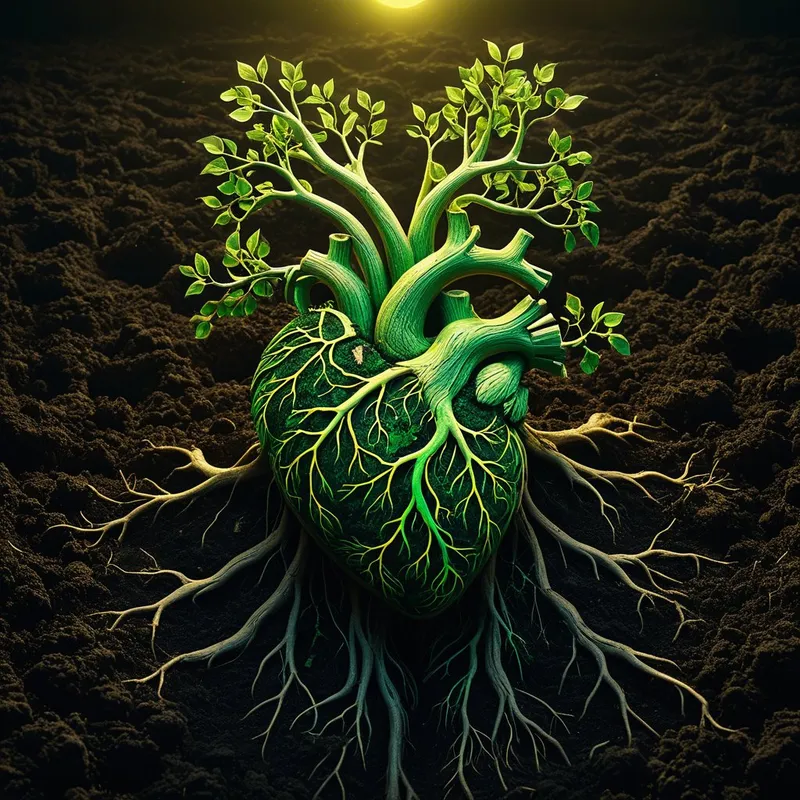
The act of being covered by the earth is a powerful symbol of burial, descent, and incubation. It is a necessary return to the prima materia, the dark, chaotic state from which new order emerges. The corn plant that rises is the archetypal world axis, linking the underworld (roots), the earthly plane (stalk), and the celestial realm (tassels reaching for the sun). The kernels are not just food; they are the fragmented, multiplied essence of the divine, distributed for the sustenance of all. The myth encodes the alchemical truth that spirit must become matter, and matter, when treated as sacred, reveals its spiritual essence.
The Dreamer's Resonance
When this myth stirs in the modern psyche, it often surfaces in dreams of profound offering or somatic sensations of deep, sacrificial transformation. One might dream of cooking an elaborate meal for strangers, of breastfeeding a child that is not one's own, or of one's body slowly turning into wood or earth. There may be dreams of burying a treasured possession or a part of oneself, accompanied not by grief, but by a solemn sense of necessity.
Psychologically, these dreams signal a crucial phase in the development of the Caregiver archetype. The dreamer is processing a profound internal demand: what part of my current identity, my energy, my "flesh," must I willingly give up to nourish a new phase of life—be it a relationship, a creative project, or one's own future self? It is the somatic recognition that growth is not just additive but transformative, requiring a death of the old. The anxiety in the dream mirrors the villagers' horror, confronting the terrifying yet essential law that life feeds on life.
Alchemical Translation
For the individual on the path of individuation, the Corn Mother's journey is a precise model of psychic transmutation. Our initial state is often one of "hunger"—a spiritual or creative lack, a sense of something missing. We may wander, gathering scattered insights (berries) but lacking a sustaining core.
The alchemical operation begins with the decision of the conscious ego (the Corn Mother's resolve) to offer up a dominant, perhaps outworn, complex or identity to the transformative process. This is the sacrificium, the sacred making. We must "clear the ground" of our psyche and submit this part of ourselves to the inner fire of attention and emotion.
Individuation is the process by which one becomes, paradoxically, both the sacrificed and the nourishing harvest.
The crucial, most difficult phase is the nigredo: the burial, the dark night where the old form seems lost, disintegrated, and gone. This is the period of depression, confusion, or incubation, where the work happens unseen. Faith is essential here—the faith of the villagers who waited.
The eventual "greening," the emergence of the new life (the albedo and citrinitas), is the birth of a new psychic function or attitude. The corn—the integrated insight, the sustained creativity, the capacity for deep nourishment—is the rubedo, the final product. It is a substance that both feeds the individual and can be shared with the community. The myth teaches that our greatest gifts to ourselves and the world are born not from what we acquire, but from what we are willing to surrender and transform. We are both the field and the farmer, the seed and the harvest.
Associated Symbols
Explore related symbols from the CaleaDream lexicon: