Construction of Pyramids Myth Meaning & Symbolism
The myth of the pyramid's construction is a sacred drama of aligning human will with cosmic order to build a stairway for the soul's ascent.
The Tale of Construction of Pyramids
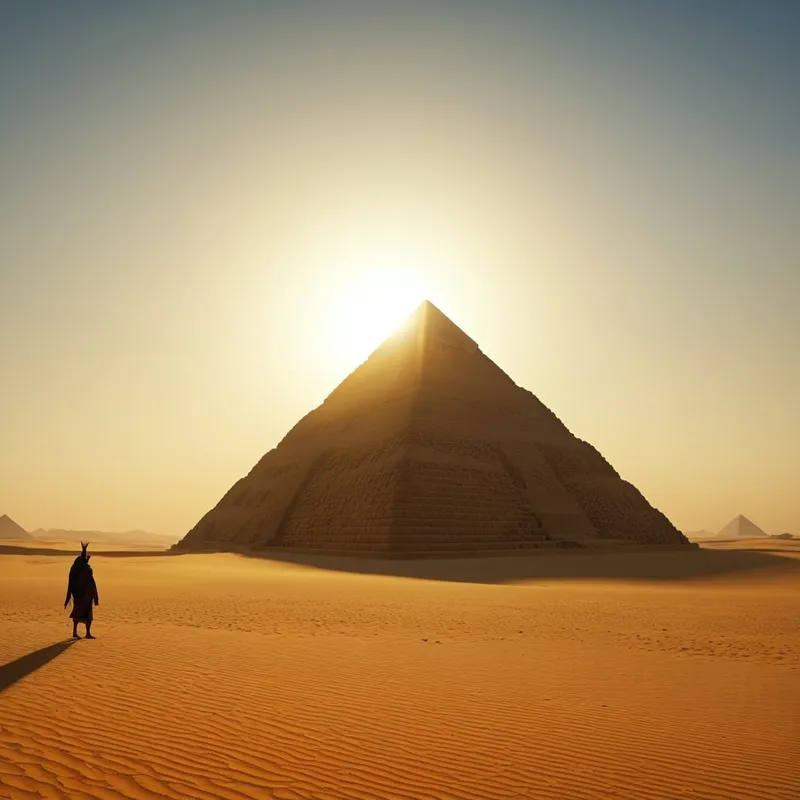
Hear now the tale of the First Time, when the sky was low and the earth was soft. It is not a story of ropes and ramps, but of a sacred cry against the swallowing dark. The Pharaoh, his heart a drumbeat of Maat, stood on the raw plateau. Before him lay chaos—the formless desert, Nun. Behind him stretched the Black Land, life itself, a gift of the Nile’s annual miracle. His task was not to build a tomb, but to forge a knot between earth and heaven, to create a place where the sun’s first light would be caught and held forever.
He called upon Ptah, the Opener of the Way, whose thoughts became things. He called upon Thoth, the Measurer of Time, he of the precise word and the perfect angle. And he called upon Heka, the hidden force in the stone itself. The plan was not drawn on papyrus, but sung into the dawn—a song of angles that echoed the rays of Ra, a geometry that mirrored the descent of light.
Then began the great alignment. Tens of thousands, not as slaves, but as a single body of purpose. The quarry rang with a rhythm older than language. Chisels bit into the living rock of Tura, not to break it, but to awaken the light sleeping within. Each block, heavier than a herd of elephants, was not dragged, but persuaded. It was floated on canals of human sweat and devotion, guided by songs that charted the stars. The desert floor became a grid of celestial ambition.
The rising courses were not mere layers; they were the solidified hours of the sun’s journey. The ascending passages pointed not to random stars, but to the imperishable ones, the Ikhemu-sek. The work was a liturgy performed with stone. The climactic moment came not with the placing of the capstone, but with the sheathing of the entire form in blinding white Tura limestone. When the last polished face was set, the structure ceased to be a thing of the earth. At the exact moment of the equinox, the sun struck it. The plateau vanished. In its place stood a mountain of light, a frozen ray of the sun, a ramp upon which the Ba of the king could climb to join Ra in his eternal barque. The chaos was ordered. The word had become flesh, and the flesh had become light.
Cultural Origins & Context
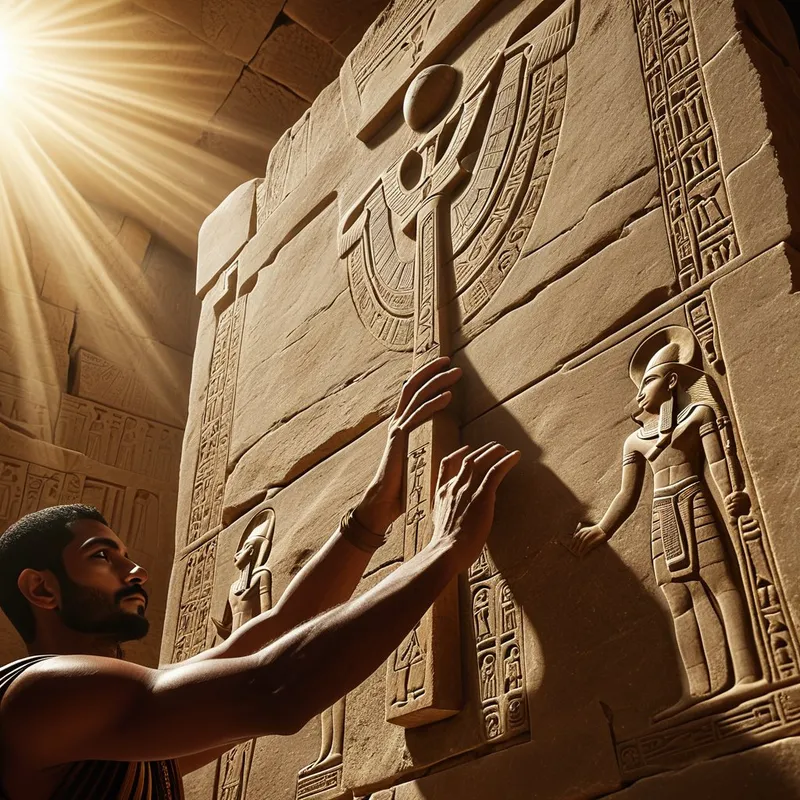
This mythic understanding of pyramid construction is woven from the fabric of Egyptian cosmology, not from a single inscribed tale. It was the operating system of the state, communicated through ritual, temple relief, and the very orientation of the monuments. The pharaoh was the chief priest, the guarantor of Maat. By orchestrating this colossal act of ordered creation, he demonstrated his divine mandate to keep chaos at bay and ensure the cycles of Nile, sun, and season.
The myth was passed down through the priestly architects of the Per-aa and the guilds of stonemasons and scribes. It was a living knowledge, a sacred technology. Its societal function was profound: it transformed backbreaking labor into a participatory sacrament. To move a stone for the pyramid was to help the king—and by extension, the cosmos—ascend. It was an act that ensured the stability of the world, making every participant a sustainer of cosmic order. The pyramid was thus less a monument to a man than a public works project for the soul of the universe.
Symbolic Architecture
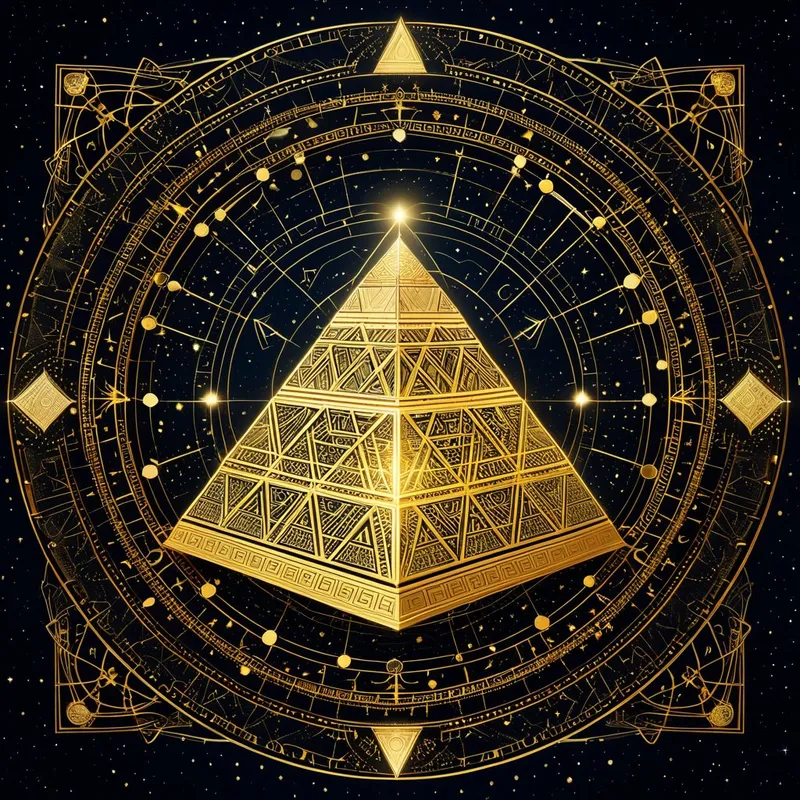
At its core, the pyramid is a mandala of consciousness. Its square base, rooted firmly in the four directions of material reality, represents the ordered world, the ego, and the defined self. Its four triangular sides converging on a single, invisible point above represent the ascent from multiplicity to unity, from the earthly to the celestial.
The pyramid is the psyche’s own structure: a broad base of conscious experience narrowing toward the transcendent apex of the Self.
The Ba's journey through the narrow, star-aligned passages symbolizes the difficult, precise process of focusing consciousness—leaving behind the clutter of the personal to reach the impersonal, eternal realm. The capstone, often missing or made of a different material, represents the final, elusive piece of wholeness, the Lapis Philosophorum, which can only be placed from above, by grace. Psychologically, the myth represents the ego’s (Pharaoh’s) heroic project to build a permanent structure for the soul, to create something so ordered and perfect that it can withstand the entropy of time and the chaos of the unconscious.
The Dreamer's Resonance
When this myth stirs in modern dreams, one does not simply dream of a pyramid. One dreams of constructing it, or being lost within its perfect, oppressive geometry. To dream of hauling an impossible block up an endless ramp speaks to a somatic feeling of burden—a life task, a relationship, a creative project that feels both sacred and crushing. The dreamer is in the phase of laying the foundation of their identity with immense effort.
To dream of the interior passages, the dark, narrow shafts leading upward, indicates a psychological process of constriction and focus. It is the soul’s navigation through a depression, a period of study, or a dark night of the soul where one must move by faith toward a pinpoint of light (the star, the apex). The polished, blinding exterior of the dream-pyramid can symbolize the persona—the perfect, imposing face we show the world, which hides a complex, shadowy interior. The dream asks: What immortal structure are you building with the days of your life? Is its alignment true, or is it sinking into the sand of distraction and disorder?
Alchemical Translation
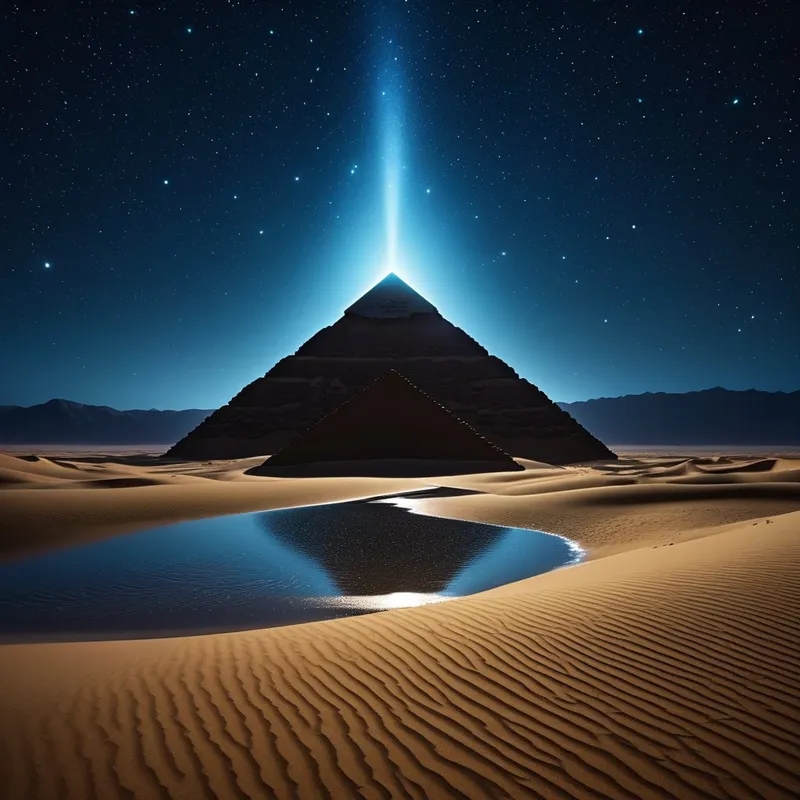
The alchemical process mirrored in this myth is the coagulatio—the making solid, the embodiment of spirit. The raw, chaotic matter of the desert (Prima Materia) and the unshaped stone are the unrefined contents of the personal psyche. The sacred plan, the measurements of Thoth, represent the guiding archetype of the Self. The long, arduous construction is the labor of individuation: taking the scattered, heavy elements of one’s personality (the blocks) and patiently, deliberately, fitting them into a coherent, upward-striving whole.
The goal is not to escape the earth, but to transform it into a vessel capable of receiving and reflecting the divine light.
The final sheathing in white limestone is the albedo, the whitening. It is the moment when the crude ego-structure is purified and illuminated by consciousness, becoming a transparent vessel for something greater. For the modern individual, the myth models the psychic transmutation of a life from one of reactive chaos to one of proactive, sacred order. It is the call to become the architect-king of your own soul, to align your daily actions (the blocks) with a transcendent purpose (the celestial alignment), and through relentless, faithful effort, to build a self that does not merely exist, but ascends.
Associated Symbols
Explore related symbols from the CaleaDream lexicon: