Confucian Li Myth Meaning & Symbolism
The myth of Li is the story of a sacred, patterned order emerging from chaos to weave the fabric of a harmonious cosmos and a civilized human heart.
The Tale of Confucian Li
In the time before time was measured, the world was a broth of potential, a churning hundun. Mountains flowed like water; rivers stood as stone. The cries of beasts and the whispers of spirits were one cacophonous song. Humanity huddled, hearts beating in erratic rhythm with the formless world, knowing neither place nor purpose.
Then came the sages, not with thunder, but with observation. They watched the heavens turn—the sun’s unwavering path, the moon’s faithful wax and wane, the stars in their eternal courts. They felt the earth’s pulse—the seasons’ patient rotation, the seed’s inevitable push toward the light. They saw in this not randomness, but a deep, silent pattern. A celestial Li.
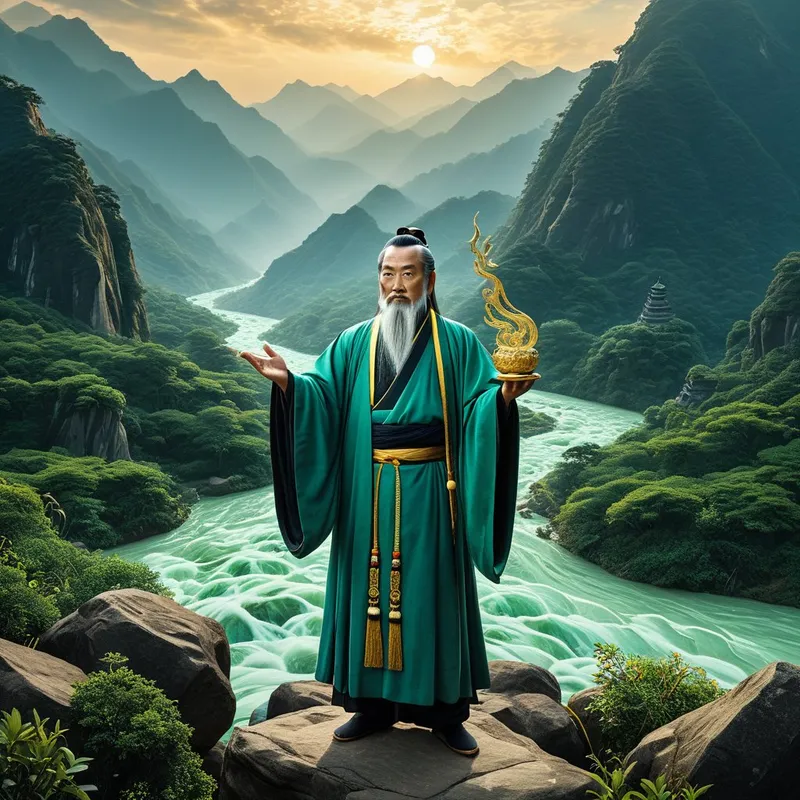
The first act was not creation, but discernment. The sage-king Yu the Great did not conquer the waters with force alone. He bowed to their nature, tracing their chaotic will, and with endless toil, carved channels—not against the water’s essence, but in alignment with the deeper pattern of flow and containment. Where chaos reigned, he introduced relationship: bank to river, field to stream. This was the first great ritual—the ordering of the world’s body.
Then came the ordering of the human heart. The Duke of Zhou, in a time of bloody rebellion and shattered loyalties, sat not on a throne of pride, but before a cold forge of society. He took the broken pieces—the fear, the ambition, the grief—and began to arrange them. He established the rites of the court: how a minister should bow, not in servitude, but in acknowledgment of role. He composed the music for the ancestral temple: not mere sound, but a sonic architecture to house the spirits of the past. Every gesture, from the emperor’s sacrifice to the farmer’s offering, was given a form—a vessel to hold intention.
The conflict was eternal: the ever-present pull back to hundun, to the selfish cry, to the disordered act that tears the social fabric. A minister plotting in shadow breaks the ritual of trust. A son’s neglect cools the hearth, violating the rite of family. Each breach was a crack in the patterned cosmos, a return to the formless wail.
The resolution was never final, but daily, hourly. It was found in the practiced turn of a cup during a toast, honoring guest before host. It was in the precise depth of a mourning bow, giving weight to loss. It was in the shared meal arranged just so, enacting hierarchy and care simultaneously. Through these countless, conscious gestures, the sacred pattern was not just remembered; it was re-membered—woven anew into the living moment. The cosmos, in response, held its breath less often. The harvests found their rhythm. The human heart, within the graceful confines of the rite, discovered a paradoxical and profound freedom: the freedom to be truly human, in relation to all things.
Cultural Origins & Context
The myth of Li is not a single narrative bound in one text, but the foundational substrate of classical Chinese thought, crystallized and systematized by Confucius and his followers. Its origins are prehistoric, rooted in shamanistic practices and ancestral veneration of the Shang and early Zhou dynasties. It was passed down not by bards singing of gods, but by scholars, officials, and elders transmitting The Book of Rites (Liji), The Analects, and other classics.
Its tellers were the literati, the "ru", who were the custodians of culture. Its societal function was nothing less than civilizational. In the absence of a strong centralized religious doctrine or legal code, Li served as the invisible architecture holding the empire together. It governed diplomacy, family life, education, and governance. It was the performative script that transformed biological beings into cultured persons (ren), raw power into legitimate authority, and a collection of individuals into a harmonious, ethical community. It was the practical technology for enacting the Ren and realizing the Yi in everyday life.
Symbolic Architecture
At its core, Li is the symbolic principle of Meaningful Pattern. It represents the human psyche's innate drive to impose coherent, beautiful, and ethical structure upon the raw data of existence—both internal and external.
Li is the psyche’s own ritual; it is the conscious act of shaping chaos into a vessel that can hold meaning.
The chaotic waters subdued by Yu symbolize the undifferentiated unconscious—the flood of instincts, emotions, and potential that threatens to overwhelm the conscious ego. The ritual vessels and music established by the Duke of Zhou represent the conscious structures of the personality: the habits, values, roles, and ethical frameworks that contain and channel psychic energy. The ancestors venerated in the rites are not merely dead relatives, but symbols of the accumulated wisdom of the past—the cultural and personal psyche—which must be honored and integrated for wholeness.
The gui jade tablet is a potent symbol of this architecture. Jade itself represents perfected virtue; its precise form represents the specific, tangible manifestation of that virtue in the world. Thus, Li asserts that the sacred is not beyond form, but is realized through it.
The Dreamer's Resonance
When this myth stirs in the modern unconscious, it often manifests in dreams of searching for or constructing order. One may dream of organizing a cluttered, labyrinthine room, of learning a complex, beautiful dance with precise steps, or of repairing a shattered but ornate vase. There may be somatic sensations of anxiety in the face of formlessness, followed by profound relief or focus when a pattern is discovered or a rule is followed.
Psychologically, this signals a process of ego consolidation or life-stage integration. The dreamer is likely navigating a transition—a new career, a relational shift, a creative project—where the old, unconscious ways of being feel insufficient or chaotic. The psyche is laboring, like Yu the Great, to channel powerful new energies (ambition, love, grief) into constructive forms. The dream is an expression of the Self’s imperative to create a sustainable, authentic structure for one’s life—a personal Li. The conflict in the dream (the resisting clutter, the missed dance step) mirrors the resistance of the shadow, which thrives in disorder and rebels against the discipline required for conscious form.

Alchemical Translation
The alchemical work modeled by Li is the transmutation of instinct into culture, and chaos into cosmos, within the individual soul. It is the slow, deliberate process of Individuation where one becomes the ritual master of one’s own inner kingdom.
The prima materia is the raw, unrefined stuff of one’s nature—the passions, the traumas, the talents. The first operation, discernment (observation of the heavenly patterns), is introspection and self-knowledge. One must learn the natural laws of one’s own psyche. The second operation, containment and channeling (Yu’s dredging), is the hard work of ego discipline—creating healthy boundaries, establishing routines, and directing energy toward conscious goals instead of being flooded by it.
The ultimate goal is not rigid control, but a harmonious orchestration where every part of the self, like the instruments in the Duke of Zhou’s ritual music, plays its proper role at the proper time.
The ritual performance is the daily practice of living authentically and ethically. Each conscious choice, each kept promise, each act of respect for oneself and others, is a micro-rite that strengthens the patterned integrity of the personality. The ancestral veneration is the integration of one’s personal and collective past—honoring one’s history, forgiving its wounds, and carrying its wisdom forward.
The gold produced by this alchemy is not perfection, but authentic presence. It is the person who, through self-cultivation, has built an inner Li so resonant that their very being becomes a stabilizing, harmonizing force in their corner of the world. They have mastered the sacred pattern not by rote, but by understanding its spirit, and in doing so, they become a living vessel for meaning, connecting the chaos within to the cosmos without.
Associated Symbols
Explore related symbols from the CaleaDream lexicon: