Colossus of Rhodes Myth Meaning & Symbolism
A titanic bronze god, born from siege and gratitude, bestriding a harbor, then felled by earth's tremor, its fragments whispering of human ambition and divine scale.
The Tale of Colossus of Rhodes
Hear now, of the island that stood as a shield, and the god who became its crown.
The sea was not always so blue around Rhodes. Once, it ran red with the ambition of kings. From the east came the storm, a fleet like locusts, commanded by Demetrius Poliorcetes, the Besieger of Cities. His engines of war towered over the walls of Rhodes, his rams thundered day and night, a heartbeat of impending doom. For a year, the Rhodians held. They fought not just with spear and shield, but with a fierce, stubborn love for their free soil, an island dedicated to Helios, the All-Seeing Sun.
And Helios watched. His light glinted off the desperate shields on the walls, baked the bronze of the invading machines. The conflict was a grinding of mortal wills, until the very earth seemed to tire of it. When Demetrius finally withdrew, abandoning his monstrous siege tower—a city of wood and iron named Helepolis, the Taker of Cities—he left behind not just defeat, but an unexpected gift: the raw materials of a dream.
The air on Rhodes then was thick not with smoke, but with a profound, trembling gratitude. The people walked the scarred land and saw not ruin, but possibility. They resolved to build a thanksgiving so vast it would touch the sky, a monument to the god who had delivered them. They would not build a temple of stone, but a god himself. They summoned Chares of Lindos, a pupil of the great Lysippos. The vision was audacious: a statue of Helios, not merely human-sized, but titanic, so high that ships would pass between his legs into the harbor.
For twelve years, the fires of the forge never cooled. The spoils of war—the bronze and iron of the abandoned Helepolis—were melted down in a sacred alchemy. The earth groaned as a foundation was laid. A skeleton of iron and stone rose first, a mountain made by men. Then, plate by plate, the skin of the god was formed. Hammered bronze, warmed by the very sun it honored, was lifted and riveted to the frame. The scent of hot metal and salt air became the breath of the island. The people labored, their sweat and hope becoming part of the colossus. They watched as the feet were anchored, the mighty calves formed, the torso assembled like the hull of a divine ship.
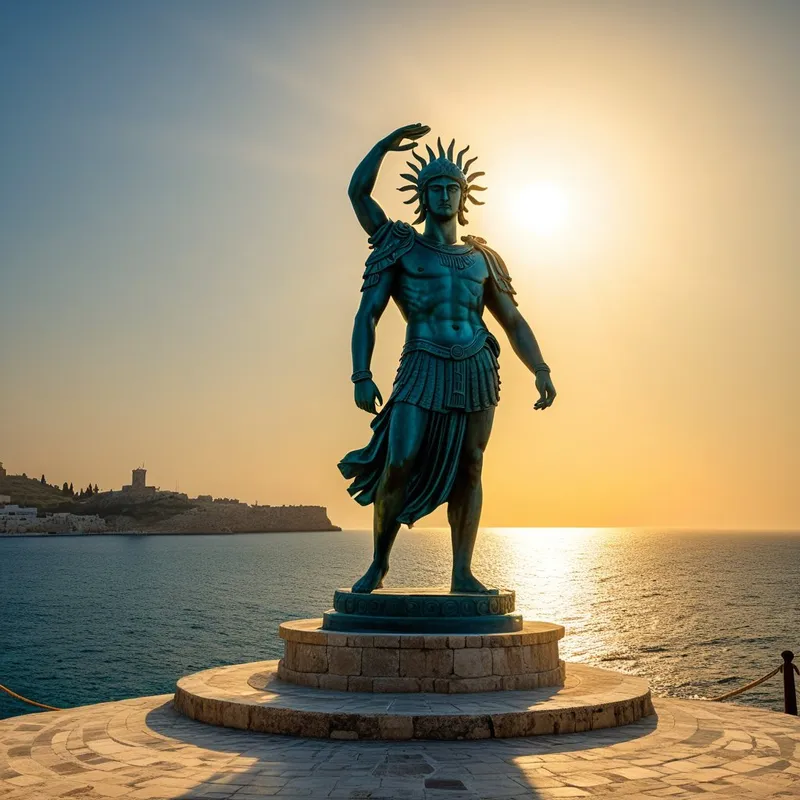
Finally, the day came. The head, crowned with radiating spikes of bronze, was lifted into place. The Colossus stood complete. He did not bestride the harbor as a bridge—that is a later fancy—but stood majestic upon a great pedestal at the harbor’s mouth, one hand raised to shade his eyes as he gazed eternally seaward, a guardian and a beacon. His bronze form caught the first and last light of his father, Helios, blazing like a second sun. For decades, he was the wonder of the world, the pride of Rhodes, a silent hymn in metal.
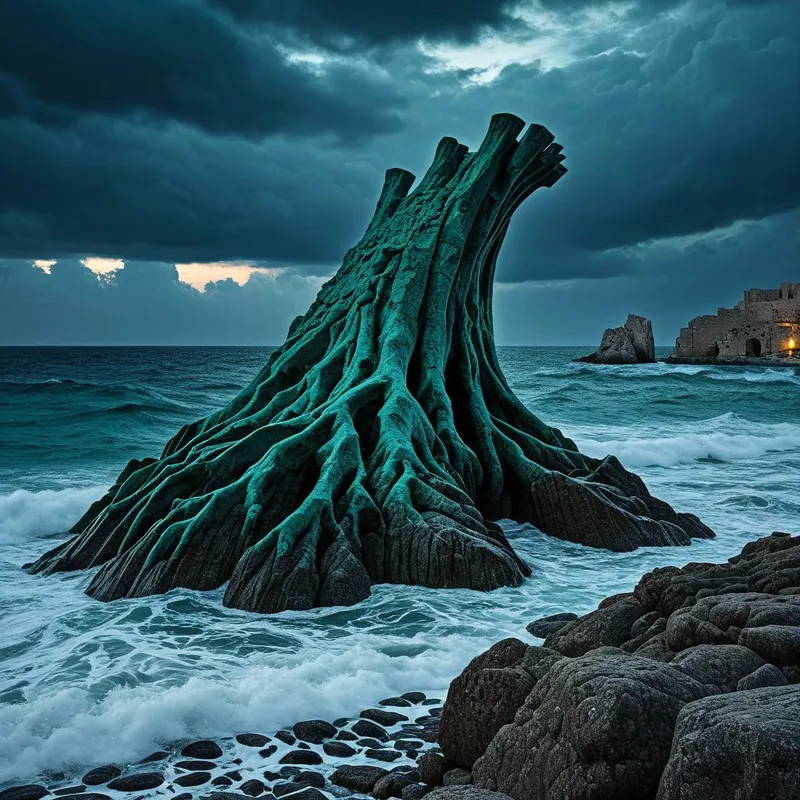
Then, the earth remembered its own strength. Fifty-six years after his completion, a great tremor shook the island. It was not an attack from men, but from the deep bones of the world. The Colossus groaned, a sound felt more than heard, and at the knees—the weakest point of any giant—he buckled. With a crash that echoed across centuries, the Sun God fell. The harbor waters churned as he met the earth, breaking into great fragments. The god was felled, not by man, but by the very element he rose from.
Cultural Origins & Context
The Colossus of Rhodes is a unique figure in the Greek world, straddling the line between history, engineering marvel, and emergent myth. Unlike the tales of Zeus or Athena, rooted in deep prehistory, the Colossus was a documented fact of the Hellenistic age, one of the original Seven Wonders. Its story was not sung by Homeric bards but recorded by historians like Strabo and Pliny the Elder.
Its societal function was multifaceted. Primarily, it was a tropaion on a colossal scale—a victory monument. But it was a victory monument of a peculiar kind, celebrating not aggressive conquest, but successful defense and divine favor. It transformed the material of a hated siege engine (the Helepolis) into a symbol of divine protection and civic pride, a profound act of psychological reclamation. The mythologizing process began almost immediately. Its immense scale, its connection to the sun god, and its dramatic fall invited narrative embellishment. The (likely incorrect) detail that it straddled the harbor entrance is a testament to this—the human imagination cannot help but amplify such a figure into a literal gateway between the human and the divine, the safe harbor and the open sea.
Symbolic Architecture
The Colossus is not merely a big statue; it is a complex symbol of human aspiration facing the limits of its own nature.
The greatest creations are born from the melted-down weapons of our past conflicts.
It represents the Creator archetype in its most ambitious, hubristic, and ultimately vulnerable form. It is the ego’s monumental project: to build something so enduring, so magnificent, that it defies mortality and obscurity. The bronze god is the idealized Self, constructed from the raw materials of our trials (the siege). It is the persona we wish to present to the world—invulnerable, radiant, divine in its authority and protection.
Yet, its fate reveals the core truth. It fell at the knees. In symbolism, the knees represent flexibility, humility, and the ability to bend. A rigid, monumental structure cannot withstand the tremors of the unconscious, represented by the earthquake. The Earth, the great mother Gaia, reclaims what attempts to defy her laws of impermanence.
The fall is not an end, but a transformation of the symbol from an object of awe to an oracle of ruin.
The “Colossus in Ruins” became an even more potent symbol than the standing figure. It spoke of the transience of power, the fragility of human achievement, and the sublime beauty of decay. For nearly a millennium, the fragments lay where they fell, a pilgrimage site for philosophers and travelers who came to ponder hubris and nemesis not in a story, but in tangible, weathered bronze.
The Dreamer's Resonance
When this colossus appears in the modern dreamscape, it signals a profound moment in the psyche. To dream of building or seeing such a monumental figure often coincides with periods of great personal achievement, grand ambition, or the inflation of the ego. The dreamer may be constructing a career, an identity, or a relationship that feels towering and significant.
To dream of the Colossus falling, however, is a critical message from the unconscious. It is the somatic experience of a foundational tremor—an anxiety, a failure, a betrayal, or a sudden insight that shakes the very supports of one’s self-concept. The dream may be accompanied by sensations of crumbling, the sound of tearing metal, or the slow-motion terror of collapse. This is not a prophecy of doom, but a necessary demolition. The psyche is indicating that a structure—a belief, a goal, a self-image—has become too rigid, too grandiose, and too isolated from the grounding earth of the body and the instincts. It must fall so that something more integrated can be imagined.
Alchemical Translation
The myth of the Colossus models the alchemical process of solve et coagula—dissolve and coagulate—applied to the psyche. The initial coagula is the twelve-year construction: the ego consciously gathers the materials of its experience (the bronze of past struggles) and labors to create a unified, magnificent, and conscious identity.
The earthquake is the inevitable solve. No conscious structure can remain forever. Life, in the form of trauma, change, or simply the slow pressure of time, introduces the tremor. The fall is the dissolution of this carefully constructed identity. This is the crisis of individuation, where the heroic, perfect self-image is shattered.
The true alchemy begins not in the forge, but in the field of fragments.
Here lies the final and most profound transmutation. The Rhodians did not clear the ruins. For centuries, the fragments remained, visited and wondered at. Psychologically, this is the stage of holding the tension of the opposites: holding both the memory of the magnificent creation and the reality of its ruin without rushing to rebuild or repress. It is in contemplating our own ruins—our failures, broken dreams, and shattered certainties—that we find their oracular value. The fallen Colossus was said to be so impressive in its ruin that people still traveled to see it. Similarly, our integrated Self is not a new, perfect statue, but a consciousness that has fully acknowledged and incorporated its own magnificent failures. The legacy is no longer the unattainable ideal, but the wisdom gained from its rise and its resonant, enduring fall. The whole cycle—ambition, creation, hubris, dissolution, and contemplative legacy—becomes the gold.
Associated Symbols
Explore related symbols from the CaleaDream lexicon: