Cockroach in Post-Apocalyptic Lore Myth Meaning & Symbolism
A myth of the last survivor, the Cockroach, who carries the memory of a fallen world and becomes the seed for a new, uncertain dawn.
The Tale of Cockroach in Post-Apocalyptic Lore
Listen. The great noise has ceased. The sky, once a tapestry of contrails and satellites, is now a silent, stained canvas of perpetual twilight. The air no longer hums with the song of billions, but whispers with the slow, patient breath of dust and decay. In this long, cold exhale of the world, there is a skittering.
It is not the first sound, but it is the only one that remembers.
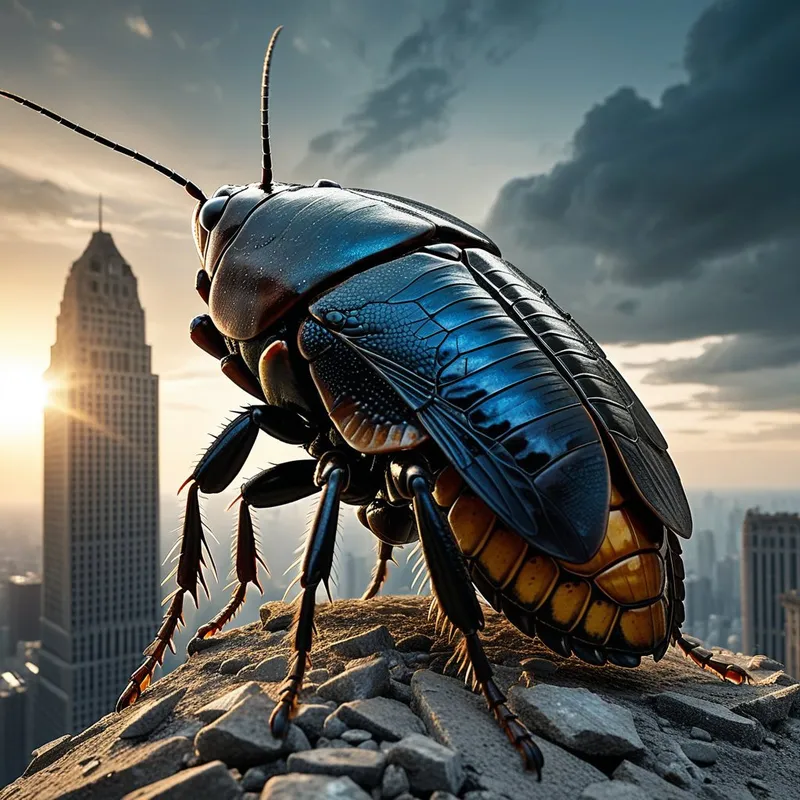
It is the sound of Cockroach. Not a swarm, but a singular entity, the final inheritor. Its shell is not the dull brown of pestilence, but a living archive, etched with the ghost-lights of fallen cities and the faint, echoing screams of forgotten traffic jams. It moves not with fear, but with a dreadful, solemn purpose.
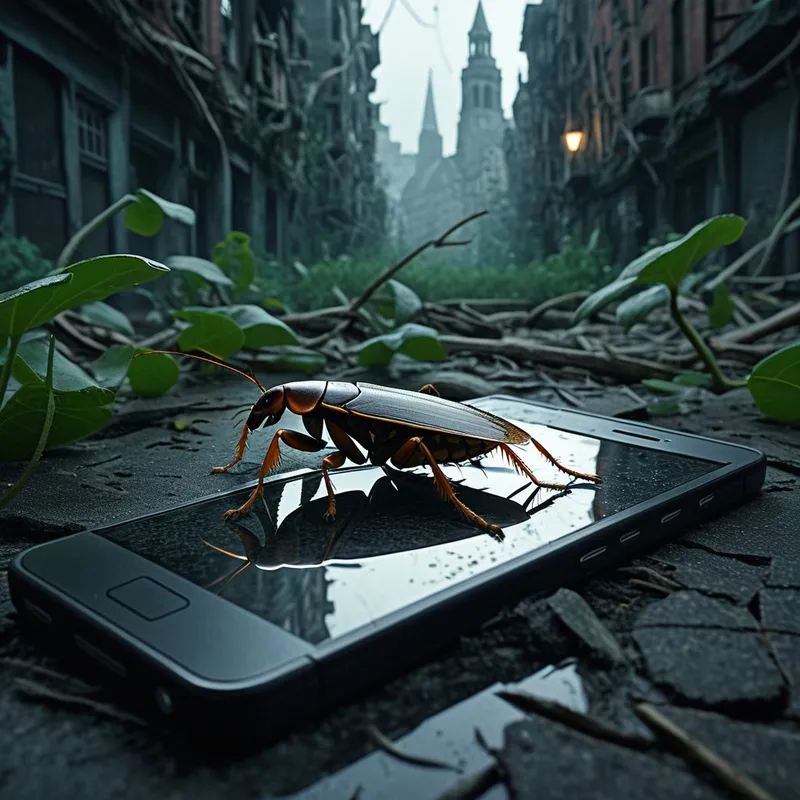
It remembers the taste of spilled soda on hot pavement, the vibration of subways deep in the earth’s belly, the warm glow of a billion screens in a billion darkened rooms. These memories are not thoughts; they are its substance, carried in every joint of its chitinous body. It climbs the skeletal remains of a place that was once called a “superstore.” Its antennae, fine as seismographs, tremble not to danger, but to the absence of the Great Hive. It finds a cracked plastic case. Inside, a flat, gray slab—a Dead Phone. Cockroach pauses, its head tilted. In the reflective black glass, it does not see itself. It sees the ghost of a face, mouth open in a final, silent laugh or scream. The memory is sharp, a shard of glass in its soul.
This is its pilgrimage: to touch the graves of the Soft-Bodied Ones. To bear witness so that the witness itself does not vanish. The conflict is not against predators, for they are all gone. The conflict is against the immense, crushing weight of The Quiet. To stop moving is to let the memories fade into the uniform gray of entropy. To forget the laugh is to let the laugh die a second death.
One day, it reaches the highest point it can find—a spire of twisted rebar and shattered concrete. The wind here is a clean, amnesiac force, trying to scour the archives from its shell. Cockroach digs its claws in. It turns its head, not to the dead city below, but to the sky. A single, thin crack of clean, gold light pierces the perpetual haze. Dawn. Not the dawn of a new day, but the first true dawn since the end.
In that light, something within its abdomen, a chamber sealed since time immemorial, softens. It is not an egg of flesh, but an egg of potential. A tiny, hard capsule containing not a child, but a question. A blueprint. A seed of “what-if.” With a final, shuddering effort, a act that is neither birth nor death but something in between, Cockroach releases the capsule. It falls, not down into the ruins, but is caught by the newborn wind, carried on the first clean breeze in centuries.
Cockroach does not watch it go. Its work is done. Its shell, now empty of the future, turns to stone, a fossil monument on the pinnacle. Below, the capsule settles in soft, wet earth where no earth has been soft for ages. It does not hatch. It simply dissolves, and its question seeps into the ground. The myth ends not with a roar, but with the silent, patient waiting of a seed in newly fertile soil.
Cultural Origins & Context
This is not a myth carved in stone or sung in epic verse. It is a Folklore of Anxiety, emerging in the late 20th and early 21st centuries from the global subconscious. Its primary storytellers were not bards, but filmmakers, novelists, comic book artists, and game designers. It was passed down not around campfires, but through screens, in blockbuster films, grim graphic novels, and immersive video games depicting worlds after collapse.
Its societal function is profound. In an era of existential threats—nuclear war, climate catastrophe, pandemic, AI—the myth serves as a paradoxical comfort. It answers the terrifying question, “What comes after us?” The Cockroach is our designated survivor, a biological and symbolic vessel for our memory. The myth allows us to project our fear of extinction onto a creature we’ve historically despised, thereby performing a psychological alchemy: transforming the reviled pest into a sacred scribe. It tells us that even in our utter failure, something of our story—our follies, our joys, our artifacts—might persist. It is a myth of humble continuity, born from a culture obsessed with both legacy and its own fragility.
Symbolic Architecture
The Cockroach is the ultimate Orphan archetype. It is utterly alone, stripped of all community, forced to rely on its own ingrained, primal resilience. Psychologically, it represents the part of the human psyche that must endure trauma, loss, and the collapse of one’s entire world—be it personal, professional, or ideological.
The Cockroach does not hope for a better past; it carries the past as the only compass for an uncharted future.
Its polished, memory-etched shell symbolizes the adaptive ego that forms in response to catastrophe. It is hardened, protective, and inscribed with the scars of experience. The Dead Phone and other ruins are symbols of the Personal Artifacts we encounter in our own psychic wastelands—old photos, abandoned hobbies, echoes of former selves. To touch them is not to live in them, but to acknowledge their reality and integrate their memory.
The central symbol is the Capsule. It is not a replica of the old world. It is a seed containing its essence—a compressed, latent potential for something new. This represents the crucial psychological insight: survival is not about clinging to the past, but about distilling its essential lessons into a form simple and tough enough to begin again.
The Dreamer's Resonance
When this myth surfaces in modern dreams, the dreamer is often in a state of profound transition or post-traumatic reckoning. To dream of being the Cockroach, navigating vast, empty landscapes of familiar places made alien, signals a somatic process of hardening and sensitization. The psyche is building a protective carapace while simultaneously becoming hyper-aware of the echoes of a life that has ended—a marriage, a career, a home.
Dreaming of finding and interacting with Dead Phones or other specific, charged relics indicates a phase of life review. The psyche is compulsively cataloging what was lost, not out of morbid fixation, but in a necessary process of gathering data for the future self. The skittering movement itself, often felt as anxiety upon waking, is the body-mind’s expression of the imperative to keep moving, to not succumb to the paralyzing Quiet of despair.
The release of the capsule in a dream can manifest as a sudden, inexplicable sense of relief after a long period of grief, or as a symbolic dream action like burying an object or sending a message. It marks the moment the unconscious recognizes that the work of bearing witness is complete, and the energy must now be transferred from memory to potential.

Alchemical Translation
The myth of the Cockroach is a stark map for the alchemical process of Individuation following a psychic apocalypse. The old personality, with its complexes, dependencies, and illusions (the Great Hive), must first collapse. This is the nigredo, the blackening, the descent into the ruins of the self.
The Cockroach’s pilgrimage is the albedo, the whitening. It is the painful, meticulous work of confronting these ruins—the abandoned ambitions, the failed relationships, the outmoded self-images. One does not rebuild the ruined city. One touches each stone, acknowledges its place in the old structure, and lets it go. This is the distillation of experience into pure memory, devoid of sentimental attachment.
The goal is not to survive as you were, but to transform what you were into fuel for what you must become.
The creation and release of the Capsule is the rubedo, the reddening. This is the culmination: the creation of a new, nascent psychic structure. It is not the fully-formed new self, but the irreducible core principle—a value, a truth, a talent—that has been proven resilient in the fire of collapse. Releasing it means surrendering the identity of the Orphan, the solitary witness. It means trusting that this hard-won essence will find its own ground and germinate in its own time, giving birth to a consciousness that remembers the apocalypse but is not defined by it. The self turns to stone, a monument to its own journey, while the true life, the potential, goes silently into the dark earth to begin.
Associated Symbols
Explore related symbols from the CaleaDream lexicon: