
Coat of Arms Myth Meaning & Symbolism
A myth of a hero forging a living emblem from ancestral memory and personal trial, becoming a vessel for lineage and destiny.
The Tale of Coat of Arms
Listen, and hear the tale not of a man, but of a becoming.
In the days when memory was etched in stone and blood, there lived a soul named Alaric the Unmarked. He walked the world without a sigil, a man whose lineage was a whisper lost in the wind. His shield was bare wood, his banner an empty field. In the great hall of the world, where others stood beneath the roaring lion, the stoic oak, or the soaring eagle, Alaric stood in silence, a question without an answer.
His journey began not with a quest, but with a haunting. In dreams, he walked a Grey Moor, where the mist clung like forgotten names. From the fog emerged figures—a woman with eyes like a hawk, her hands stained with earth; a man whose laugh echoed with the clash of swords; a child weaving reeds into impossible, beautiful knots. They spoke no words, but in their presence, Alaric felt a terrible longing, a pull toward a shape he could not see.
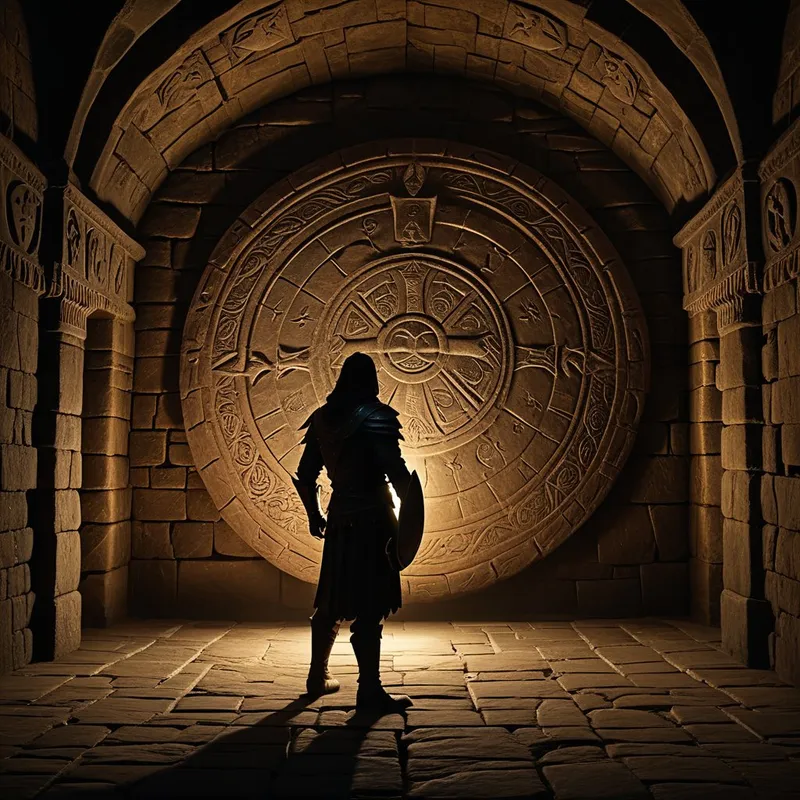
Guided by this spectral yearning, he sought the Chamber of Echoes, said to lie beneath the oldest standing stone. It was not a treasure vault, but a cavern of resonance. Here, the walls were not stone, but a substance like darkened mirror and deep water. As he entered, the whispers of the moor grew loud. The figures of his dream appeared in the walls, not as ghosts, but as essences. The hawk-eyed woman’s presence bled into the stone as a field of fertile green. The warrior’s echo rang out, leaving a streak of crimson like a sunset wound. The child’s clever fingers traced a silver thread that wove a complex, binding border.
But the chamber demanded more than witness; it demanded sacrifice. To give form to the echo, Alaric had to pour his own substance into the void. He pressed his bare hands against the cold wall. It was not enough to remember; he had to feel. He channeled the pride of the warrior—and felt the burn of old shame. He embraced the nurturing of the earth-tender—and knew the weight of her sorrows. He grasped the cleverness of the child—and touched the fragility of its innocence. His joys, his failures, his silent fears—all were drawn from him, not as story, but as raw color, texture, and line.
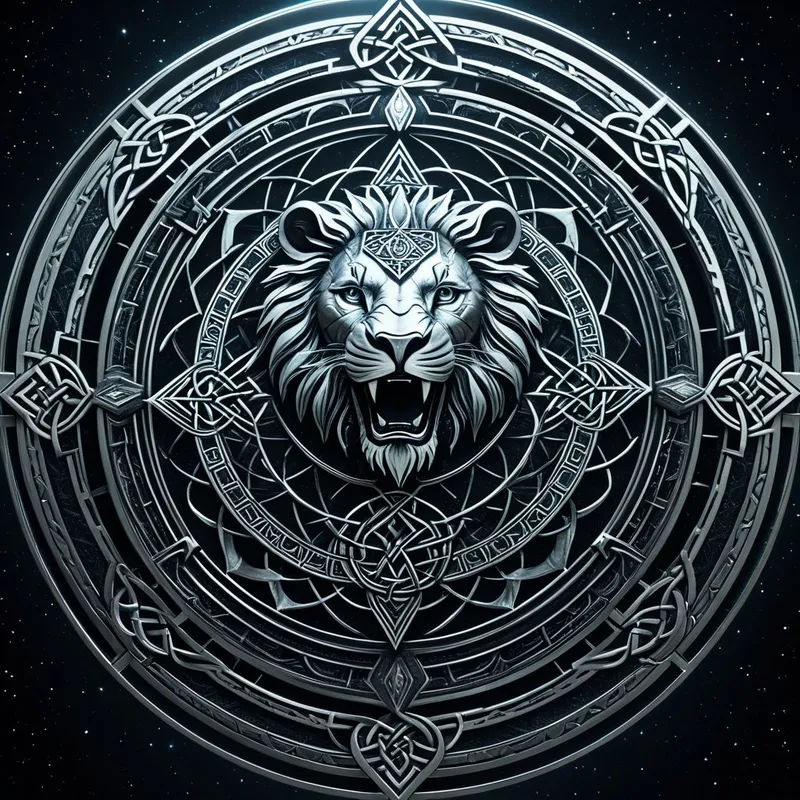
From this alchemy of inherited memory and personal trial, the wall began to move. The colors did not paint themselves, but birthed themselves. The green field sprouted a golden sheaf of wheat. The crimson band coalesced into a lion, rampant, forged from molten courage. The silver thread became a chain of roses, linking the elements. They were not mere images. The lion’s roar vibrated in his bones. The wheat smelled of harvest. The roses held the scent of both beauty and thorn.
With a final, resonant pull, the living emblem detached from the stone, not as a physical shield, but as a constellation of light and meaning. It floated toward Alaric and did not settle upon his arm, but into his very breast. He did not bear the Coat of Arms. He became it. He walked out of the chamber, and where he passed, people did not see a man named Alaric. They saw the story. They saw the lineage. They saw the question answered, the silence filled with a harmonious, roaring song of identity.
Cultural Origins & Context
This myth finds its roots not in a single text, but in the living practice of the Heraldic Tradition. It was the foundational story told by Heralds to young nobles and aspiring knights during the vigil before their dubbing or the granting of arms. It was not a history lesson, but an initiation narrative. Its function was ontological: to explain that a true coat of arms was not a decorative award, but a visible manifestation of a psychic and ancestral truth. The myth was passed down in the solemn, torch-lit atmosphere of armories and chapels, emphasizing that the right to symbols came with the duty to integrate their meaning. It served as a cultural bulwark against vanity, framing heraldry as a sacred contract between the individual, their ancestors, and the community that would recognize the blazon.
Symbolic Architecture
At its core, the myth maps the profound human struggle to synthesize inherited identity with individual consciousness. Alaric the Unmarked represents the modern, or perhaps eternal, condition of the ego adrift, lacking a coherent narrative of self.
The bare shield is the tabula rasa of the soul, a terrifying freedom that is also an emptiness demanding to be filled.
The Grey Moor is the personal and collective unconscious, where ancestral memories (the dream figures) reside as disconnected potentials. The Chamber of Echoes is the crucible of individuation—the interior space where these archetypal fragments are confronted and engaged. The critical action is not selection, but sacrificial engagement. Alaric does not choose pleasing symbols; he submits to the painful and joyous process of feeling the full weight of what he has inherited. The lion is not just courage, but the burden of aggression and leadership. The wheat is not just bounty, but the responsibility to nurture and the acceptance of cyclical death. The resulting Coat of Arms is the Self made visible—a unique, composite emblem where lineage and personal experience are forever fused.
The Dreamer's Resonance
When this myth stirs in the modern psyche, it often manifests in dreams of searching for a lost heirloom, standing naked before a judging crowd, or trying to read a book with fading ink. Somatic sensations may include a heavy pressure on the chest (the unborne shield) or a feeling of being invisibly watched by vague, familiar figures. Psychologically, this signals a critical phase in identity formation or reformation. The dreamer is at the threshold of the Chamber of Echoes. They are being called to inventory their own Grey Moor—to consciously engage with family patterns, cultural inheritances, and forgotten personal potentials that clamor for recognition. The anxiety in the dream is the fear of the sacrificial engagement required: to feel the full emotional truth of one's history, not just intellectually know it.
Alchemical Translation
The myth provides a precise model for the alchemical individuation process. Nigredo (the blackening) is Alaric's state as the Unmarked, the sense of void and meaningless. Albedo (the whitening) is the appearance of the dream figures, the separation of ancestral "colors" from the murk of the unconscious. The crucial stage is Citrinitas (the yellowing), represented by the Chamber itself.
Here, the lead of passive inheritance is subjected to the fire of personal experience—the sacrifice of the ego to the deeper truth of the lineage and the Self.
By pouring his own lived reality—his shame, joy, and fragility—into the ancestral patterns, he performs the true alchemy. The inherited archetypes are not merely repeated; they are transmuted by his unique life. The final stage, Rubedo (the reddening), is the birth of the living Coat of Arms—the creation of a new, sovereign identity that honors its source but is distinct from it. For the modern individual, this translates to the conscious work of creating a personal "mythology." It is the act of weaving one's family narrative, cultural background, personal traumas, and triumphs into a coherent, living emblem of self-understanding. One does not simply inherit an identity; one must, like Alaric, earn it through the courageous and feelingful engagement with all that one is and all that has come before.
Associated Symbols
Explore related symbols from the CaleaDream lexicon: