Clotho Myth Meaning & Symbolism
Clotho, the youngest Fate, spins the thread of every mortal life at its inception, embodying the irrevocable moment of beginning and the raw potential of destiny.
The Tale of Clotho
Before memory, before time was measured, there was the hum. It was not a sound of the world, but the sound behind the world, a vibration in the marrow of existence. In a chamber that was neither on Olympus nor within the earth, but in the liminal space where being becomes, three sisters tended to this hum. The air was thick with the scent of lamb’s wool, ozone, and something else—the metallic tang of potential.
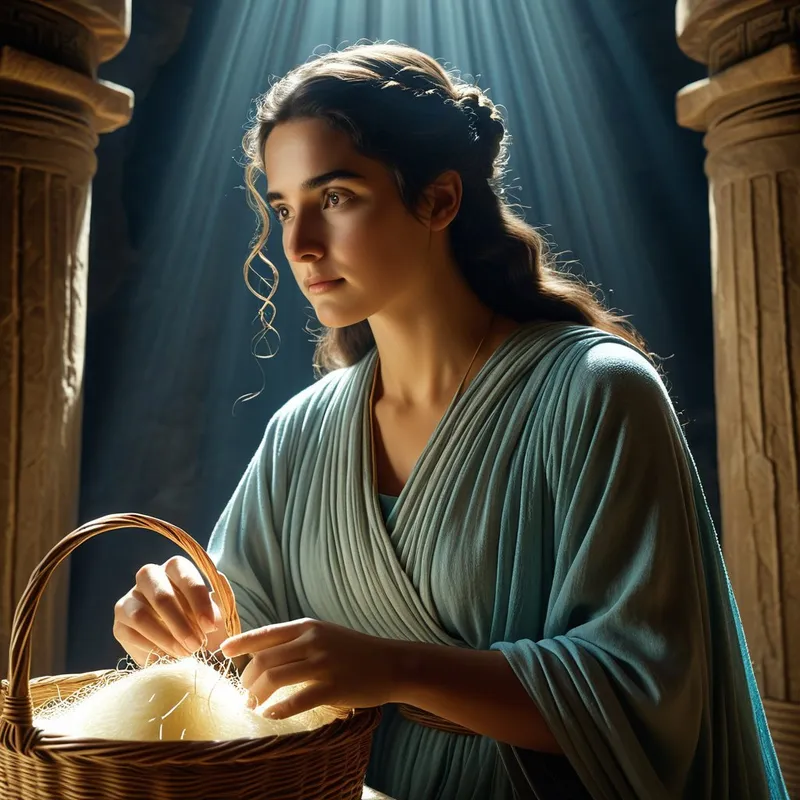
Here, in the silent loom-room of the cosmos, sat Clotho. She was the youngest, her face not yet etched with the stern finality of her sisters. Her fingers, pale and swift as doves, moved with a tender urgency. Before her rested a basket, not of woven reed, but of living shadow and raw, unshaped possibility. This was the Chaos from which all things are drawn.
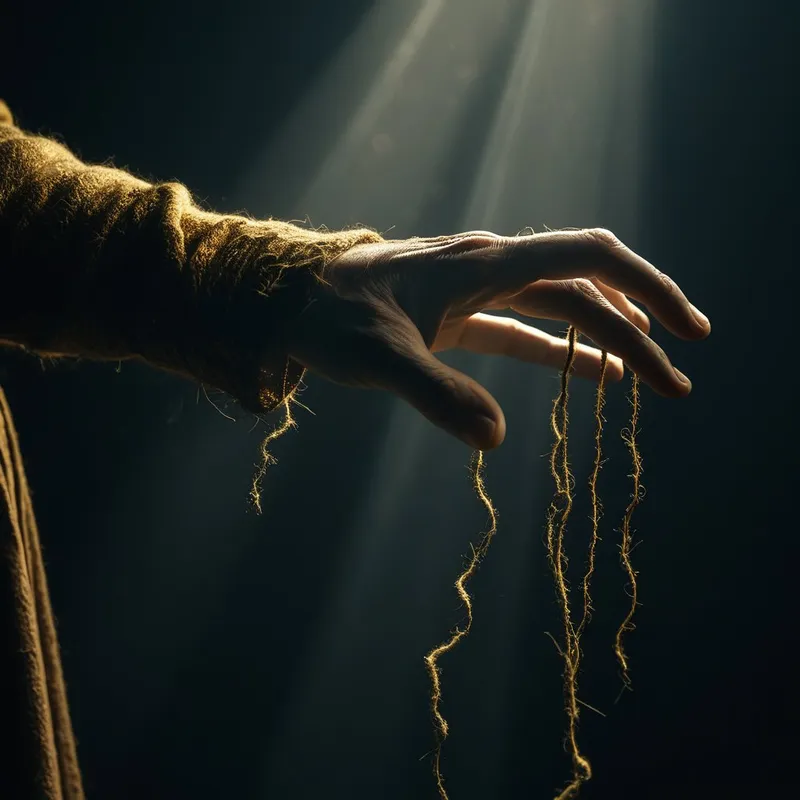
A sigh would pass through the chamber, a breath from the Gaia herself, or perhaps a plea from the unseen Pantheon. It was the signal. Clotho would reach into the basket. Her touch was not a selection, but a summoning. From the formless mass, a substance would cohere—gossamer at first, then gaining substance, color, texture. It might gleam like spun gold for a hero, or be coarse and grey for a shepherd; it could be strong as hemp or fragile as spider-silk. This was the moment of inception, the absolute, irrevocable beginning. With a twist of her wrist and the steady whirl of her spindle, the first twist was set into the fiber. The hum deepened, becoming the specific vibration of a single, nascent life.
She did not look at what she spun. Her eyes were fixed on the point where nothing became something, where the void yielded its first thread. Her task was pure, unadulterated creation. The thread, now singing with its own unique frequency, passed from her hands to her sister Lachesis, who would measure its length against the stars. But in Clotho’s hands, it had no length, only existence. It simply was. In that primal act of spinning, a universe of laughter and tears, of triumphs and despairs, was born. She set the twist, and the destiny, however long or short, however glorious or humble, began its inevitable unwind.
Cultural Origins & Context
The figure of Clotho, alongside her sisters Lachesis and Atropos, emerged from the deepest, most primal layer of Greek religious thought. They were the Moirai, and their authority was older and more fundamental than that of Zeus himself. Their myths were not the property of epic poets like Homer alone, but were woven into the fabric of everyday life, passed down through generations in household rituals, laments for the dead, and philosophical discourse.
Hesiod, in his Theogony, places them among the earliest divine beings, daughters of Nyx (Night), which underscores their elemental, unconscious nature. They were not worshipped in grand temples with festive games, but were acknowledged with a sober, fearful reverence. Their societal function was to provide a cosmic explanation for the most pressing human mysteries: Why is life the length it is? Why does fortune vary? Why must we die? Clotho, as the Spinner, answered the first and most profound question: Why are we here at all? Her action represented the inscrutable, impersonal cause of individual existence, a cause beyond even the gods' full control. To understand Clotho was to confront the awesome, neutral power of beginnings themselves.
Symbolic Architecture
Clotho is the archetypal moment of conception, not merely biological, but existential. She symbolizes the initial spark, the first cause, the point of no return from which all subsequent events flow. Her basket of raw wool is the unmanifest potential of the psyche, the infinite possibilities contained within the unconscious.
The spindle is the axis of a world, and the first twist in the thread is the birth of time for a soul.
Psychologically, Clotho represents the autonomous, creative impulse of the unconscious. We do not choose our fundamental nature, our core drives, or the raw material of our psyche; it is "spun" for us. She is the innate gift and the innate burden, the genetic code and the ancestral complex, the inexplicable talent and the inexplicable wound that appears at the very start of our story. She is not concerned with fairness, morality, or outcome—only with the act of bringing form from formlessness. In her, we see the profound truth that every life, regardless of its eventual measure or cut, begins as a act of pure, sacred creation.
The Dreamer's Resonance
When the pattern of Clotho appears in modern dreams, it often signals a profound somatic and psychological process of genesis. The dreamer may find themselves in a room with a spinning wheel, holding a spool of thread, or, most tellingly, searching for the beginning of a tangled skein. There is a somatic quality of tension, a feeling of something being "twisted into being" within the chest or gut.
This dream imagery arises when the psyche is at the precipice of a new phase of life—not just a new job or relationship, but the birth of a new self. It can accompany pregnancy, a creative breakthrough, the onset of a spiritual awakening, or even the emergence of a previously buried complex into consciousness. The dreamer is experiencing the primal, often unsettling, energy of a beginning that feels fated and beyond their control. The conflict is between the conscious ego, which wants to plan and choose, and the autonomous, spinning force of the unconscious, which is initiating a process according to its own deep logic. The dream is the psyche's way of saying, "A thread is being spun. Your task is not to question its color, but to acknowledge that the weaving of your life has entered a new, foundational chapter."

Alchemical Translation
The alchemical journey of individuation always begins at the prima materia—the base, chaotic matter. Clotho is the personification of this first, crucial operation: the Coniunctio of spirit and matter at the level of the individual soul. Her myth models the process of psychic transmutation by illustrating that true self-creation always feels like a fateful discovery, not a wilful invention.
The modern individual seeking wholeness must first confront their own "basket of raw wool"—the inherited traumas, innate potentials, cultural conditioning, and unconscious drives that form their unspun nature. The alchemical work is to sit, as Clotho does, with this chaos and engage in the sacred act of spinning. This means drawing forth the unique thread of one's own life from the mass of possibilities, accepting the fundamental "givenness" of one's core being.
To individuate is to take up the spindle of consciousness and, with reverence, begin to spin the raw material of the unconscious into the coherent thread of a lived life.
This is not a passive acceptance of predestination, but an active collaboration with fate. Lachesis (measurement) becomes our conscious choices and experiences that give length and shape to the thread; Atropos (the cut) becomes the necessary endings and sacrifices we make. But Clotho’s lesson is primary: before you can measure or cut, you must have a thread. The triumph is in recognizing and honoring the mysterious, creative source within that initiates your particular journey, embracing the awesome responsibility and beauty of having been, against all cosmic odds, spun into being at all. The process begins not with striving, but with attending to the first, faint hum of becoming.
Associated Symbols
Explore related symbols from the CaleaDream lexicon: