Cloch na Teine Myth Meaning & Symbolism
A myth of a sacred stone that holds the sun's fire, guarded by a goddess, requiring a hero's sacrifice to rekindle the world's light and warmth.
The Tale of Cloch na Teine
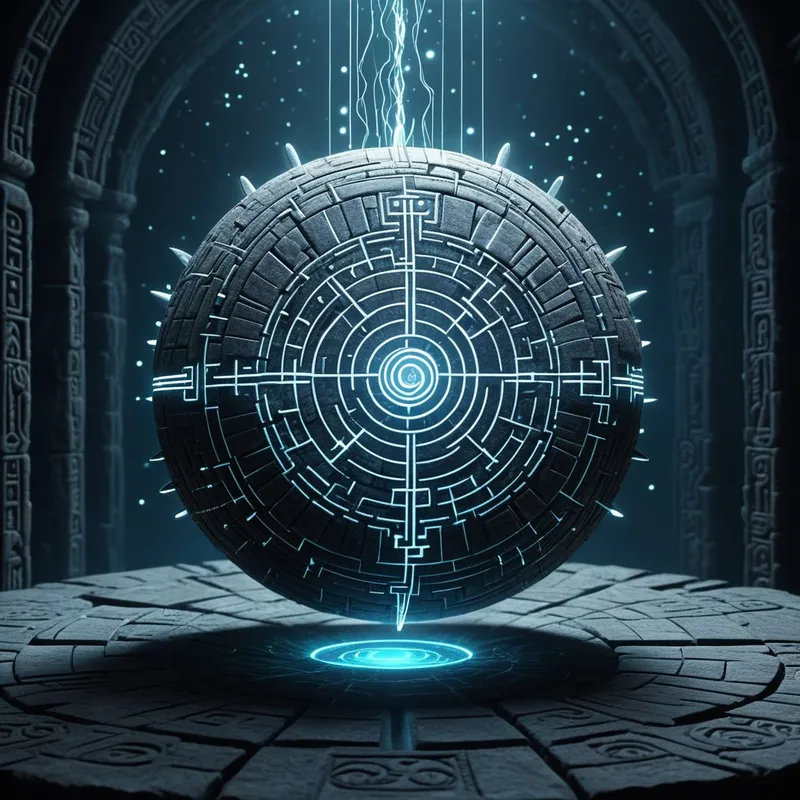
Listen. The world was younger then, and the veil between the green earth and the shimmering Tír na nÓg was thin as morning mist. In the deep heart of the forest, where the oldest oaks whispered secrets to the stones, there stood Cloch na Teine. It was not a stone of this world, but a vessel. Within its dark, unyielding heart, it held captive the very first spark of the sun, the primal fire that warmed the land and lit the soul of every living thing.
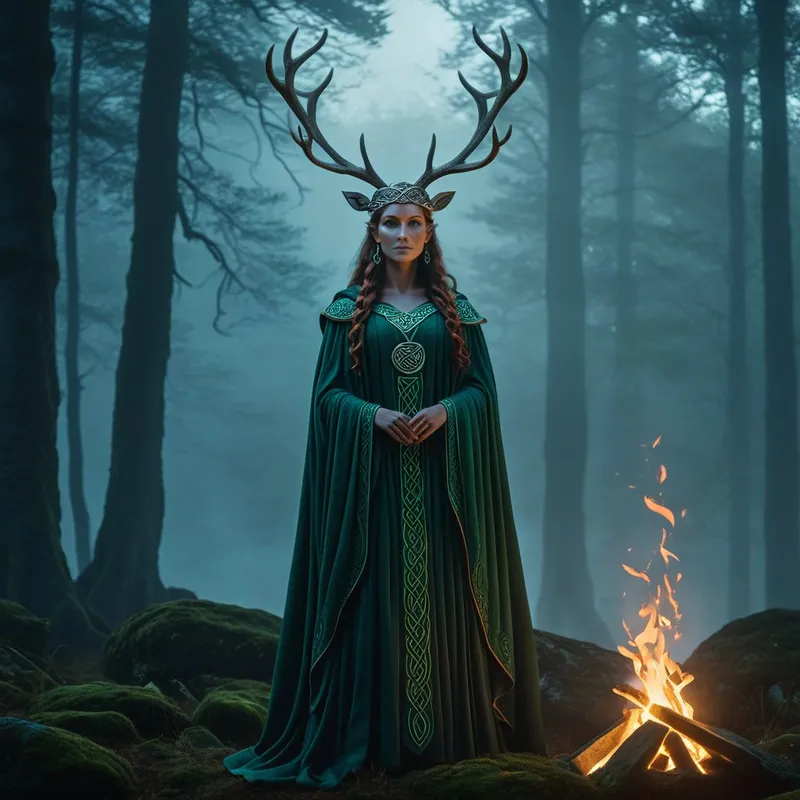
This stone was the ward of the goddess Flidais. She of the wild places, whose hair was the cascade of a waterfall and whose eyes held the stillness of forest pools. Her charge was eternal: to guard the stone, to ensure its fire never waned, for its dimming meant the creeping chill of a world without spirit, a land sliding into grey dormancy. For ages untold, the stone pulsed, a steady, warm heartbeat at the world’s core.
But balance is a fragile thread. A shadow grew, born not of evil, but of profound neglect—a forgetting. The people, in their bustling settlements, began to take the warmth for granted. They built their own fires from deadwood, forgetting the living source. They praised their own cleverness, forgetting the ancient covenant. With each forgotten prayer, each hubristic claim, the sacred flame within Cloch na Teine flickered. A coldness seeped from the stone, first a whisper, then a sigh. The harvests grew thin. The songs lost their joy. The very light of day seemed pallid, drained of its gold.
Flidais felt the weakening pulse. Her calls to the people went unheard, drowned by the noise of their own making. The stone was dying, and with it, the soul of the land. Yet, the law of the Aos Sí was clear: she could guard, but she could not rekindle. That power belonged to mortal hands—a hand that understood not just taking, but giving. A hand that could make a sacrifice of the self.
From the dwindling tribes came a man named Dubhán. He was not the strongest king nor the most cunning bard. He was a man who felt the world’s ache in his own bones, who heard the land’s lament in the wind. Guided by dreams of a fading light, he journeyed past the boundaries of the known, through forests that grew silent and cold, to the hidden clearing.
There he found Flidais, her form shimmering with a grief as deep as the earth. Before her, Cloch na Teine stood, a dark, inert monolith, radiating a void that sucked the warmth from the air. “The fire sleeps,” she said, her voice the rustle of dead leaves. “It can only be awakened by a fire greater than its own slumber. It demands a spark from the forge of a human spirit. To touch it now is to offer your own inner flame. Many have come; all have found only cold ash and a heart turned to stone.”
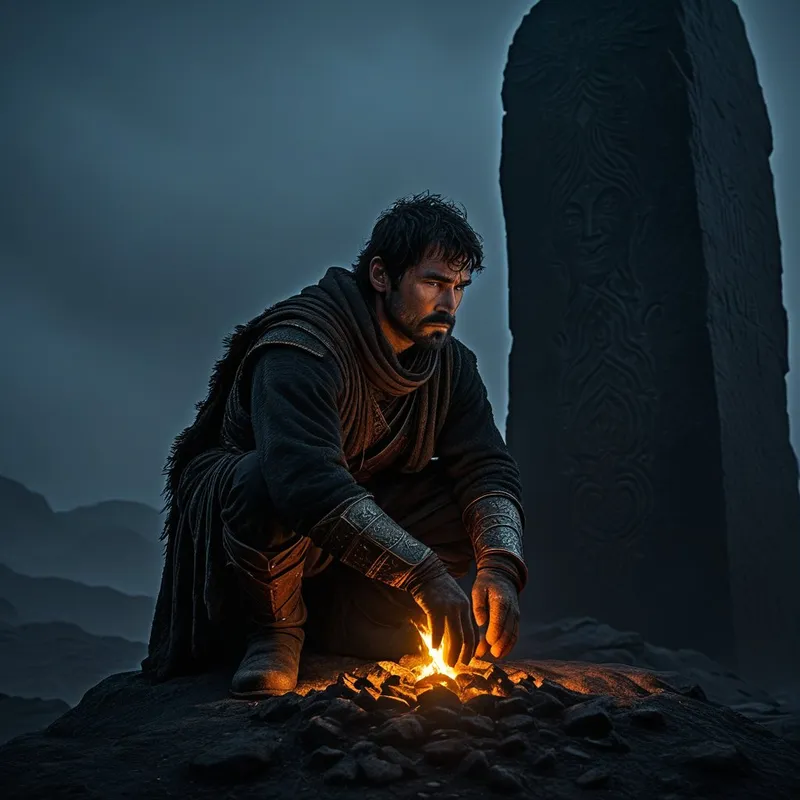
Dubhán did not speak. He looked at the dead stone, then at his own hands—hands that had built, held, fought, and comforted. He understood. This was not a battle to be won, but a gift to be given. A transaction of essence. He stepped forward, ignoring the paralyzing cold that emanated from the rock. He placed his palms flat against the rough, icy surface.
Agony. It was not the burn of flame, but the searing cold of absolute emptiness, drawing the very life-force from his veins. His memories, his loves, his fears, his warmth—all began to stream from his heart, through his arms, into the void of the stone. He felt himself emptying, becoming a shell. Just as the last flicker of his own consciousness was about to be extinguished, a resistance formed. Not from him, but from the stone. His sacrifice, complete and willing, had become the kindling.
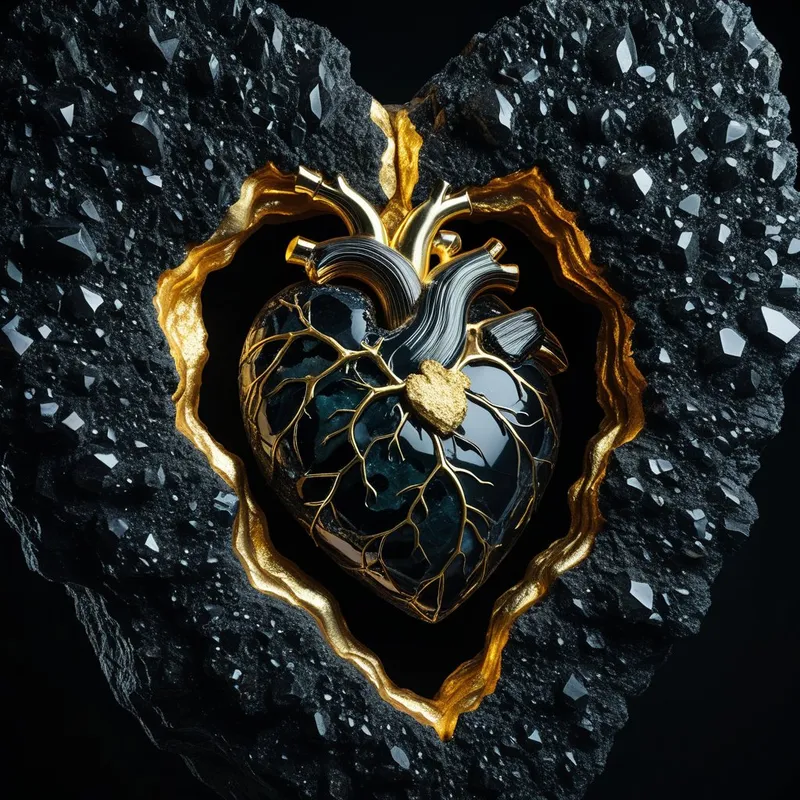
A single, tiny ember glowed deep within the blackness. Then another. A network of fiery lines spread like waking veins. The cold reversed, not into heat, but into pure, radiant presence. The stone awoke. Light, golden and profound, erupted from its core, flooding the clearing, shooting through the bare branches to the sky. The world inhaled.
Dubhán fell back, alive, but forever changed. His hands bore no scar, but his eyes now held the quiet, enduring glow of the stone itself. Flidais bowed her head, a gesture of deep respect from a goddess to a true sovereign. The warmth returned to the land, not as a taken right, but as a remembered gift, sealed by a mortal’s ultimate offering.
Cultural Origins & Context
The fragments of this myth, like so much of the rich Celtic narrative tapestry, survive in the liminal spaces of folklore, recorded by later scribes often filtered through a Christian lens. It belongs not to a single text, but to a constellation of motifs found across Ireland and Scotland concerning sacred stones, sovereignty, and the custodian role of the goddess of the land. The figure of Flidais, a complex deity of wild beasts, forestry, and territorial sovereignty, provides the mythic anchor. Her role as guardian, not owner, of a primal power source reflects a core Celtic worldview: the divine interfaces with the mortal realm, but ultimate responsibility—and power—rests with human action and integrity.
These tales were the province of the fili, the poet-seers. They were not mere entertainment but functional cosmology, told to affirm the sacred contract between the people, the land (talamh), and the sí. The myth of Cloch na Teine served as a societal and spiritual regulator. It explained the cycles of fertility and blight not as arbitrary punishment, but as a direct consequence of communal psychic and ritual health. It defined true kingship (or heroic virtue) not as martial conquest, but as the willingness to undergo a symbolic death for the life of the tribe.
Symbolic Architecture
At its core, Cloch na Teine is an image of the Self in its latent, dormant state. It is the innate, divine spark within, the source of our vitality, creativity, and authentic being. The goddess Flidais represents the anima or the soul of the world itself—the psychic function that connects us to this inner treasure and warns us of its neglect.
The fire is never stolen; it is only ever exchanged. To receive light, one must first become a vessel for the darkness.
The creeping cold symbolizes the life of identification with the persona—the socially constructed self. When we live only on the surface, taking warmth from external validation and material comfort while ignoring the inner sacred source, the soul grows cold. Dubhán’s journey is the ego’s painful turn inward, toward the neglected Self. His sacrifice is the critical dissolution of the ego’s claim to autonomy.
The act of placing his hands on the stone is the ultimate act of psychological surrender—offering the contents of the conscious personality (his memories, his identity) as fuel to reanimate the greater, transpersonal psyche. He does not fight the stone; he marries its condition with his own life-force.
The Dreamer's Resonance
When this myth stirs in the modern dreamer, it often manifests as a profound somatic experience. One may dream of a cold, dead hearth at the center of a familiar house; of a prized gem or crystal that has turned opaque and icy to the touch; or of a vital machine or engine that has seized, refusing to start despite all efforts.
The psychological process at work is an encounter with the nigredo—the blackening, the depressive, enervating feeling that one’s inner resources are exhausted, that the “fire” has gone out of one’s life. This is not clinical depression alone, but a symbolic one: a calling from the Self to cease the outward striving that has led to depletion. The dream is a diagnosis from the depths, indicating that the psyche’s energy has been withdrawn from the external world and is concentrating at the core, preparing for a death-and-rebirth sequence. The chilling sensation in the dream is the felt experience of this withdrawal, a necessary prelude to rekindling.
Alchemical Translation
The myth of Cloch na Teine is a perfect allegory for the alchemical opus, the journey of individuation. The cold, dark stone is the prima materia—the leaden, hopeless state that is the starting point of all transformation.
The hero is not the one who conquers the dragon, but the one who recognizes the dragon is the guardian of the gold, and that the price of the gold is a piece of the conqueror’s own flesh.
Dubhán’s journey is the nekyia, the descent. His sacrifice at the stone is the central alchemical operation of solutio et coagulatio. His conscious ego (the solve) is dissolved, offered up. This dissolution is not annihilation, but a freeing of essential energy from its identification with personal history. This energy then becomes the seed for the coagulatio—the re-formation of the personality around the awakened Self, symbolized by the rekindled stone.
For the modern individual, this translates to those moments of crisis where our old ways of being, our achieved identities, suddenly feel dead and meaningless. The myth instructs us not to frantically seek a new external fire, but to have the courage to touch the cold, dead place within. It is the act of fully feeling our despair, our ennui, our creative barrenness—and offering that very feeling, that experience of emptiness, as the sacred fuel. The rekindling is the emergence of a new orientation to life, no longer driven by the hungry ego, but warmed and illuminated from a deep, inner center that feels both profoundly personal and eternally connected to something greater. We become, like Dubhán, a vessel for the fire, not its owner—sovereign over our lives because we are in service to the soul.
Associated Symbols
Explore related symbols from the CaleaDream lexicon: