Cloak of Freyja Myth Meaning & Symbolism
A myth of the goddess Freyja, whose cloak of falcon feathers grants flight, weaving themes of sovereignty, desire, and the shapeshifting nature of the soul.
The Tale of Cloak of Freyja
Hear now a tale not of thunder, but of longing. In the high halls of Vanir, where the air smells of wet earth and blooming things, dwells Freyja. She is Lady of the Einherjar, Mistress of Seiðr, and her tears are red gold. Her heart is a vast country, and it knows a hunger that the feasts of Fólkvangr cannot sate. It is a hunger for what is lost, for what lies beyond the next mountain, the next star.
This hunger found its shape in a treasure beyond price: the Brísingamen, a necklace of such blazing beauty it seemed to hold the fire of the sun itself. To possess it was a desire that burned. And so Freyja journeyed, not across land, but into the hidden, smoldering realms. She came to the hall of four dvergr, beings of earth and forge, whose hands could coax wonders from the dark. They had wrought the necklace. Their price was not gold.
For four nights, Freyja entered that hall of soot and shimmering heat. Each night, she lay with a different dvergr. The air was thick with the scent of metal and musk. There was no violence, only a profound, unsettling transaction—a goddess trading the sovereignty of her body for the sovereignty of an object of ultimate desire. When she emerged, the Brísingamen lay cold and glorious against her skin, a captured star. But the whispers followed her. Odin Allfather, he who trades his eye for wisdom, heard them. His one eye saw not just the necklace, but the debt, the vulnerability.
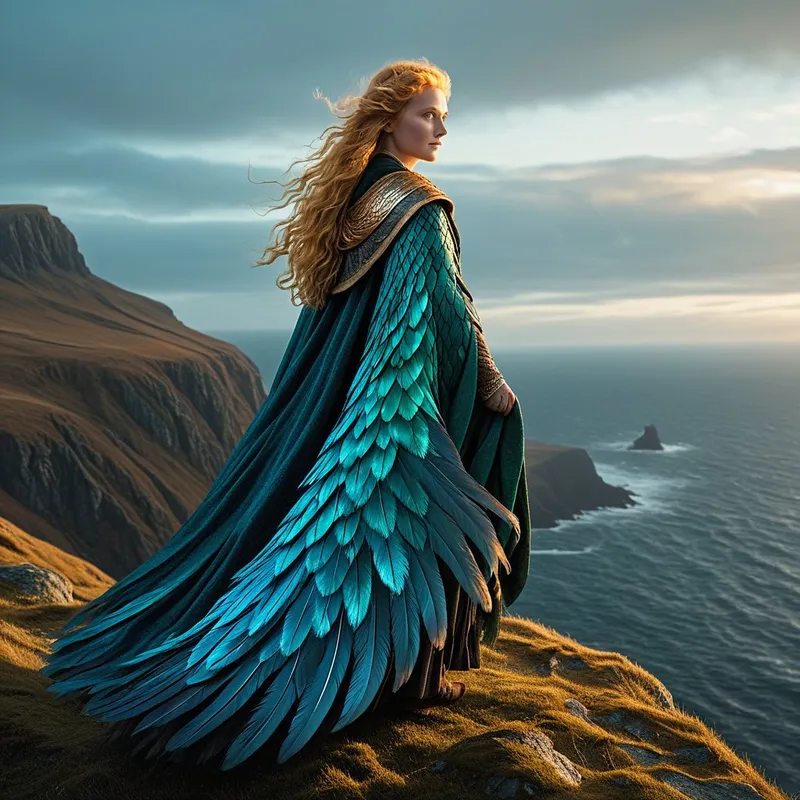
And here the cloak enters, her other great treasure. Not won through bargain, but born with her, an extension of her Vanir soul. It is a cloak of falcon feathers, each one a perfect blade of brown and grey, stitched with spells older than Asgard. When the weight of the world—the whispers, the longing, the confines of her own halls—becomes too much, she calls for it. Her handmaidens bring it, and it is not heavy, but alive with a rustling, avian energy.
She swings it over her shoulders. The world shifts. The stone floor falls away, the ceiling opens to sky. Her bones hollow, her sight sharpens to a needle-point that can see a mouse twitch from a league away. The goddess is gone. In her place is a falcon, a fierce, feathered bolt of purpose. With a cry that is both triumph and relief, she beats her wings—her wings—and rises. The nine worlds sprawl beneath her, not as kingdoms to rule, but as a tapestry to read, a mystery to traverse. She flies to find what is lost, to see what is hidden, to simply be, for a time, nothing but motion and sky. The cloak is her escape, her power, her other self. It is the answer to the price paid in the dark. It is freedom, feathered and absolute.
Cultural Origins & Context
The tales of Freyja and her cloak are fragments preserved primarily in the Poetic Edda and later, with more narrative flair, in the Prose Edda of Snorri Sturluson. These were not holy texts, but literary compilations from an already fading oral tradition. The myths were living stories, told in longhouses by firelight, serving as cosmology, moral framework, and deep entertainment.
Freyja, as a Vanir goddess, represents a potent, pre-Indo-European layer of Norse belief centered on fertility, magic, and a sovereignty that is fiercely personal. Her cloak is a key attribute in this context. In a culture where travel was perilous and the world was vast and ringed by unknown forces, the ability to traverse it instantly, to gain a bird’s-eye view, was a divine power par excellence. It connected her to the shamanic undercurrents of Seiðr, where practitioners (often women) would enter trance states to journey and see. Freyja, who taught this magic to the Æsir, embodies it physically through her cloak. The myth thus functioned to validate and mystify the very real practices of seers and witches, while also exploring the nature of a goddess whose domain encompassed love, war, death, and ecstatic flight.
Symbolic Architecture
The Cloak of Freyja is not a mere magical tool; it is a profound symbol of the autonomous, shapeshifting Self. It represents the capacity for radical perspective-shifting and the liberation from fixed identity.
The cloak is the psyche’s ability to become what it needs to be to see what must be seen.
The falcon, in Norse and many other symbologies, is the keen observer, the messenger, the creature that bridges heaven and earth. To don the falcon-skin is to activate the transcendent function—to rise above the entangled, ground-level conflicts of life (the politics of Asgard, the debt of the necklace) and gain clarity. It is the moment of “stepping back” from one’s own drama. Furthermore, the cloak exists in dynamic tension with the Brísingamen. The necklace is desire made manifest, beautiful but binding, acquired through a complex, compromising exchange. The cloak is innate potential, a birthright of the soul, used for exploration and return. One ties her to the world of transaction and object; the other frees her into the realm of spirit and subject.
The Dreamer’s Resonance
When this myth stirs in the modern unconscious, it may surface in dreams of sudden, effortless flight—not as a superhero, but as a bird. It may appear as finding a forgotten, extraordinary garment in a closet, or feeling feathers erupt from one’s shoulders. These are somatic signals of a psyche straining toward a higher vantage point.
The dreamer experiencing this pattern is likely feeling trapped—by a “deal they made” (a job, a relationship, a life path that feels purchased at a cost to their integrity) or by the sheer weight of a fixed role (caregiver, professional, responsible one). The flight dream is not an escape from reality, but an escape into a broader reality. It is the soul’s insistence that there is another way to see, another shape to take. The somatic process is one of expansion, of lightening, of trading the heavy density of a problem for the fluid intelligence of perspective. There may also be anxiety: the fear of falling, of not being able to control the flight. This mirrors the risk of transcendence—the fear of losing one’s familiar self in the process.
Alchemical Translation
The alchemical journey modeled here is the transmutation of compromise into sovereignty. The base material is the “deal with the dwarves”—the parts of ourselves we have bartered away for glittering prizes: security, approval, success. This creates the nigredo, the darkening, the feeling of being owned by our own choices.
The crucible is the moment of putting on the cloak. It is the conscious, willful act of engaging one’s innate transformative capacity.
The albedo, the whitening, is the flight itself—the ascension to a viewpoint where the old deal is seen in its full context, not as a damning failure, but as one thread in a larger tapestry. From this height, the dreamer does not deny the necklace (the choice, the consequence), but is no longer defined by it. The rubedo, the reddening or completion, is the return. Freyja always returns. The integration is not about staying a falcon, but about bringing the falcon’s sight back into the goddess’s body. The modern individual completes this cycle when they can stand grounded in their life, yet access that detached, clear, soaring perspective at will. They become both the one who makes deals in the world and the one who can fly above it to assess the cost. They hold both the binding beauty of their desires and the liberating power of their own transformative spirit. In this, they achieve a measure of the divine sovereignty that Freyja herself embodies.
Associated Symbols
Explore related symbols from the CaleaDream lexicon: