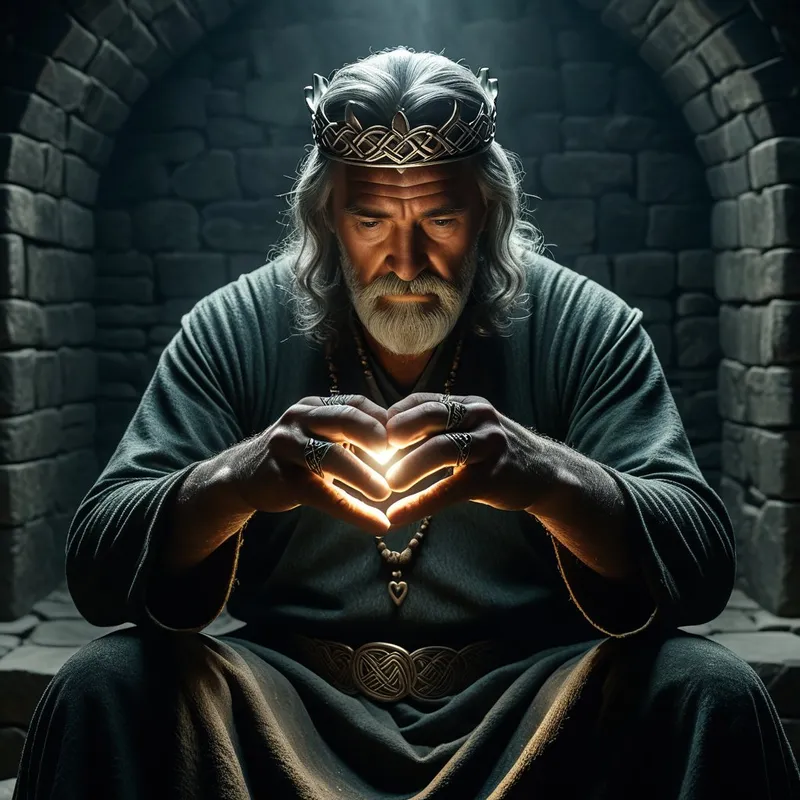
Claddagh Ring Myth Meaning & Symbolism
A tale of a captive goldsmith who forges a ring of heart, hands, and crown, embodying the soul's journey through love, loyalty, and self-rule.
The Tale of Claddagh Ring
Listen, and let the peat-smoke carry you across the grey sea, to the stony shores of Claddagh. The wind here sings of salt and sorrow, of nets cast and hopes hauled from the deep. But our tale begins not on the water, but far from it, in a land of burning sun and cruel sands.
There was a man of the Gaels, a master of the forge. His name was Richard Joyce, and his hands could persuade silver and gold to sing. His heart, however, was pledged to a maiden with hair like autumn bracken and eyes the grey of a Galway sky. Their love was a steady flame, a promise whispered against the crash of the Atlantic. But fate is a capricious tide. On a voyage to seek his fortune, his ship was set upon by Algerine corsairs. The sea, once his road, became his prison. He was dragged in chains to a sultan’s court, a captive soul in a gilded cage.
The years stretched like desert horizons. The sun bleached his memories, and the alien tongue scraped at his ears. Yet, in the silence of his cell, the memory of his love did not fade; it crystallized. It became a forge-fire within his own breast. Using scraps of metal, pilfered tools, and the fierce patience of a breaking heart, he began to work. He was not merely a prisoner; he was an alchemist of absence.
He fashioned a band. Upon it, he placed two hands—not in prayer, but in offering. They cradled a heart, not whole, but crowned. This was no simple trinket. Every hammer stroke was a vow. The hands were his hands, remembered and promised. The heart was their heart, beating across the miles. The crown was the sovereignty of their bond, a kingdom that no sultan could ever conquer. He poured fourteen years of longing, loyalty, and unbroken will into this circle of metal.
Then, the tide turned. With the intervention of a king, the prison doors groaned open. Richard Joyce walked out, a free man, the ring clutched tight. He returned across the sea, the salt spray now tasting of homecoming. Did he find his love? The bards say he returned to find her waiting, her own faith as steadfast as the stone walls of Lynch's Castle. And when he placed the ring upon her finger, it was not a man reclaiming a possession, but a soul completing a circuit begun in darkness. The circle was closed. The hands held fast. The heart was home. The crown was theirs.
Cultural Origins & Context
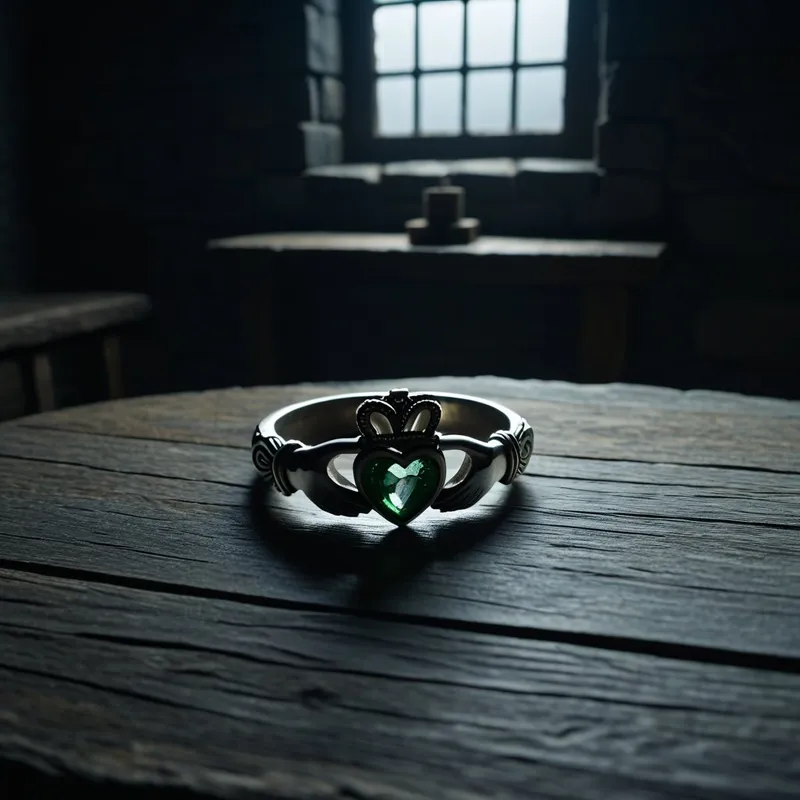
The tale of the Claddagh ring is a folk memory, a story that breathes life into an object. Its historical roots are in the 17th century, post-medieval Ireland, a time of hardship, emigration, and fierce communal loyalty. The village of Claddagh itself was a tight-knit fishing community with its own king and laws, a world unto itself on the edge of Galway. This context is crucial: the myth emerges not from royal courts, but from the world of sailors, fishermen, and craftsmen—people intimately acquainted with separation, risk, and the fragile bonds that tether one to home.
The story was passed down not in illuminated manuscripts, but across hearths and in taverns. It functioned as a charter myth for the ring itself, transforming jewelry into a vessel for profound cultural values. In a society where young men often left for sea or for work in foreign lands (a pattern tragically amplified during the Great Famine), the ring became a tangible pledge. It was a physical anchor for emotional bonds that had to withstand immense distance and uncertainty. The myth gave people a language for fidelity that was active, creative, and resilient—a loyalty forged, quite literally, in the fires of adversity.
Symbolic Architecture
The power of the Claddagh myth lies in its stunningly concise symbolic architecture. Each element is a profound psychological glyph.
The ring is not an ornament, but a map of the soul in relation to another.
The hands symbolize friendship, trust, and the active, willful choice to hold and be held. They are not passive; they are agents of connection. Psychologically, they represent the ego’s capacity to reach out, to make and keep promises, to build bridges across the inner and outer worlds.
The heart, centrally placed, is the seat of love, of course, but in the Celtic worldview, the heart was also the center of courage and memory. It is the emotional core, the vulnerable, feeling self that must be both protected and offered.
The crown is the master symbol. It represents loyalty, yes, but a loyalty that elevates. It is the rule of law over the relationship, the dignity and sovereignty granted to both the self and the other. It signifies that true bonding is not a diminishment, but an ennoblement. The crown sits upon the heart, suggesting that the highest authority in this union is love itself.
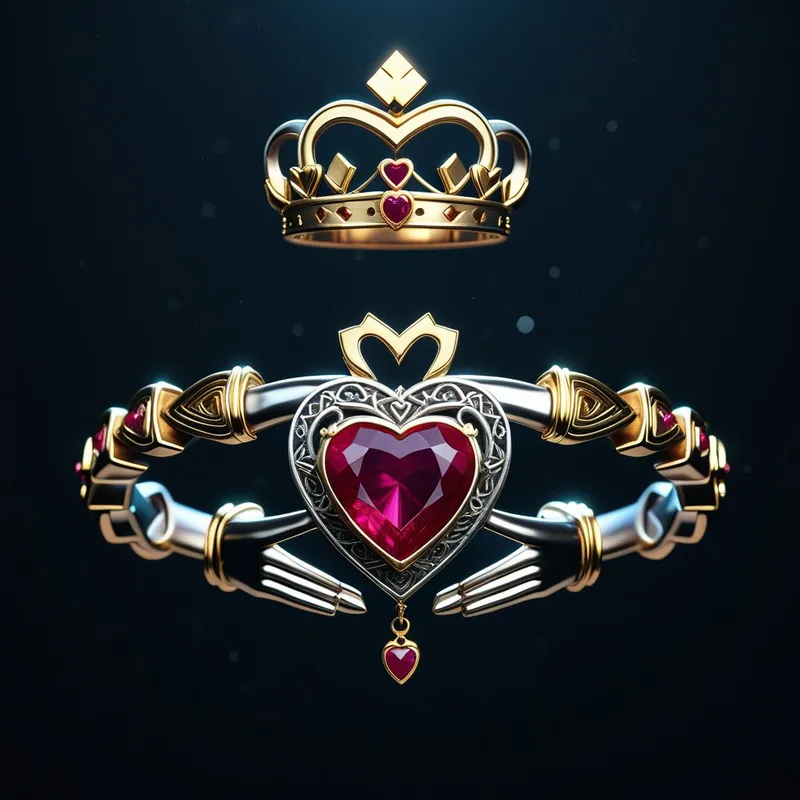
Together, this triad forms a complete system: the hands (action/ego), the heart (feeling/affect), and the crown (spirit/sovereignty). The myth narrates the process of integrating these parts when they are most threatened—when the self is in captivity.
The Dreamer's Resonance
When the imagery of the Claddagh ring surfaces in modern dreams, it rarely appears as mere jewelry. It manifests as a process, a somatic puzzle the psyche is working to solve.
A dreamer might find themselves in a sterile, featureless room, trying to assemble the ring from separate, scattered parts—the hands are cold metal, the heart is a raw, beating thing, the crown is too heavy. This dream speaks to a feeling of emotional disconnection or a relationship where the components of trust (hands), love (heart), and mutual respect (crown) are not integrated. The dream-ego is tasked with the alchemical work of joining them.
Alternatively, one might dream of wearing the ring, but it is impossibly tight, constricting, or made of a material like thorny vines or burning ice. This points to a bond that feels imprisoning rather than freeing—a relationship where loyalty has become obligation, love has turned to possession, and the crown of sovereignty has been surrendered. The dream highlights the shadow side of the myth: bonding that captivates rather than liberates.
The most potent Claddagh dream is one of forging the ring. The dreamer is at a forge, hammering the symbol into being amidst great personal struggle. This is the psyche actively engaged in the "Richard Joyce" process: creating a container for love and loyalty out of the raw materials of one's own life experiences, perhaps while feeling emotionally or circumstantially "captive."

Alchemical Translation
The myth of the Claddagh ring is a perfect model for the alchemical process of psychic individuation, particularly the stage of coniunctio—the sacred marriage.
Individuation is the captive goldsmith within, forging the ring of the Self from the base metals of experience.
First, there is Captivity (Separation): The hero is ripped from his familiar world. Psychologically, this is the necessary alienation from the comfortable persona, the plunge into the unconscious or into a life crisis that feels like an imprisonment. It is the dark night of the soul, the nigredo.
Then, the Inner Forge (Transformation): In the cell, the work begins. This is the opus, the inner work. The memory of the beloved (the Anima/Animus, the image of wholeness) provides the heat. The ego (the goldsmith) uses the tools of reflection, patience, and will to shape a new symbolic reality. He does not just wait; he creates. This is the albedo, the whitening, where meaning is distilled from suffering.
The Forging of the Symbol (Integration): The ring itself is the lapis philosophorum, the philosopher's stone for the modern soul. It represents the synthesis of opposites: love and will (heart and hands), humanity and divinity (heart and crown), connection and autonomy (hands and crown). It is a mandala of the integrated personality.
Finally, Return and Completion (Wholeness): The return to the beloved is not a regression to a previous state. It is the conscious integration of the transformed self back into relationship. The ring is offered, completing the circuit. The crown signifies that this wholeness is now under the rule of the Self, sovereign and complete. This is the rubedo, the reddening, the achievement of a living, embodied wholeness that can love, hold, and rule its own kingdom.
Thus, the Claddagh myth teaches that our deepest bonds and our truest selves are not found in freedom from constraint, but are often forged in its very crucible. We are all the captive goldsmith, and our task is to build, from within our own limitations, the unbreakable circle of a sovereign heart.
Associated Symbols
Explore related symbols from the CaleaDream lexicon: