
Circe Myth Meaning & Symbolism
The goddess Circe transforms men into beasts, testing Odysseus's spirit and revealing the primal, untamed nature hidden within the civilized self.
The Tale of Circe
Hear now the tale of the one who dwells where the sun’s path ends, on the mist-wrapped isle of Aeaea. She is Circe, of the bright-tressed hair, daughter of the Sun-Titan Helios and the ocean nymph Perse. In her halls of polished stone, where light falls in honeyed shafts through colonnades twined with vine, she sings in a voice that stills the wind. Her magic is not of darkness, but of a terrible, clarifying light—the light that reveals the true shape of things.
The ship of Odysseus, breaker of cities, was drawn to her shore by a silence more profound than any storm. His men, heartsick for home, scouted the island and found only this palace in a forest clearing, and the sound of that weaving-song. They were welcomed, fed cheese and barley and pale gold honey, and wine red as pomegranates. And as they drank from her silver cups, she touched each man once upon the shoulder with her wand of polished crystal. A shudder passed through them. Their cries died in their throats, becoming grunts and snuffles. Bristles pierced their skin, their backs arched, and their minds clouded with simple, rooting hunger. Where warriors stood, now only swine remained, their human eyes blinking in bewilderment from bestial faces, driven with a whistle to the stone pens.
One man escaped, racing back to the black ship on the shore, his face a mask of terror. Odysseus, hearing this, took up his bronze sword and his heart of oak. But as he went to confront this dread goddess, the god Hermes appeared to him in the path, a young man with a wand of his own. He offered salvation: a milk-white herb, moly, black-rooted and bitter to taste, a charm against her spells. “When she seeks to enchant you,” Hermes said, “rush upon her as if to strike. She will invite you to her bed. Do not refuse the goddess, but make her swear a great oath by the blessed gods that she will plan no further harm.”
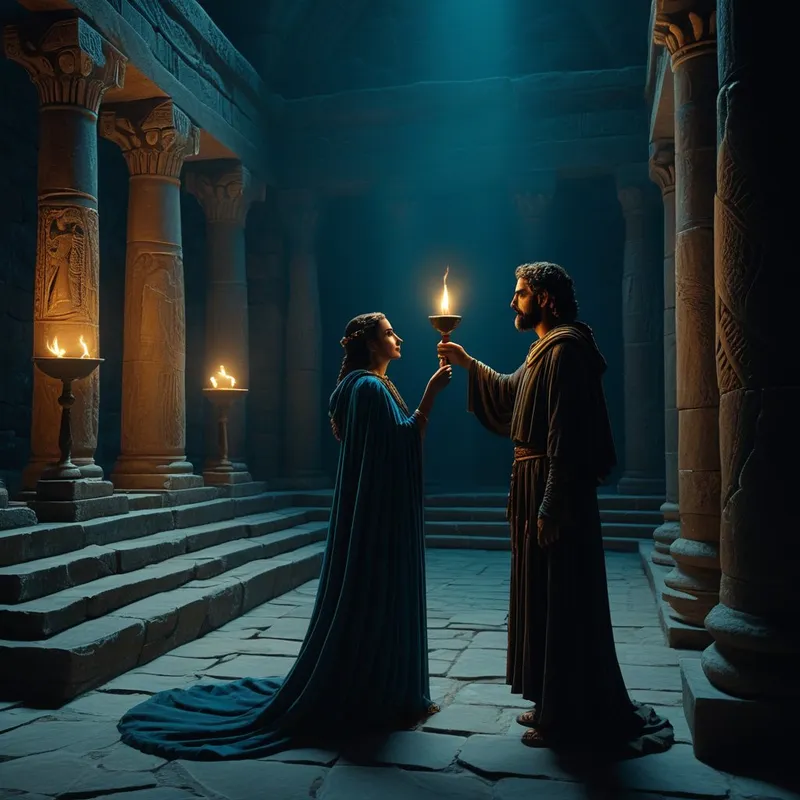
So Odysseus entered her sunlit hall. She offered the cup, he drank, and felt her power wash over him—a tide seeking to pull him under, to reshape his very bones. But the moly held him firm. He sprang forward, drawing his sword, and the bright blade kissed her throat. A gasp, then a laugh of pure astonishment. “You are Odysseus,” she said, “of the many turns, the one foretold. Who are you, that you resist my art?” She swore the oath, and the tension broke like a wave. In her bath, his men were restored, younger and fairer than before. For a year, the hero lingered in her enchanted house, feasting and resting, while she, the transformer of men, became his guide, revealing the hidden paths he must yet walk through the house of Hades and the singing Sirens. When the wind turned fair for home, she sent him on his way, not as a destroyer, but as one who had been unmade and remade in her fire.
Cultural Origins & Context
The myth of Circe is woven into the grand tapestry of the Odyssey, a foundational text of Greek culture that served as both entertainment and a deep repository of cultural values, anxieties, and cosmology. Circe’s story belongs to the genre of the nostos (homecoming) tale, but she represents a critical detour—a necessary descent. As an oral epic performed by bards (rhapsodes) for aristocratic audiences, the Odyssey used figures like Circe to explore the limits of Greek identity, of what it meant to be civilized (polis-dwelling) versus wild (agrios).
Circe is not a monster from the chaotic edges of the world, like Scylla. She is a goddess, a member of the old Titan order, operating within a divine household. Her magic is domestic yet profoundly transgressive. She perverts the sacred rites of hospitality (xenia) by transforming guests into beasts. This violation made her a potent symbol of the dangers that awaited the Greek traveler in foreign, “uncivilized” lands, where the normal social contracts did not apply. Her ultimate aid to Odysseus, however, reframes her. She becomes a necessary initiator, a figure who uses transformative crisis to prepare the hero for the even greater mysteries of death and prophecy that lie ahead.
Symbolic Architecture
Circe is the archetypal catalyst of the shadow. Her island, Aeaea, is not a place of punishment, but a ritual chamber of revelation. The men she transforms are not made into monsters they are not; she merely renders visible the latent, unintegrated animal nature within them—the greed, lust, and gluttony that lurk beneath the veneer of the disciplined warrior. The swine are not random; in the Greek imagination, the pig was an animal of unchecked appetite and earth-bound stupidity.
The potion does not create the beast; it unveils the beast that was always there, drinking from the same cup as the man.
Odysseus, armed with the divine antidote moly (symbolizing consciousness, discernment, or the “god within”), is able to withstand the dissolution. His confrontation is not a battle of strength, but of recognition. By resisting her enchantment, he forces Circe to see him—not a victim to be transformed, but an equal consciousness. Their subsequent union is one of the great symbolic acts in mythology: the integration of the conscious hero with the transformative, magical power of the unconscious (the anima). She ceases to be a threat and becomes an ally, guiding him to the underworld—the ultimate confrontation with the shadow and the past.

The Dreamer's Resonance
When the pattern of Circe manifests in modern dreams, it signals a profound encounter with the personal shadow and a crisis of identity. The dreamer may find themselves in a beautiful yet unsettling place (a lavish party, a pristine forest clearing, a therapist’s office) where they are offered something seductive—a drink, a promise, a new ideology, a relationship. Upon accepting, they feel a terrifying somatic shift: their body feels foreign, heavy, bestial; their voice is gone; they are driven by base impulses they cannot control.
This is the psyche’s enactment of enchantment: the feeling of being possessed by a complex, of losing one’s higher faculties to a compulsive behavior, a toxic relationship, or a submerged trauma that “swine-ifies” the personality. The dream is not a condemnation, but a stark, symbolic diagnosis. It asks: What in your life has such power over you that it transforms your essential humanity into something you do not recognize? The terror of the dream is the shock of seeing one’s own unintegrated shadow materialized. The resolution, if it comes, often involves finding or receiving a “moly”—a moment of lucidity, a helpful intervention (therapist, friend, book), or an inner resolve that allows the dream-ego to stand firm and demand restoration.

Alchemical Translation
The Circe myth is a precise map for the alchemical process of individuation—the journey toward psychic wholeness. The first stage, nigredo (blackening), is the transformation of the crew into swine: the confrontation with the shadow in its most humiliating, base form. The ego is dissolved in the potion of unconscious contents. Odysseus represents the resilient core of the Self that must undergo this dissolution without being permanently lost to it.
His receipt of moly from Hermes is the albedo (whitening)—the arrival of transcendent insight, the “spirit of meaning” that allows one to face the unconscious without being assimilated by it. The confrontation and oath-swearing symbolize the establishment of a new relationship between the ego and the powerful, magical forces of the psyche (the anima). One does not destroy these forces; one negotiates with them, earning their respect and cooperation.
The year of feasting on Aeaea is the rubedo (reddening)—the period of integration, where the transformed energy nourishes and strengthens the psyche.
Finally, Circe’s guidance to the underworld marks the ultimate purpose of this alchemy. The encounter with her is not an end, but a preparation for a deeper descent. She teaches that true transformation is not about avoiding one’s beastly nature, but about facing it with consciousness, so that one becomes fit to confront even greater mysteries—the ghosts of the past, the inevitability of death, and the prophetic voice of the future. The modern individual’s “Circe moment” is thus any profound crisis of transformation that, if met with Hermes-given consciousness, ceases to be a curse and becomes the very initiation that prepares the soul for its deepest, most necessary work.
Associated Symbols
Explore related symbols from the CaleaDream lexicon: