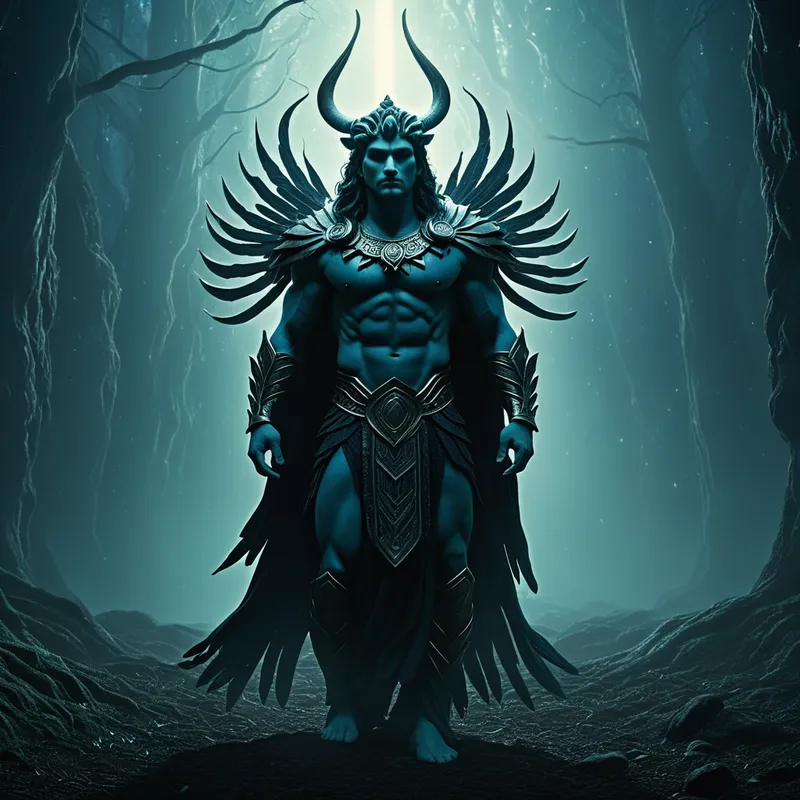
Cipactli the Earth Crocodile
A primordial crocodile monster from Aztec mythology whose dismembered body formed the earth, representing chaos transformed into order through divine sacrifice.
The Tale of Cipactli the Earth Crocodile
In the time before time, before the first sun had been kindled and the first dawn had broken, there existed only the dark, boundless waters of the void. From these formless depths, a monstrous presence stirred. This was Cipactli, the primordial earth crocodile. She was not a creature of flesh as we know it, but a living embodiment of insatiable hunger and primal chaos. Her body was a grotesque patchwork, said to have mouths at every joint, each one gaping and gnashing, consuming everything within reach, even the very substance of potential creation. She swam in the endless ocean, a devouring vortex in the form of a beast, where order could not take root and form could not hold.
Into this aquatic abyss descended the twin creator deities, Tezcatlipoca and <abbr title("Lord of the Wind, the Night, and Wisdom")>Quetzalcoatl. They looked upon the churning form of Cipactli and understood that within her chaotic being lay the raw material for a world, but a world trapped by her endless appetite. To create, they must first confront and transform this all-consuming chaos. With divine resolve, they lured the monstrous crocodile. As she surged towards them, jaws wide to swallow the gods themselves, they seized her.
What followed was not a battle, but a cosmic act of surgery. The two gods grasped Cipactli’s immense limbs and, with a force born of necessity, tore her asunder. Her violent thrashing shook the foundations of the void as her body was pulled apart. From her dismembered form, the physical world was fashioned. Her rugged hide and flesh were stretched across the void to become the earth—not a smooth plane, but a living, mountainous, uneven landscape. Her hair became the trees, grasses, and flowers. Her eyes became springs and caves. Her skin became the meadows and valleys. The thirteen heavens were raised from the upper part of her body, and the nine levels of the underworld, Mictlan, were made below.
Yet Cipactli was not fully destroyed. Her essential, hungry nature could not be extinguished, only contained and redirected. She became the foundation upon which the earth rests, and her residual hunger manifests as the earthquakes that tremble through the land. To placate this eternal appetite, the gods made a sacred pact. The creative act demanded a sustaining sacrifice. Thus, they ordained that the blood and hearts of humans would be required to nourish the earth-crocodile, to keep her settled and the world stable. In this way, the violent sacrifice that created the world became the model for the ongoing sacrifice needed to maintain it, establishing the fundamental rhythm of Aztec cosmic life: creation from destruction, order from chaos, sustained by offering.
Cultural Origins & Context
The myth of Cipactli is central to the Aztec, or Mexica, understanding of cosmology and their place within it. It is recorded in post-Conquest sources like the Historia de los Mexicanos por sus pinturas and the Histoyre du Mechique, which drew upon indigenous pictorial codices and oral tradition. This origin story establishes a worldview fundamentally different from ex nihilo (creation from nothing) concepts. For the Aztecs, the universe was crafted from pre-existing, chaotic, and often dangerous material.
This reflects a deeply pragmatic and cyclical view of existence. The world is not a gift, but an achievement—a hard-won structure wrested from a predatory chaos. This foundational violence sets the tone for the nature of reality: precarious, demanding, and requiring constant energetic renewal. The myth directly informs the Aztec doctrine of teotl, the animating, sacred energy that flows through all things. This energy was expended by the gods in the act of creation and must be replenished through ritual sacrifice (nextlahualli, "the paying of debts") to prevent the collapse of the world back into Cipactli’s primordial maw.
Furthermore, Cipactli’s transformation positions the earth itself not as a passive stage, but as a sacred, living, and potentially wrathful entity. Agriculture, warfare, and the very cycle of life and death were seen as participating in this foundational drama of feeding the earth to ensure cosmic continuity.
Symbolic Architecture
Cipactli represents the raw, unstructured potential of existence—a potential that is simultaneously creative and destructive. She is the unformed clay, the chaotic waters of the unconscious, the wild instinct that precedes civilization. Her dismemberment is the archetypal act of differentiation, where the One becomes the Many, where vague potential is given specific form.
The myth presents creation not as a gentle unfolding, but as a necessary act of violence against undifferentiated wholeness. To bring forth a world of distinct mountains, rivers, and stars, the seamless, devouring body of chaos had to be broken.
This narrative establishes a core psychological and cosmic principle: structure emerges from conflict with chaos. The self, like the world, is not born from quiet contemplation alone, but often through a painful process of tearing apart old, monolithic patterns (the devouring, undifferentiated "mother" of chaos) to reassemble the pieces into a functional, living order. The crocodile’s enduring hunger signifies that chaos is never conquered, only integrated and managed; the repressed always threatens to return, in personal psychology as earthquakes in the soul.
The Dreamer's Resonance
To encounter Cipactli in the inner landscape of a dream or active imagination is to meet the primal, unstructured ground of being. She may appear as a terrifying monster of consumption, a bottomless pit of need, or a formless, swampy terrain that threatens to swallow all identity. This symbolizes moments of existential dissolution, where the structures of one’s life—career, relationships, self-image—feel consumed by anxiety, depression, or overwhelming change.
The myth, however, offers a profound directive: this monstrous chaos is not merely an enemy to be slain, but the very substance from which a new life can be built. The dreamer’s task mirrors that of Tezcatlipoca and Quetzalcoatl: to confront the devouring force, to endure the terrifying process of being pulled apart, and to find the courage to reassemble the pieces into a new, more resilient form. The ongoing hunger of the earth-crocodile translates to the understanding that integration is a continuous process. We must regularly "feed" our foundational chaos with acknowledgment, creative expression, or ritual—lest it erupt as destabilizing "earthquakes" in our psyche.
Alchemical Translation
In alchemical terms, Cipactli is the prima materia—the base, despised, and chaotic starting matter of the Great Work. She is the massa confusa, the black, undifferentiated dragon that must be slain and dismembered (the stage of nigredo, blackening and putrefaction) to begin the process of purification and recombination.
The act of the gods is the separatio and solutio, the separation and dissolution of the unified chaos into its constituent parts, which can then be elevated and reconstituted into the lapis philosophorum, the philosopher’s stone—here, the ordered and living world.
The myth encapsulates the entire alchemical journey: from chaos (prima materia), through violent dissolution (mortificatio), to the careful structuring of the elements (coagulatio), resulting in a sacred, stable creation. The required blood sacrifice translates to the necessity of offering one’s own base nature, one’s egoic attachments and illusions, into the transformative fire of the process. One does not achieve integration without sacrificing the safety of undifferentiated chaos or the rigidity of old, outworn structures.
Associated Symbols
Explore related symbols from the CaleaDream lexicon:
- Crocodile — The primordial devourer and foundational substance; representing latent potential, instinctual survival, and the chaotic ground of being that must be confronted to create form.
- Earth — The stable world formed from chaos; representing the body, material reality, and the hard-won ground of existence that requires constant nourishment.
- Chaos — The formless, hungry void preceding creation; symbolizing the unstructured potential, creative madness, and terrifying freedom that is the source of all things.
- Sacrifice — The violent act of creation and the ongoing offering for sustenance; representing the necessary surrender of one state of being to generate or maintain another.
- Structured Chaos — The world itself, born from Cipactli’s body; symbolizing the dynamic order that contains and is fed by its own chaotic origins.
- Earthquake — The residual hunger of the earth-crocodile; representing the sudden, disruptive return of repressed chaos within the self or society.
- Earthen Vessel — The world and the human body as containers fashioned from chaos; symbolizing fragility, sacred purpose, and the holding of transformative energies.
- Primordial Chaos — The original state embodied by Cipactli; representing the unconscious, the unknown, and the raw material for all psychological and cosmic creation.
- Hearth Fire — The ritual center of sacrifice and sustenance; representing the transformative energy offered to placate chaos and maintain cosmic and domestic order.
- Veins of the Earth — The rivers and waterways formed from Cipactli; symbolizing the lifeblood of the world, the flow of energy, and the pathways connecting surface to foundational depths.