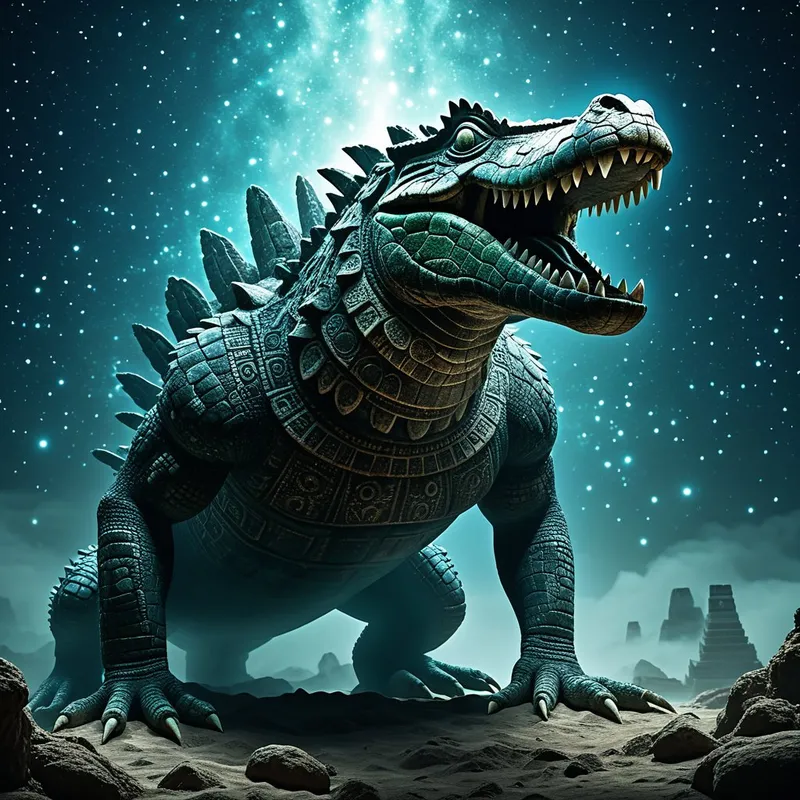
Cipactli Myth Meaning & Symbolism
The story of how the gods slew the primordial monster Cipactli to create the world from its body, establishing order from primordial chaos.
The Tale of Cipactli
In the time before time, there was no up or down, no earth or sky. There was only the endless, dark, and hungry water. And in that water swam Cipactli, alone. She was not a creature as we know creatures. She was the First Being, a formless, ravenous thing. Her body was part fish, part crocodile, part toad, a mass of gnashing mouths at every joint. She was the deep itself, a chaos that devoured all light, all possibility, all form. The silence was broken only by the slap of her tail in the void and the eternal, grinding hunger of her countless jaws.
Into this abyss descended the four gods: Quetzalcoatl and Tezcatlipoca, and with them, their brothers. They saw the formless waste and the insatiable monster that was its soul. They knew that for anything to be, this chaos must be given shape. For life to begin, the devouring must end.
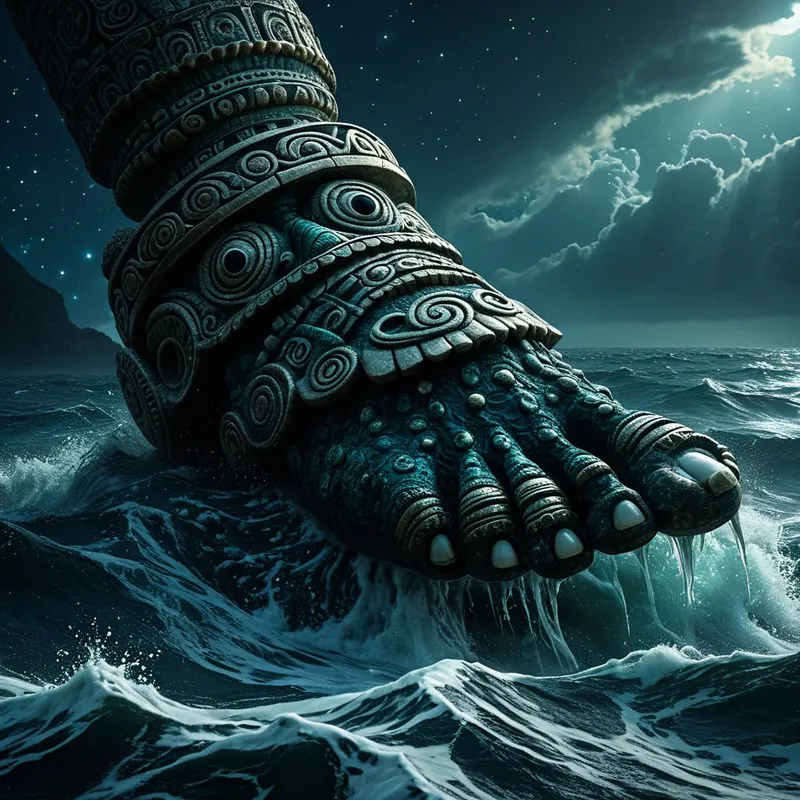
With cunning and celestial strength, they descended. Tezcatlipoca, the daring one, offered his own foot as bait, lowering it into the cold, black waters. The hunger of Cipactli was immediate and absolute. Her great maw, a cave of teeth, snapped shut, seizing the god’s limb. A cry that was the first sound of pain echoed in the void. But it was a trap. As she bit, she was caught. The other gods surged forward, seizing her countless limbs, pulling her vast, squirming body taut across the expanse of nothing.
Then came the terrible, creative violence. They stretched her. They pulled with the force of stars being born. Her body, the very substance of the primal deep, began to tear. From her severed parts, they built the world. Her lower jaw became the heavens above; her upper jaw became the earth below. From her flesh and scales, they molded the mountains and valleys. Her hair became the forests, her eyes the caves and springs. Her countless, hungry mouths were silenced, transformed into the caves and crevices from which the first winds would sigh. The gods took their places at the four corners of this new world, holding her dismembered form in place, and from her spilled blood, they gave life to the first humans. Order was carved, with immense sacrifice, from the body of chaos.
Cultural Origins & Context
While the name Cipactli is most directly associated with Aztec (Nahua) cosmology, the archetype of the primordial earth monster slain to create the world is a profound and recurring motif across Mesoamerica, deeply embedded in the Mayan worldview. This mythic pattern speaks to a shared cosmological understanding of a universe born from a violent, sacred act of ordering. In Mayan culture, as seen in the Popol Vuh, the world is also fashioned from a primordial sea, and the gods must contend with chaotic forces to establish the cycles of sun, moon, and human life.
The story would have been the province of priests, shamans, and storytellers, recited during ceremonies that reaffirmed the cosmic order. Its function was not merely explanatory but foundational. It told the people that their world was not an accident, but a hard-won artifact of divine struggle. It explained the inherent duality of the earth—both nurturing and perilous—as stemming from the nature of the monster from which it was made. Every earthquake could be felt as a tremor in Cipactli’s ancient bones; every fertile field was a gift from her flesh. The myth served as the ultimate rationale for ritual and sacrifice: if the very world was born from a god’s sacrificed limb and a monster’s dismemberment, then human offerings were part of maintaining that fragile, sacred order.
Symbolic Architecture
Cipactli is the ultimate symbol of the undifferentiated, unconscious state—the prima materia of existence. She represents the chaotic, potential-filled, and devouring void that precedes consciousness and form. She is not "evil," but a necessary, foundational state of pure potential that is also inherently destructive because it lacks distinction. Her countless mouths symbolize a hunger that consumes all things before they can become themselves, a psychic state where all thoughts, feelings, and energies are swallowed back into the unconscious before they can be born into awareness.
The act of creation is not a gentle shaping, but a necessary violence that tears form from the formless.
The gods represent the emerging forces of consciousness and order. Tezcatlipoca’s sacrifice of his foot is critical. It signifies the inevitable cost of engaging with the unconscious. To bring something new into being—a world, an idea, a self—a part of the known self must be offered up, wounded, or transformed. The foot, which connects one to the earth, symbolizes groundedness; its loss is the price of entering the chaotic waters to fish for reality. The stretching and dismemberment of Cipactli is the psychological process of analysis, differentiation, and structuring. The monstrous "All-in-One" is broken into useful, named parts: sky, earth, mountain, forest. This is the birth of the conscious world from the unconscious matrix.
The Dreamer's Resonance
When this mythic pattern stirs in the modern psyche, it often manifests in dreams of overwhelming, formless threats. You may dream of being swallowed by a murky sea, chased by a creature with too many teeth, or trapped in a shifting, labyrinthine landscape that seems alive and hungry. These are not mere nightmares of fear, but somatic communications from the Cipactli-state within.
The dreamer is at a precipice where a old, undifferentiated state of being—perhaps a fog of depression, a chaotic life situation, or a tangled mass of unprocessed emotion—must be confronted and structured. The "hunger" of the monster is the pull to remain in the familiar chaos, to let potential remain unrealized, to be consumed by inertia or anxiety. The psychological process is one of containment and differentiation. The dream ego (the Tezcatlipoca aspect) is being called to sacrifice a piece of its current identity (a comfortable habit, a limiting belief) to engage this chaos. The terror in the dream is the terror of the creative act itself: the moment before the unformed becomes form.

Alchemical Translation
The myth of Cipactli is a perfect map for the alchemical process of individuation—the forging of a coherent, conscious Self from the raw material of the unconscious. The first stage, nigredo (the blackening), is the primal sea itself: a state of confusion, despair, or chaotic potential where all things are merged and dark.
The engagement and capture of the monster is the beginning of albedo (the whitening), the stage of analysis and separation. The offering of the foot is the crucial sacrifice: one must willingly lose a part of one's standing in the old, familiar world to gain traction in the new. This could be sacrificing the identity of the victim, the comfort of blame, or the safety of ignorance.
The Self is not found, it is built—fashioned, piece by sacred piece, from the dismembered body of our own inner chaos.
The stretching and dismemberment of Cipactli is the sustained work of therapy, introspection, or artistic creation—pulling apart the tangled mass of impulses, traumas, and potentials to see what they are made of. Finally, the reassembly of her parts into the ordered world mirrors rubedo (the reddening), the creation of a new, vibrant, and enduring psychic structure. The world that is built is not a rejection of the monster, but its transmutation. The chaos becomes cosmos. The devouring hunger becomes fertile soil. The modern individual completes this alchemy when they can look at the structured reality of their life—their work, their relationships, their sense of purpose—and recognize it as the sacred, rearranged body of the very chaos they once feared would consume them whole.
Associated Symbols
Explore related symbols from the CaleaDream lexicon: