Cinvat Bridge Myth Meaning & Symbolism
A soul's final journey across a cosmic bridge that widens for the righteous and narrows to a blade for the wicked, judged by divine forces.
The Tale of Cinvat Bridge
Hear now the tale of the final crossing, the journey no living foot may tread, yet for which every soul is made. In the silence after the last breath, when the body becomes mere clay, the soul stirs. It is drawn forth, not by wind, but by a summons older than mountains. Before it lies a landscape of spirit: the peaks of Hara Berezaiti pierce a sky of eternal twilight, and between this world and the next stretches the Bridge of the Separator—Cinvat.
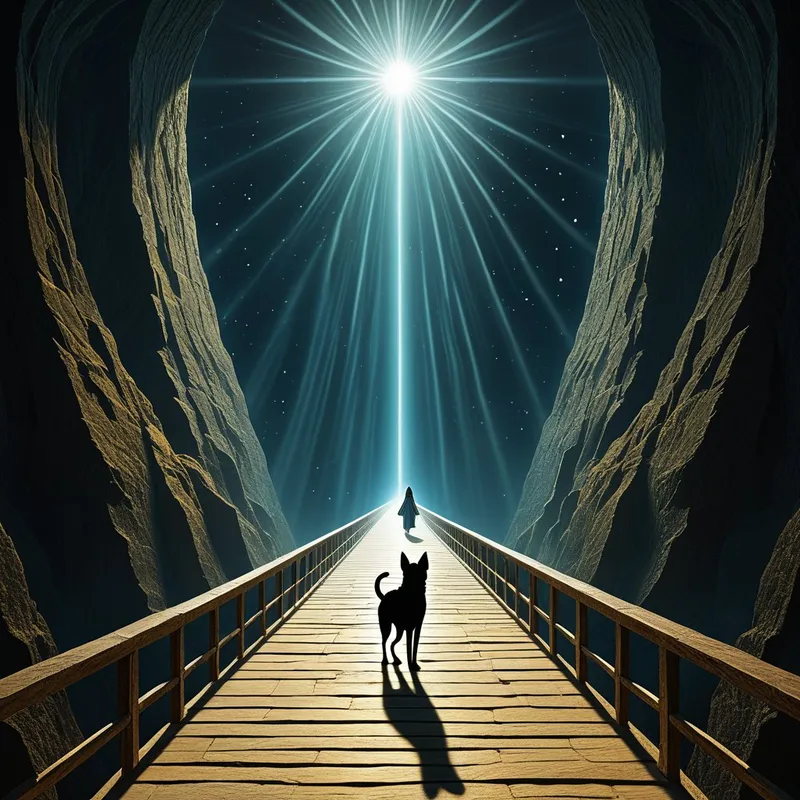
At the head of this bridge stands a presence of terrifying grace: Daena. She is not a goddess of mercy, but of truth. Her form is the very essence of the soul’s own life—radiant and fragrant as a summer garden if the soul’s deeds were good, wretched and foul as a corpse if they were wicked. With her is the four-eyed dog, a beast of vigilance whose gaze sees all deeds, hidden and revealed.
The soul approaches. For the ashavan, the righteous one, Daena is a breathtaking maiden. The bridge responds. It widens, becoming a glorious causeway nine spears broad, firm and welcoming. The path is fragrant with the scent of good thoughts, words, and deeds. From the far side, from the House of Song, comes a sweet wind, and the soul is guided across with ease into the everlasting light.
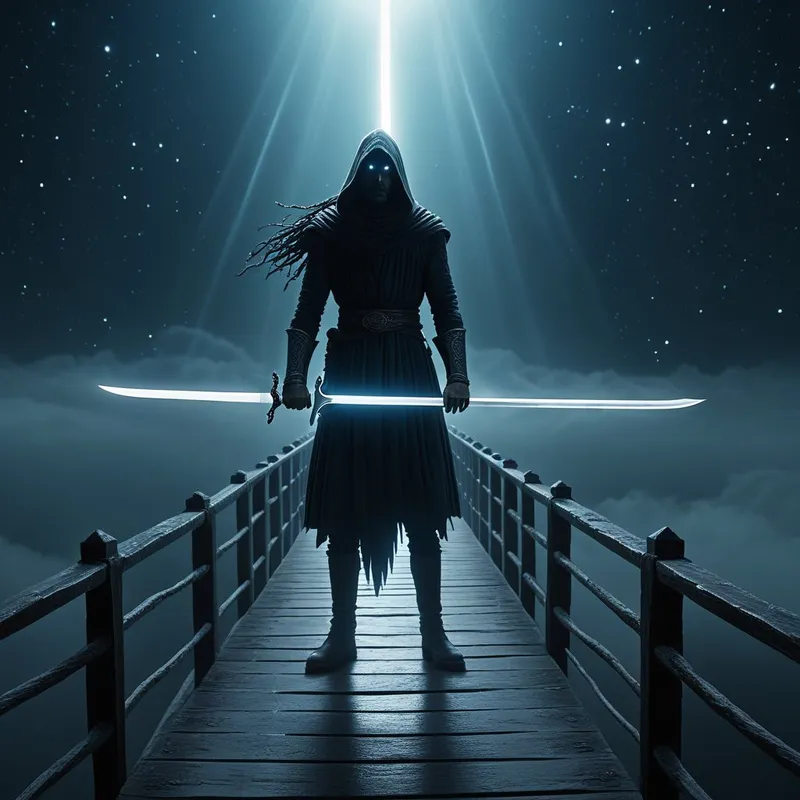
But for the druj, the follower of the Lie, Daena is a horror. A hag, reeking of decay, the living record of their own corruption. The bridge recoils. It narrows, sharpens, until it is the cutting edge of a blade, thinner than a hair, sharper than a razor. The soul must attempt the crossing. Below is not water, but the yawning abyss of Druj, a void of howling darkness and regret. The soul stumbles, loses its balance, and falls—not down, but into. It is consumed by its own essence, descending into the misery of the House of Lies, where the food is poison and the darkness is absolute. The crossing is not a punishment imposed, but a truth revealed. The bridge itself is the judge; the soul’s own weight of being determines its width or its keen, final edge.
Cultural Origins & Context
This profound vision of post-mortem judgment is a cornerstone of Zoroastrian eschatology, the religious tradition of ancient Persia that flourished for over a millennium. The myth is meticulously preserved in sacred texts like the Avesta, particularly in the Arda Wiraz Namag, and in the Middle Persian Pahlavi literature.
It was not merely a story for the afterlife, but a powerful social and ethical engine for this life. Told by priests (Mobeds) and woven into funeral rites and daily prayers, it served a critical societal function: it visualized the cosmic consequences of ethical choice. In a worldview defined by the cosmic struggle between Ahura Mazda and Angra Mainyu, every human thought, word, and deed was a vote for one side or the other. The Cinvat Bridge myth made this abstract battle viscerally real. It taught that the soul is its own final prosecutor and witness, and that the ultimate judge is the unalterable law of consequence, personified as Daena, one's own spiritual double. This provided a profound framework for personal responsibility and the imperative to live in asha (truth, order, righteousness).
Symbolic Architecture
The myth’s power lies in its impeccable, terrifying symmetry. It is a perfect allegory for the moment of existential truth, where the sum of a life is weighed.
- The Bridge Itself: It is the ultimate liminal space, the threshold between states of being. It is not a place, but a process of evaluation. Its physical properties are direct manifestations of psychic and moral reality.
The bridge does not change; it reveals. Its width is the measure of the soul's alignment with its own foundational truth.
- Daena: She is perhaps the most psychologically sophisticated figure in ancient mythology. Daena is not a foreign deity passing sentence, but the personification of the individual's accumulated conscience and consciousness. She is the record of the life lived, transformed into a living entity. The beautiful maiden or the foul hag is the soul's own self-image, made objective and inescapable.
- The Four-Eyed Dog: This creature symbolizes vigilant conscience and the inescapability of truth. Its "four eyes" see in all directions—past and future, public and private. It represents the fact that no deed is ever truly hidden; all is recorded in the fabric of one's being.
- The Fall: Notably, there is no demon pushing the wicked soul. The fall is a direct result of imbalance, of an inability to navigate the narrow path one has created. The abyss of Druj is not a torture chamber designed by a god, but the inner state of chaos, falsehood, and self-estrangement taken to its absolute conclusion.
The Dreamer's Resonance
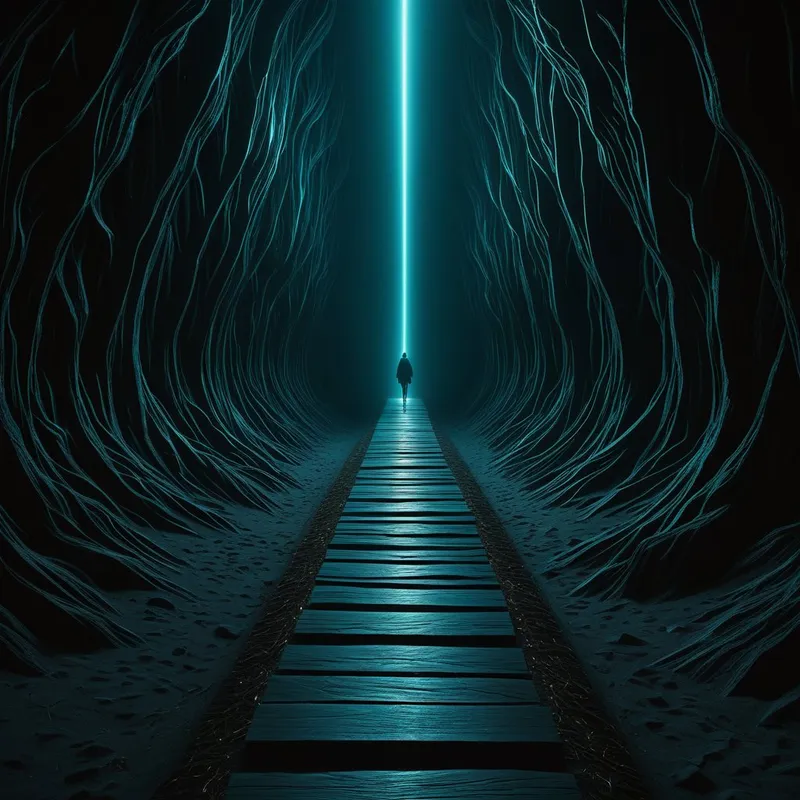
When this myth stirs in the modern unconscious, it rarely appears as a literal Persian bridge. Instead, it manifests as the core experience of precarious judgment and self-evaluation. To dream of crossing a narrow, terrifying pass; of walking a plank over an abyss; of taking a test for which you are utterly unprepared; or of being scrutinized by a figure that is both yourself and a stern authority—these are the echoes of Cinvat.
The somatic feeling is one of acute imbalance, vertigo, and profound anxiety. Psychologically, this dream pattern surfaces during life transitions (career change, relationship end, aging) or after actions that conflict with one's core values. The dream-ego is facing its own Daena—the part of the psyche that holds the ledger of your actions against your professed ideals. The chasm below is the fear of psychic dissolution, of falling into a state of meaninglessness, shame, or inner chaos. The dream is not a prophecy of damnation, but a urgent summons from the Self to examine the path you are on, to integrate neglected aspects, and to find your moral and psychological center before life forces a crossing.
Alchemical Translation
For the modern individual on the path of individuation—the process of becoming a coherent, whole self—the Cinvat Bridge models the final, most daunting phase of psychic transmutation: the confrontation with the totality of one's life.
The journey begins with the nigredo, the gathering of all aspects of the self—the noble and the shadowy. These are the deeds and thoughts that approach the bridge. The figure of Daena represents the stage of albedo, of mirror-like reflection, where this gathered material is seen with ruthless clarity. There is no more self-deception. You see your inner maiden and your inner hag, both true.
The alchemical fire is not under the bridge, but in the crossing. The soul is the ore, the path is the flame, and the outcome is the revelation of its essential metal.
The crossing itself is the rubedo, the reddening or final purification. For the integrated soul, the path widens. This symbolizes the achievement of inner congruence, where thoughts, words, and deeds are aligned. The psyche becomes a "house of song," a harmonious whole. For the unintegrated soul, the path becomes a blade. This is the necessary, painful confrontation with the unreconciled shadow. The "fall" into Druj is not a failure, but in a psychological sense, a descent into the neglected chaos of the unconscious for the purpose of reclamation. Even this is part of the alchemical process, a return to the prima materia to begin again.
Thus, the myth teaches that individuation is a daily crossing. Every ethical choice, every moment of self-honesty, every integrated shadow, widens the bridge within. We are not building our character for a distant judgment; we are, with each breath, forging the very path we will one day have to walk.
Associated Symbols
Explore related symbols from the CaleaDream lexicon: