Cicero's Toga Myth Meaning & Symbolism
A Roman statesman's sacred garment, stained by his life's work, becomes the measure of his soul before the gods of the underworld.
The Tale of Cicero's Toga
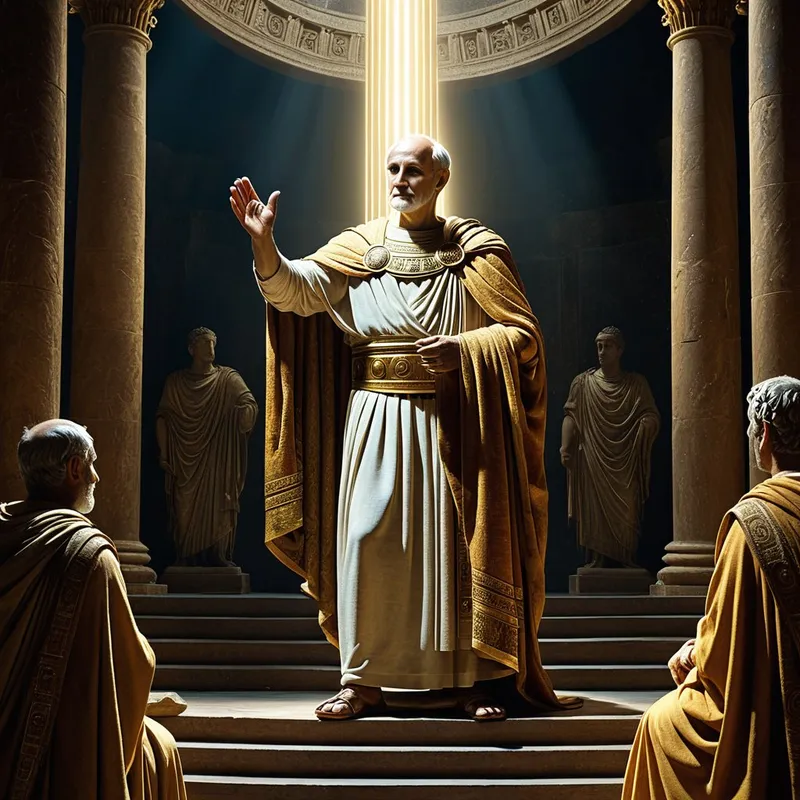
The forum is silent. Not with the quiet of night, but with the profound, listening stillness that follows the final word of a great argument. Marcus Tullius Cicero stands alone on the Rostra, the marble cool beneath his sandals. The crowd has dispersed, carrying his phrases like seeds, but the air itself seems thickened by his speech—a speech for the life of the Republic, a plea against the gathering dark of tyranny. He feels a peculiar weight, not of years, though he has many, but of the garment upon his shoulders. His toga, the plain, undyed wool of the Roman citizen, feels heavier than armor.
He returns to his home on the Palatine. The lamps are lit. As his slave helps him disrobe, the ritual of the day’s end feels more significant than ever. The wool falls from his shoulders, and for a moment, it seems to hold its shape in the air—the ghost of his civic self. He takes it in his own hands. To his shock, the fabric is no longer plain. Where his heart had beat in the heat of oration, a stain like old gold has seeped into the weave. Along the border where his arm gestured, threads of a profound blue, the color of a deep sky, trace the arc of his rhetoric. But there are other marks: a grey smudge of compromise near the hem, a faint, rusty thread of anger where he denounced Catiline, and a delicate, almost invisible silver filigree of a truth spoken at great personal risk.
Cicero stares. This is no longer merely cloth. It is a ledger. Each case argued, each law defended, each friendship forged and betrayal endured has been woven into its very fibers by the silent, impartial Lares of his duty. The toga has recorded what his memory has softened or sharpened. It is the objective biography of his public soul.
Years pass. The Republic falls. Cicero’s voice is silenced by the swords of Antony’s men. His spirit descends, not to the bleak Avernus of the common dead, but to the silent judgment hall of Pluto and Proserpina. Before the obsidian throne, he stands, not in a shroud, but once more clad in the toga. Now, in the light of the underworld, it is fully illuminated.
The gods do not speak. They do not consult a scroll of his deeds. They simply gaze upon the garment. The gold of eloquence shines, but next to it, the grey of political expediency pulses dully. The blue of idealistic fervor is beautiful, but is it woven strong enough to support the fabric? The stains of fear and the threads of courage are laid bare, inseparable. The toga is his soul’s resume, its texture the true record of a life lived in the res publica—the public thing. Pluto’s finger points, not at Cicero, but at the toga itself. The judgment is not a verdict of paradise or punishment, but a simple, terrifying acknowledgment: This is what you offered. This is what you were. This is the weight you chose to carry. The myth ends with Cicero, forever in that hall, contemplating the intricate, self-woven tapestry of his own legacy, the final and only audience his own immortalized conscience.

Cultural Origins & Context
This myth, while not found in a single canonical text like Virgil’s Aeneid, emerges from the deep substratum of Roman civic religion and philosophical practice. It is a “philosopher’s myth,” likely circulated in the late Republic and early Imperial periods within Stoic and Neo-Platonic circles, for whom Cicero was a towering, tragic exemplar. It functioned as a powerful ethical thought-experiment.
The storytellers were not bards in a mead hall, but rhetoricians in a schola or philosophers in a garden. They passed it down as a exemplum—a teaching story. Its societal function was profound: in a culture where public service (cursus honorum) was the highest calling for a patrician, the myth internalized the concept of accountability. Rome had laws and courts, and the gods demanded sacrifice, but this myth proposed a more intimate, inescapable tribunal. It taught that one’s role in the social fabric (the toga) becomes the very substance of the soul, judged not by popular acclaim but by the impersonal, chthonic truths of the universe. It was a warning against hypocrisy and a consolation for the honest statesman: your true record is kept, even if history distorts it.
Symbolic Architecture
The toga is the ultimate symbol of the Persona. In Rome, it was not merely clothing; it was the legally mandated uniform of citizenship, of rank, and of civic duty. To wear it was to enact your role in the body politic.
The Persona is not a lie; it is the necessary garment of social being. But it is permeable. The soul dyes it from the inside.
In the myth, this social garment is psychologized. It becomes a living document, a somatic record. The “stains” are not flaws but imprints: the gold of earned wisdom, the blue of articulated ideals, the grey of necessary compromise. The myth suggests that our professional, public selves are not shallow masks but deep, formative vessels. What we do in our roles literally weaves the spiritual body we will have to present at our personal judgment. Cicero’s shock upon seeing the stained toga is the shock of objective self-awareness—seeing the Self as it truly is, beyond its own stories and justifications.
The underworld gods, Pluto (wealth, the substratum) and Proserpina (the cyclical soul), represent the unconscious psyche’s faculty of ultimate valuation. They judge not good vs. evil in a simplistic sense, but weight, integrity, and authenticity of weave. Did the persona serve as a conduit for the true self, or was it a barricade against it?
The Dreamer's Resonance
When this myth appears in modern dreams, it rarely involves a literal toga. Instead, one dreams of a work uniform that is impossibly heavy, a business suit that has grown into one’s skin, a nurse’s scrubs or a judge’s robe that is stained with indelible colors. One may dream of standing in a boardroom or courtroom, naked, while others only see the professional garment.
This is the psyche signaling a critical moment of somatic integration or Persona inflation. The dreamer is processing the profound psychological truth that their life’s work has altered them at a soul-level. The “stain” is the feeling that one’s job has become one’s identity, for better or worse. The dream often arises during career transitions, retirement, or ethical crises at work. The somatic feeling—the crushing weight, the shock of the stain—is the body speaking the truth the conscious mind avoids: “This role has written itself into my nervous system. Who am I beneath it?” The dream invites a fearless inventory of what has been woven into the fabric of the self through daily action.

Alchemical Translation
The alchemical process mirrored here is coagulatio—the making solid, the embodiment of spirit into matter. Cicero’s life of thought and speech (spiritus) is coagulated into the physical artifact of the toga (corpus). The individuation journey modeled is the conscious assumption and ultimate sacrifice of the Persona.
Individuation does not mean discarding the Persona, but wearing it consciously, accepting that it will be stained by the journey, and finally offering it up for dissolution in the fires of self-knowledge.
The modern individual undergoes this when they move from being a lawyer to being a person who practices law, from a caregiver to a person who cares. The first is an identification; the second is a conscious wearing of a role. The “judgment” is not an external event but the internal moment when we hold up the accumulated record of our actions—our “toga”—and see it without illusion. This is the opus contra naturam: the work against the natural tendency to blame, excuse, or inflate. We see the compromises (grey), the passions (red), the ideals (blue), and the earned wisdom (gold) all woven together.
The triumph is not a spotless garment. It is a whole garment. The alchemical goal is integration, not purity. To stand before Pluto is to stand before one’s own deepest, most impersonal truth—the Self. The myth teaches that the final stage of psychological maturity is to present the complex, stained, and authentic tapestry of a life lived in the world, and to recognize it as one’s own unique and necessary creation. The weight of the toga becomes, in the end, the weight of meaning itself.
Associated Symbols
Explore related symbols from the CaleaDream lexicon: