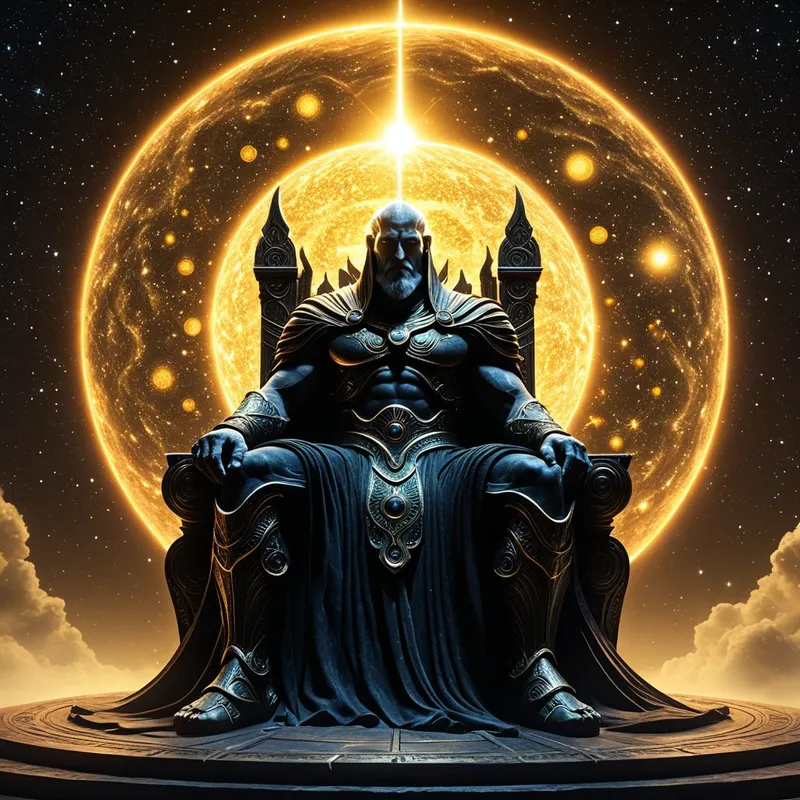
Chronos- The primord Myth Meaning & Symbolism
The primordial titan of time, who devours his own children to preserve his reign, until he is overthrown, birthing the ordered cosmos from raw chaos.
The Tale of Chronos- The primord
Before the world was a world, there was only the yawning, formless chasm of Chaos. From its depths, the first beings stirred. Among them was Chronos, not the turning of hours, but Time itself—raw, hungry, and infinite. He was the great serpent of eternity, coiled around the egg of creation. With his consort, Gaia, the solid, sighing earth, he set the stars in their first, slow dance.
But a prophecy, whispered from the very fabric of the void, coiled around his throne: a son born of him would one day rise to cast him down. This truth echoed in the hollows of his being, a seed of dread in the garden of his power. So, when Gaia bore their children—the first gods, the Titans—Chronos did not rejoice. He saw not offspring, but usurpers.
As each newborn deity was laid in his arms, he did not cradle them. He opened his maw, a gateway to a starless inner night, and swallowed them whole. Hestia, the gentle flame, was consumed. Demeter and Hera, swallowed. Hades and Poseidon, vanished into the dark belly of their father. There they remained, trapped in the suffocating eternity inside him, their divine light dimmed but not extinguished, churning in the prison of perpetual potential.
Gaia’s heart, the very bedrock of the world, cracked with a grief that shook the mountains. When she grew heavy with her last child, she devised a ruse born of desperation and cunning. She descended to a hidden grotto, and when her time came, she gave birth not only to a son but to a secret. She wrapped a great, smooth stone in swaddling clothes, its weight a perfect, terrible deception. She presented this bundle to Chronos.
The Titan King, sensing the potent divinity, did not hesitate. He took the shrouded stone and consumed it, the rock settling heavily among his captured children. The true infant, Zeus, was spirited away to a cave on Mount Ida, where his cries were drowned by the clashing of shields, raised by loyal spirits so that Chronos, who hears all, might hear nothing.
Zeus grew, fed on the milk of a divine goat and the strength of his hidden destiny. When he came of age, guided by Gaia and his mother Rhea, he confronted his father. He offered Chronos a draught not of nectar, but of potent herbs and honeyed wine—a mixture to turn the cosmos within him inside out. Chronos drank, and his reign unraveled. He convulsed, heaving forth first the stone, and then, one by one, his immortal children, reborn into the light, whole and raging.
The released Olympians, allied with their savior-brother Zeus, waged a war that shattered the foundations of the old order. Chronos was cast down, bound, and exiled to the misty edges of creation, to Tartarus or a distant, dreamless island. From his devouring chaos, the new, structured cosmos was born. Time was no longer a consuming monster, but a measured river, and the stone he vomited forth was placed at the center of the world as the Omphalos, the symbol of a new, stable order.
Cultural Origins & Context
The myth of Chronos (or Cronus) is a cornerstone of Hesiod’s Theogony, a foundational text that systematized the chaotic oral traditions of ancient Greece into a divine genealogy. This was not mere entertainment; it was a sacred narrative explaining the origin of cosmic sovereignty and the painful, necessary transition from primordial, instinctual power to a more complex, lawful order. The story was recited in ritual contexts, passed down by bards and priests, serving as a societal anchor. It answered profound questions: Why must the old king die for the new to reign? How does time itself relate to creation and destruction? It functioned as a mythic charter for patriarchal succession and the often-violent establishment of political and cosmic justice, reflecting the anxieties of a culture deeply concerned with lineage, legacy, and the overthrow of tyrannical rule.
Symbolic Architecture
At its core, Chronos represents the unconscious, devouring aspect of time and the stagnant status quo. He is not evil, but a necessary, brutal function of existence: the principle that consumes all things to preserve itself. He is the inertia that resists change, the fear that swallows new potential before it can challenge the established order.
Chronos is the psychic defense that would rather imprison the future in the belly of the past than risk the terror of transformation.
His act of swallowing his children symbolizes how unintegrated trauma, unchecked power, or rigid dogma can "consume" our nascent potentials, ideas, and emotional growth, trapping them in a dormant state within the psyche. The stone given to him is the brilliant trick of consciousness—the decoy ego, the acceptable sacrifice that protects the true, revolutionary Self (Zeus) until it is strong enough to emerge. The eventual disgorgement is the inevitable, often violent, psychic crisis where all that was repressed comes roaring back to the surface, demanding integration and forcing a new order of the mind.
The Dreamer's Resonance
To dream of the Chronos pattern is to encounter the deep, somatic anxiety of being consumed by one's own life. One might dream of a vast, slow-moving machine that grinds up personal projects or relationships, or of a powerful, shadowy parental figure who dismisses or absorbs one's voice and autonomy. The dreamer may feel themselves being swallowed by a dark space or trapped in a timeless, womblike prison that has become a tomb.
This dream signals a profound psychological process: the confrontation with the inner tyrant—the part of the psyche that, out of fear, seeks to control and nullify growth to maintain a fragile, familiar stability. The somatic feeling is often one of heavy dread, suffocation, or paralysis. The dream is the psyche's declaration that the cost of this "swallowing" has become too great; the children—one's creativity, authority, love, or unique destiny—are screaming to be born.
Alchemical Translation
The myth of Chronos is a perfect map for the alchemical stage of Nigredo, the blackening, and the subsequent Albedo. The individual begins in the chaos of undifferentiated existence, ruled by an unconscious, chronological drive (simply surviving, repeating patterns). The "prophecy" is the first, frightening inkling of individuation—the call to become oneself, which feels like a threat to the entire known world of the ego.
The "swallowing" represents our own complicity in this stagnation. We consume our true feelings, our ambitions, our wildness, to keep the peace (internal and external). The work of the modern seeker is to become both Rhea and Zeus: to craft the "stone"—the conscious persona or acceptable offering to the demands of the world—while secretly nurturing the hidden, rebellious spirit in the cave of the unconscious. The pivotal moment is administering the "potion"—the courageous act of therapy, creative expression, or life choice that induces a psychic vomiting. This is the crisis where all the swallowed parts of the self are forcibly, messily returned.
The triumph is not in destroying Time, but in deposing the Devourer, so that time becomes a medium for growth rather than a digestion of destiny.
The final stage is the establishment of the inner Omphalos—the stable center, the "navel" of a newly ordered psyche. The exiled Chronos is not killed; he is bound. This means the devouring impulse is acknowledged and contained, transformed from a ruling tyrant into a remembered function. The individual moves from being consumed by time to working with time, from being a prisoner of the past to a sovereign in the present, presiding over a cosmos of liberated potentials.
Associated Symbols
Explore related symbols from the CaleaDream lexicon: