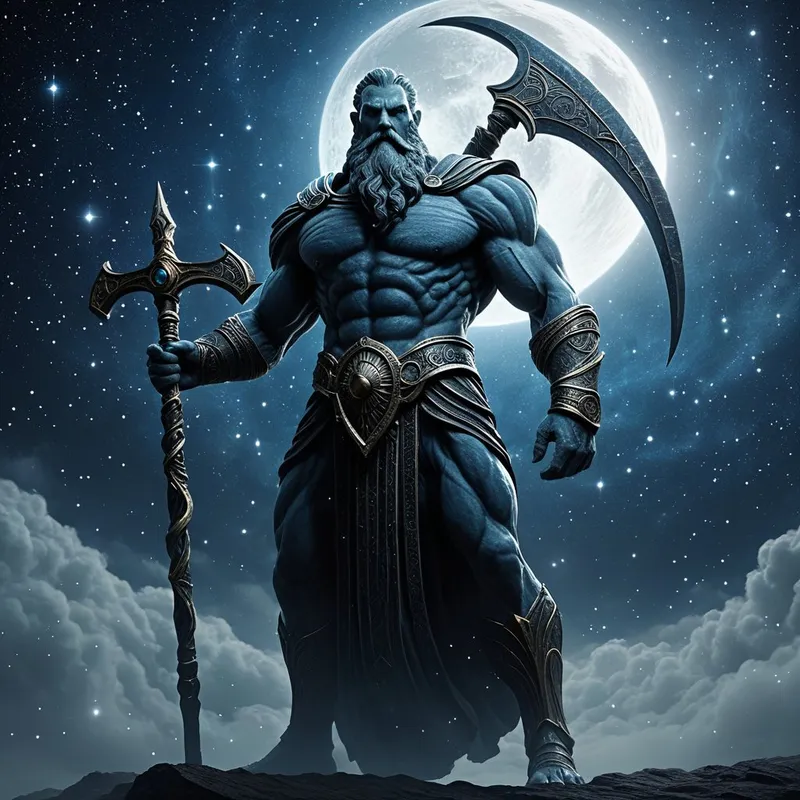
Chronos Myth Meaning & Symbolism
The primordial god of time, who castrates his father and devours his children, embodying the relentless, consuming, and cyclical nature of existence itself.
The Tale of Chronos
Before the world was shaped, there was only the yawning, formless Chaos. From its depths arose the first powers: Gaia, the broad-breasted earth, and Ouranos, the starry sky. Their union birthed the Titans, mighty and terrible, and among them was the youngest, yet the most dreadful: Chronos. He was not a god of harvest or ocean, but of the invisible force that gnaws at all things. He was time itself, serpentine and endless, a circle with no beginning and no end.
Ouranos, fearing the strength of his children, forced them back into the dark womb of Gaia, causing her immense pain. From her agony sprang a plot of grim necessity. She forged a great, jagged sickle of adamant and sought a champion among her imprisoned sons. Only Chronos, coiled in the deepest dark, possessed the ruthless will. He took the weapon, and when Ouranos next descended to embrace Gaia, Chronos struck from the shadows. With one sweeping, terrible cut, he severed his father’s power, casting it into the sea. From that act, new life foamed upon the waves, but the deed was drenched in betrayal and pain.
Chronos now ruled, with his sister Rhea as his queen. Yet the prophecy of his mother Gaia echoed in the hollows of his being: he too would be overthrown by his own child. So, the ruler of time enacted a law of absolute control. As Rhea bore their glorious children—Hestia, Demeter, Hera, Hades, Poseidon—Chronos did not cradle them. He opened his vast maw and swallowed each whole, imprisoning them in the boundless, dark cavern of his belly. He consumed the future to preserve the present, devouring his own potential to maintain his solitary reign over a static eternity.
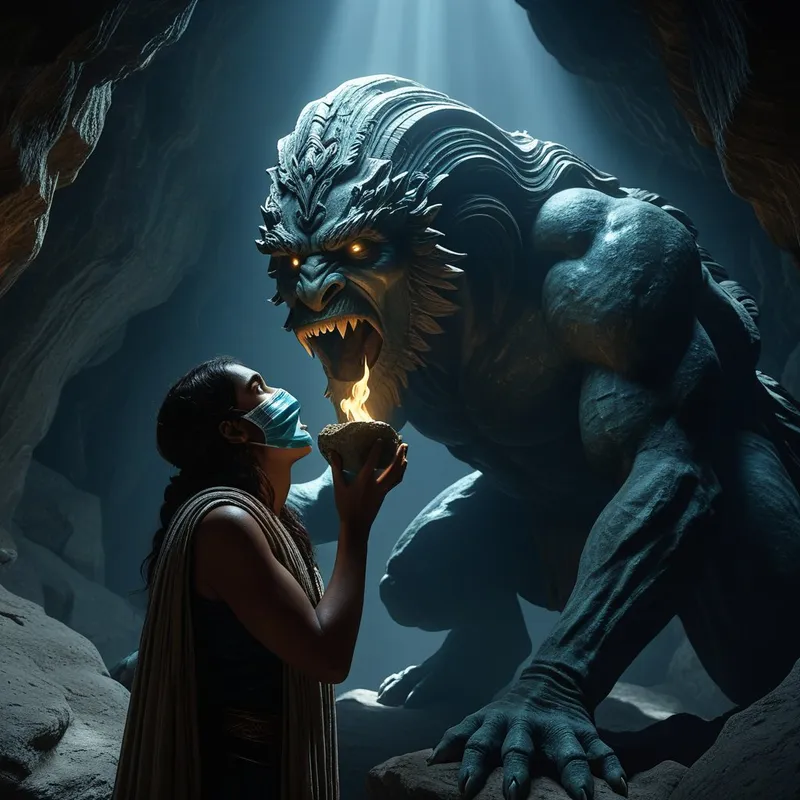
Rhea’s grief became a torrent. When her sixth child was near to birth, she fled to a hidden cave on Crete. There, in the deep earth, she brought forth Zeus. His cries were masked by the frenzied dancing and clashing spears of the Curetes. And Rhea, with a heart of stone and a mind of cunning, wrapped a large rock in swaddling clothes. She returned to Chronos and presented the bundle. Without a glance, driven by his insatiable, fearful compulsion, the Titan King swallowed the stone, believing he had once again secured his reign.
But the future, now hidden and nourished by divine milk and honey, grew strong in the lightless caves of the world. Zeus matured, and with a potion forged by Metis, he confronted his father. Chronos drank, and his body was seized with a convulsive, cosmic reversal. One by one, he disgorged his children, whole and undigested, born anew into the light. First came the stone, set at Pytho as a monument, then his divine siblings, ready for war. The released children, allied with the mighty Cyclopes and Hecatoncheires, waged a cataclysm against the Titans—the Titanomachy. Chronos and his kind were cast down, imprisoned in the deepest pit of Tartarus, and a new order, under Zeus, began. Time was dethroned, but never destroyed.
Cultural Origins & Context
The figure of Chronos (often conflated with, but distinct from, the Titan Cronus) emerges from the deepest layers of Greek cosmogonic poetry, primarily Hesiod’s Theogony. This was not a myth for casual entertainment; it was a sacred narrative explaining the painful, violent origins of cosmic order. Performed by bards and rhapsodes, it served as a foundational theology, mapping the transition from primordial, instinctual forces (the Titans) to a more structured, albeit still passionate, divine polity (the Olympians).
The societal function was profound. It explained the necessity of succession, the price of power, and the inevitability of change. The act of swallowing children was a horrifying metaphor for how the old order consumes the new to maintain itself, a pattern seen in dynastic struggles and political conservatism. The myth provided a template for understanding that creation often requires a violent severing from the past (the castration of Ouranos) and that stability achieved through suppression (devouring children) is ultimately an illusion, destined to be violently overturned.
Symbolic Architecture
Chronos is not merely a cruel father; he is the archetypal embodiment of time as a devouring, cyclical force. He represents the psyche’s terror of succession, of being replaced, of becoming obsolete. His actions are not born of malice, but of a fatalistic drive for self-preservation that paradoxically leads to self-imprisonment.
To swallow one’s children is to consume one’s own future, to live in a perpetual, sterile present where nothing new can be born.
The sickle, his instrument, is a double-edged symbol. It is the harvester’s tool, cutting down the ripe grain—a necessary end for the cycle of life. Yet, as used against Ouranos, it is the instrument of severance, cutting the primal unity of Sky and Earth, initiating the painful differentiation that allows for individuated existence. Chronos himself is the sickle’s arc: the curved, relentless path from origin to end, and back again.
The stone swallowed in place of Zeus is the central pivot of the myth. It is the trick, the substitute, the prima materia of alchemy—the worthless thing that contains the seed of redemption. It represents the hardened, petrified aspect of the psyche that must be ingested and later expelled for transformation to occur.
The Dreamer's Resonance
When the pattern of Chronos emerges in modern dreams, it signals a profound engagement with the psyche’s relationship to time, legacy, and internalized authority. To dream of devouring or being devoured by a parental or authoritarian figure points to a psychic process where one’s own potential, creativity, or “inner children” (new ideas, feelings, life paths) are being suppressed by an outdated, fear-based ruling complex.
Somatically, this may manifest as a tightness in the throat or gut—a literal feeling of something being stuck, undigested, or unable to be expressed. The dreamer may be living in a “swallowed” state, where their true self is imprisoned by the demands of chronology—deadlines, aging, societal schedules—or by an internal tyrant that says, “Not yet,” or “This is not safe to be born.”
The eventual regurgitation in the myth mirrors the often-violent, nauseating process of psychological liberation. The dreamer may experience a life crisis, a sudden upheaval, or a visceral release of long-held emotions, where what was swallowed (a trauma, a talent, a truth) is forcefully brought back into consciousness, whole but changed, ready to be integrated.
Alchemical Translation
The myth of Chronos is a perfect allegory for the alchemical nigredo, the blackening, and the subsequent stages of psychic transmutation. The ruling consciousness (Chronos) seeks to incorporate all experience into itself, to control the flow of time and change. This leads to the coniunctio in the belly—a dark, chaotic union where opposites (the swallowed siblings) are held in undifferentiated tension.
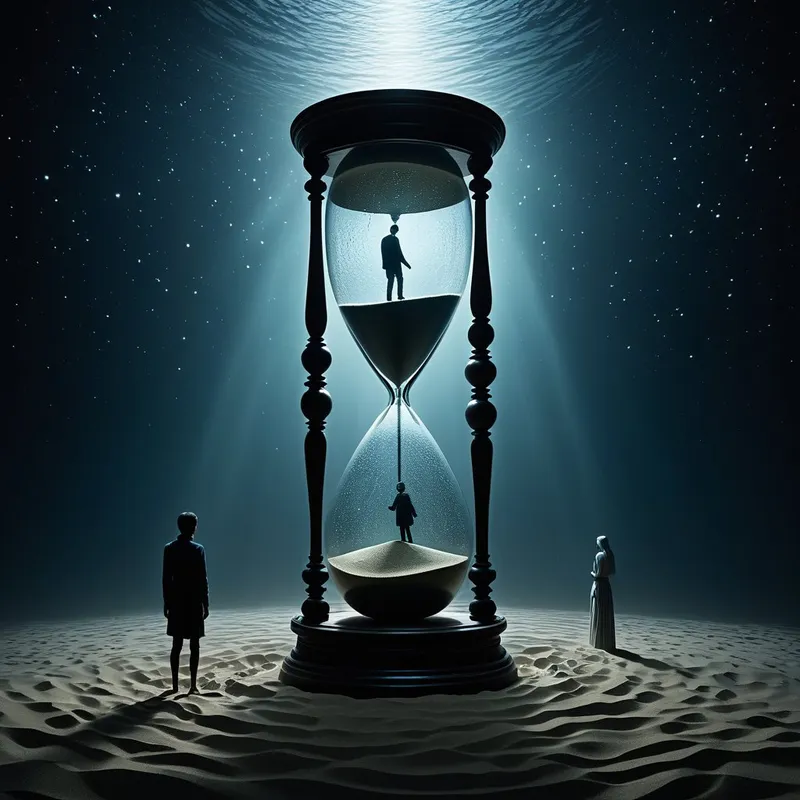
The tyranny of time is overcome not by stopping the clock, but by being disgorged from its mechanism, born a second time into a world where one creates time, rather than merely serving it.
The potion given by Metis (whose name means “wisdom,” “craft,” or “cunning thought”) represents the introduction of conscious insight and trickster intelligence into the compulsive system. It is the therapeutic intervention, the moment of self-reflection that forces a reversal. The vomiting forth is the albedo, a painful purification. What emerges is not destroyed, but saved—the core self (the divine siblings) is retrieved, and even the hardened, stony part of the self (the swallowed rock) is placed at the world’s center, no longer a prison but a sacred touchstone.
For the modern individual, the Chronos process is the journey from being ruled by time—by regrets of the past and anxieties of the future—to achieving a sovereignty where time becomes a medium for creation. It requires the courage to confront the internal Titan who devours new beginnings, to ingest the hard, stony truths about one’s own defensive structures, and to finally allow a revolutionary, Zeus-like spirit of new order to liberate the trapped potentials within. The goal is not to kill time, but to depose its tyrannical rule and establish a conscious, creative relationship with its eternal flow.
Associated Symbols
Explore related symbols from the CaleaDream lexicon:
- Hours
- Watch
- Seconds
- Longer
- Always
- Kitchen Timer
- Luxury Watch
- Timeless Wristwatch
- Transcending Time
- Temporal Shift
- Timeless Realm
- Liquid Time
- Fragmented Time
- Time Warp
- Train Station Clock
- Sundial
- Vortex of Time
- Regal Saturn
- Caesium Flow
- Radium Watch
- Ticks of Time
- Echoing Crickets
- Silverfish
- Time Traveler's Compass
- Time-Bending Hourglass
- Time Turner
- Calendar
- Time Limit
- Chess Clock
- Surreal Clock
- Wind-Up Clock
- Pocket Watch
- Harmonic Metronome
- Grandfather Clock
- Wooden Kitchen Timer
- Desk Calendar
- Desk Clock
- Flipping Calendar Pages
- City Clock Tower
- Sundial on Temple
- Chiming Clock
- Hourglass
- Dripping Candle Wax
- Smashed Clock
- Shattered Clock
- Sundial of Time
- Existential Clock
- Fleeting Time
- Sands of Time
- Philosophical Hourglass
- Shattered Hourglass
- Temporal Mirage
- Ironick Clock
- Clock Face
- Sundial Shadow
- Icicle Drip
- Timeworn Clock
- Scythe
- Number 24
- Timeless Clock
- Rhythm
- Entropy Arrow
- Time Dilation
- Adverb
- Meter
- Lag
- Slow
- Temporal
- Duration
- Tempo
- Timetable
- Oxidation
- Goldwatch
- Glacier
- Clock
- Timeless Hourglass
- Hurdling Through Time
- Metronome
- Harvesting Scythe
- Interestrate