Christ Myth Meaning & Symbolism
A divine figure descends into mortal flesh, is betrayed and sacrificed, descends into death, and returns transformed, offering a path of redemption through love.
The Tale of Christ
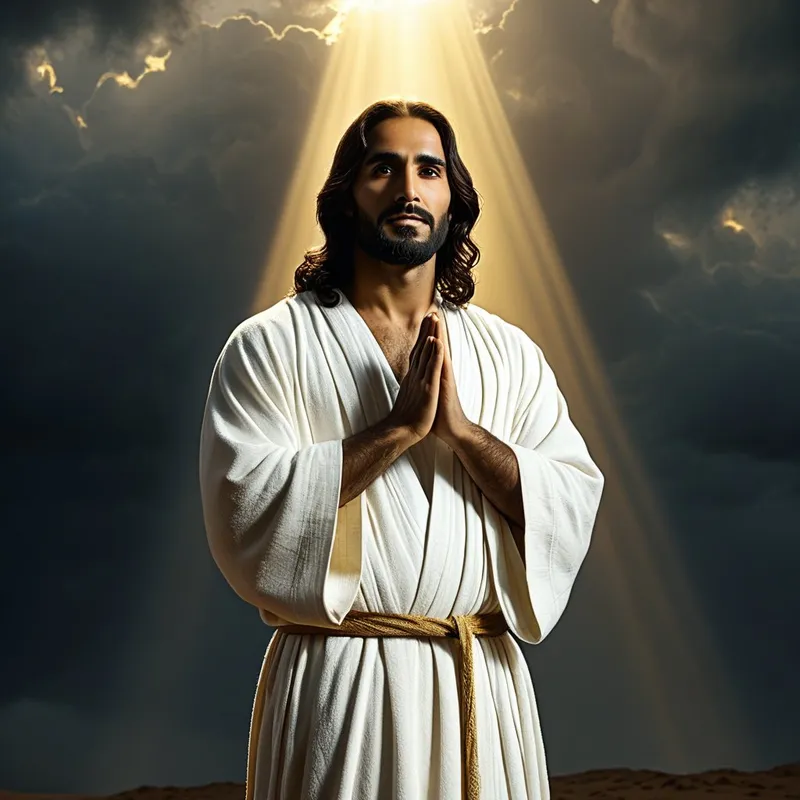
Listen. In the fullness of time, when the world groaned under the weight of its own forgetting, the Word became flesh. He did not arrive with legions or in palaces of marble, but in the animal-scented dark of a stable, wrapped in the rough cloth of the poor. They called him Yeshua, a name whispered with hope in a land occupied by empire.
He walked the dust-choked roads of Judea, his feet bare or sandaled, his voice a quiet river that carved canyons in hardened hearts. He spoke of a kingdom not of land and sword, but of spirit—where the last are first, the poor are blessed, and love for the enemy is the ultimate revolution. He touched the untouchable, his hands resting on fevered brows and leprous skin, and a current of life would surge back into withered limbs and despairing souls. He broke bread with outcasts and spoke in parables of seeds and soils, of pearls and prodigals, painting heaven in the ordinary.
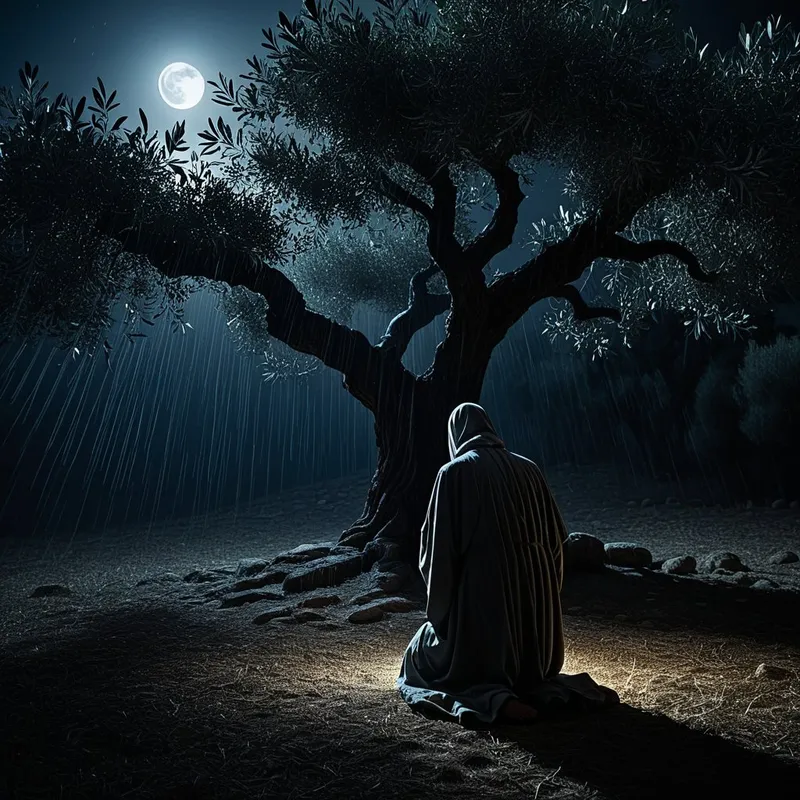
But light casts the deepest shadow. The powers of the world—religious and imperial—saw in his radical love a threat more dangerous than any rebellion. In the hushed conspiracy of an upper room, one of his own, Judas Iscariot, sealed a pact with silver. That night, in a garden heavy with the scent of olives and dread, the teacher knelt, his sweat like drops of blood falling to the earth, and surrendered his will to a terrifying purpose.
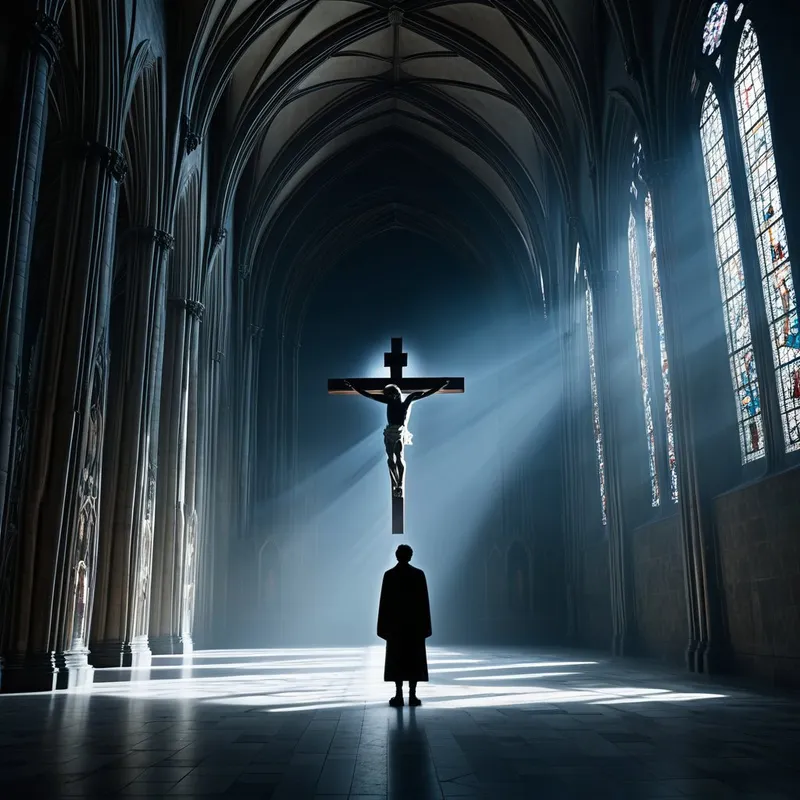
Then came the betrayal with a kiss, the mock trial, the scourging that tore flesh from bone. A crown was fashioned, not of gold, but of thorns, pressed deep into his brow. Forced to carry the instrument of his execution—a rough-hewn crossbeam—he stumbled through the jeering crowds to the Place of the Skull, Golgotha. There, iron nails were driven through his wrists and feet, and he was hoisted between earth and sky. For hours, he hung in the agony of suffocation, while darkness swallowed the sun at midday. With a final cry that echoed the loneliness of all humanity, he breathed his last. A soldier’s spear pierced his side, and water and blood flowed out. They laid his broken body in a tomb sealed with a stone, and the world fell silent, holding its breath.
But on the third day, at dawn, the women who came to anoint the corpse found the stone rolled away and the tomb empty. A presence, radiant and unmistakable yet strangely familiar, began to appear—in a garden mistaken for a gardener, on a road to a forgotten town, behind locked doors where fear had gathered. He showed them the wounds, not as scars of defeat, but as seals of a terrible passage. He broke bread once more, and in that breaking, they recognized him. The one who was dead lived. The stone of despair had been rolled from the heart of the world.
Cultural Origins & Context
This story emerged from the volatile crossroads of first-century Judea, a land simmering with messianic expectation under the heel of the Roman Empire. It was born within a Jewish milieu, drawing deeply on the prophetic and wisdom traditions of the Hebrew scriptures—the suffering servant of Isaiah, the righteous psalmist crying out from the depths.
Initially, it was an oral story, a "gospel" (good news) proclaimed by his followers, a small sect within Judaism. They told it in homes, in market squares, and eventually in letters circulated among fledgling communities across the Mediterranean. Within decades, these accounts were crystallized into written narratives—the Gospels of Matthew, Mark, Luke, and John—each weaving the core events with theological and communal concerns. The myth served as a foundational identity, explaining the group’s shocking origin in the execution of its leader and providing a cosmic framework for ethics, community (the ekklesia), and hope in the face of persecution. It functioned as a radical counter-narrative to imperial power, proclaiming a lord crucified by Rome was now the true ruler of the cosmos.
Symbolic Architecture
At its heart, the Christ myth is a profound map of a divine principle engaging fully with the mortal condition. It symbolizes the descent of spirit (Logos) into matter, the ultimate incarnation where the eternal touches the temporal in its most vulnerable form.
The crucifixion is not the failure of the plan, but its terrifying and necessary center. It is the moment where the archetype of perfect love meets the archetype of perfect betrayal and systemic violence.
The figure of Christ represents the Self in its journey through the psyche. His baptism symbolizes the conscious acceptance of a divine calling, a fate. The forty days in the wilderness are the confrontation with the shadowy devil, the psychic temptations of power, security, and spectacle. The miracles are eruptions of the Self’s transformative, healing power into a fragmented world. The Last Supper is the symbolic internalization of this archetype—"this is my body, this is my blood"—making the sacred journey a nourishment available to all.
The crucifixion is the ultimate ego death. It is the total surrender of the personal will ("not my will, but yours be done") and the conscious acceptance of suffering inflicted by the outer world (the collective) and inner betrayals (the shadow). The resurrection is the emergence of a new, transformed consciousness that has integrated the reality of death and suffering, now bearing its marks as part of its identity.

The Dreamer's Resonance
When this mythic pattern stirs in the modern dreamer, it often signals a profound crisis of identity and a call to a painful but necessary transformation. Dreaming of being betrayed by a close friend or colleague can echo the Judas archetype, pointing to a part of the self or a trusted ideal that is "selling out" one's deeper purpose for the "thirty pieces of silver" of security, approval, or convenience.
Dreams of carrying a heavy burden or being unjustly condemned mirror the via dolorosa, the road of sorrows. This is the somatic feeling of a life task or a psychological truth that feels crushing, where the dreamer feels exposed and judged by the "crowd" of internalized voices or external pressures. A dream of crucifixion itself is rare and profound, indicating an experience of being stretched between irreconcilable opposites, feeling pinned and sacrificed to a situation, relationship, or inner conflict. The somatic resonance is one of immobilization and suffocation.
Conversely, dreams of empty tombs, rolled-away stones, or encountering a familiar yet radiant presence in an unexpected place signal the resurrection phase. This is the psychic emergence after a period of depression, stagnation, or "death" of an old way of being. It is the body-mind’s way of announcing that a period of incubation in darkness has yielded a new, more resilient consciousness.
Alchemical Translation
For the individual on the path of individuation, the Christ myth models the alchemical opus: solve et coagula—dissolve and coagulate.
The incarnation is the prima materia, the commitment to embody one's unique existence fully, with all its vulnerabilities. The ministry represents the work of differentiation, confronting complexes (the demons cast out), healing splits within (the paralytics who walk), and feeding the multitude of inner needs with the few loaves and fishes of conscious attention.
The alchemical gold is not perfection, but wholeness—a consciousness that has willingly descended into its own darkness, been broken apart, and has returned bearing the philosopher's stone of integrated suffering.
Gethsemane is the nigredo, the blackening. It is the dark night of the soul where one must consciously consent to the death of an old identity, a cherished self-image, or a life plan. This is the ultimate dissolution of the ego's sovereignty. The crucifixion is the mortificatio, the killing and putrefaction, where one feels dismembered by life.
The descent into hell (the harrowing of hell) is the crucial, often missed step: the conscious confrontation with and redemption of the deepest, most forgotten contents of the personal and collective unconscious—the "spirits in prison." The resurrection is the albedo, the whitening, the dawn of a new clarity. The ascension is the rubedo, the reddening or glorification, where the transformed consciousness is integrated into daily life, no longer identified with the personal drama but acting as a vessel for a transpersonal reality.
For the modern individual, this is not about literal belief but about engaging the pattern. It asks: What in me must die—what attitude, grievance, or self-limiting story—so that a more authentic, compassionate, and resilient self can be born? How do I bear the suffering that comes with being true to my deepest calling without becoming bitter? The myth offers a map that the deepest suffering, consciously borne, is not the end of the story, but the fiery crucible of the soul's rebirth.
Associated Symbols
Explore related symbols from the CaleaDream lexicon: