
Chiron the Centaur Myth Meaning & Symbolism
The story of Chiron, the immortal centaur whose incurable wound led him to become the greatest teacher, healer, and guide of heroes.
The Tale of Chiron the Centaur
Listen, and hear the tale of the one who was not like the others. In the wild, untamed forests of Mount Pelion, where the air smells of pine and damp earth, there lived a being of two natures. He was Chiron. While his kin, the centaurs, were born of cloud and lust, roaring and wine-sodden, Chiron’s origin was written in the stars. He was the son of the Titan Cronus, who in the form of a stallion, lay with the Oceanid Philyra. From this union, a creature of profound contradiction was born: a centaur in form, yet in spirit, a philosopher, a sage.
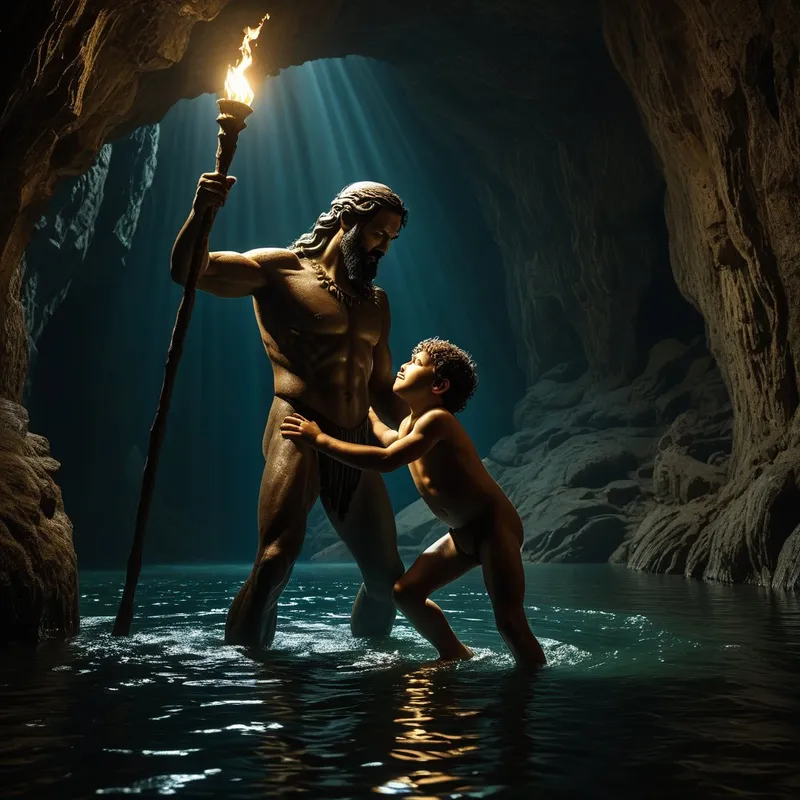
Abandoned by his mother in her shame, he was found and raised by the god Apollo himself. Under the golden lyre’s guidance, Chiron learned the arts of healing, of music, of prophecy. From Apollo’s twin, Artemis, he learned the secrets of the forest, the names of every herb, the path of every beast. His cave was not a den, but a sanctuary—lined with scrolls, drying herbs, and strange, beautiful artifacts. Here, the greatest heroes of Greece were not born, but forged. Heracles learned strength tempered with wisdom. Jason learned cunning. Asclepius learned the mysteries of medicine. And the swift Achilles was dipped in the waters of immortality, held in Chiron’s steady, immortal hands.
But fate, the weaver of cruel irony, had a poisoned thread for the wise centaur. During a visit, the mighty Heracles, in a struggle with the other, wild centaurs, let fly one of his arrows, tipped with the venomous blood of the Lernaean Hydra. The arrow, meant for a foe, found its mark in Chiron’s thigh. A scream, not of brute pain, but of profound, cosmic understanding, echoed through the valleys. For Chiron was immortal. The divine poison coursed through him, a fire that would not consume, an agony that would not end. He, the master healer, could not heal himself.
For ages, he suffered. The pain was his constant companion, a shadow to his light. He wandered the slopes of Pelion, a living monument to incurable hurt. Yet, in his suffering, his wisdom deepened. He understood wounding not as an interruption to life, but as its very text. The ultimate resolution came not from a cure, but from a trade. When the Titan Prometheus was bound to his rock, suffering eternal torment for stealing fire for humanity, a bargain was struck. Chiron, in an act of supreme compassion, offered his own immortality to free Prometheus. Zeus accepted. Released from the prison of his eternal flesh, Chiron’s pain ended. And as his mortal life faded, the father of gods placed him among the stars, forever immortalized as the constellation Sagittarius, the archer who aims his arrow at the heart of the Scorpion—the symbol of poison, pain, and ultimate transcendence.
Cultural Origins & Context
The myth of Chiron is a sophisticated later addition to the Greek mythological corpus, primarily preserved in the works of poets like Pindar and Apollonius of Rhodes, and later mythographers. Unlike the older, chaotic centaurs who represent untamed nature and barbarism, Chiron is a Hellenic ideal projected onto a "monstrous" form. He embodies the Greek pursuit of paideia—education and cultural refinement. His students are the foundational heroes of Greek identity, suggesting that true heroism is not innate but taught, cultivated through wisdom, art, and ethics.
His myth functioned as a cultural bridge. It explained the origin of medical knowledge (through Asclepius) and heroic virtue. Furthermore, it provided a profound theodicy—a way to explain suffering in a world governed by gods. Chiron’s wound, inflicted by a friend’s accident with a weapon born of a divine labor, illustrates the Greek concept of ate (divine blindness or ruin) and the inescapable, often tragic, intertwining of fates. His story was told not just to entertain, but to instruct on the nobility found in bearing the unhealable and transforming it into a source of guidance for others.
Symbolic Architecture
Chiron is the archetype of the Wounded Healer. His very body is symbolic: the human intellect and spirit fused with the animal body, representing the eternal struggle and necessary union between our civilized, conscious selves and our instinctual, somatic nature. His incurable wound is the core symbol.
The wound that does not kill, but will not heal, becomes the well from which all wisdom is drawn.
The wound is not a punishment but a vocation. It locates him. His immortality—the thing that should be his greatest blessing—becomes the cage for his suffering, symbolizing how our most fixed identities (our "I am" statements) can become prisons for our pain. His sacrifice, trading immortality for mortality to relieve another’s torment, is the ultimate alchemical act: transforming passive suffering into active, redemptive sacrifice. He moves from being a victim of fate to an author of meaning.
The Dreamer's Resonance
When the pattern of Chiron emerges in modern dreams, it signals a profound encounter with one’s own "incurable" wound. This is not a physical injury, but a core psychological or emotional hurt—a foundational trauma, a deep-seated sense of inadequacy, a grief that has settled into the bones. One might dream of a wise but limping animal, a teacher who is also a patient, or a brilliant light source with a dark, cracked core.
Somatically, this process often feels like a chronic ache in a specific area of the body, a place where emotion has become flesh. Psychologically, it is the stage where one stops trying to "fix" or "cure" the old pain and instead begins to inhabit it, to listen to it. The dream-ego is being asked to stop fleeing its own history and to turn toward the pain with the curiosity of a healer. This is the beginning of moving from identification with the wound ("I am wounded") to relationship with it ("I carry a wound, and it has taught me").

Alchemical Translation
The Chiron myth is a precise map of the individuation process, specifically the integration of the shadow and the development of the transcendent function. The initial state is one of giftedness (immortality, wisdom) yet naivete. The accidental poisoning by Heracles—the heroic, striving aspect of the psyche—represents the inevitable "wounding" by life, often by our own ambitions or complexes. The poison is the shadow content, the toxic, rejected material that enters the system.
The alchemical vessel is not the cave of retreat, but the enduring body of the life one must live, heated by the slow fire of unending pain.
The long period of suffering is the nigredo, the blackening, where one must endure the dissolution of the old, pain-free self-image. The key turn is when the centaur stops trying to extract the arrow and instead learns its weight, its texture, its message. This is the mortificatio, the death of the ego’s hope for a simple cure. The final sacrifice—exchanging immortality for Prometheus’s freedom—is the rubedo, the reddening. It symbolizes the conscious sacrifice of the ego’s claim to specialness or invulnerability (immortality) for the sake of something greater: the liberation of the creative, rebellious, life-giving spirit (Prometheus) within. One gives up the identity of "the wounded one" to become "the one who guides others through their wounds." The personal pain is transmuted into transpersonal compassion. The constellation we are left with is the Self, a pattern of meaning fixed in the heavens of the psyche, a permanent reminder that our deepest hurt and our highest purpose are forged from the same star-stuff.
Associated Symbols
Explore related symbols from the CaleaDream lexicon: