Chimera Myth Meaning & Symbolism
A fire-breathing monster of lion, goat, and serpent, slain by Bellerophon, representing the primal, fragmented psyche demanding integration.
The Tale of Chimera
Hear now a tale of fire and flesh, of a terror born not of one beast, but of three. In the wild, wind-scoured lands of Lycia, a shadow fell upon the people. It was not the shadow of a cloud, but of a living blasphemy against nature’s order. From the craggy peaks of Mount Cragus, it descended: the Chimera.
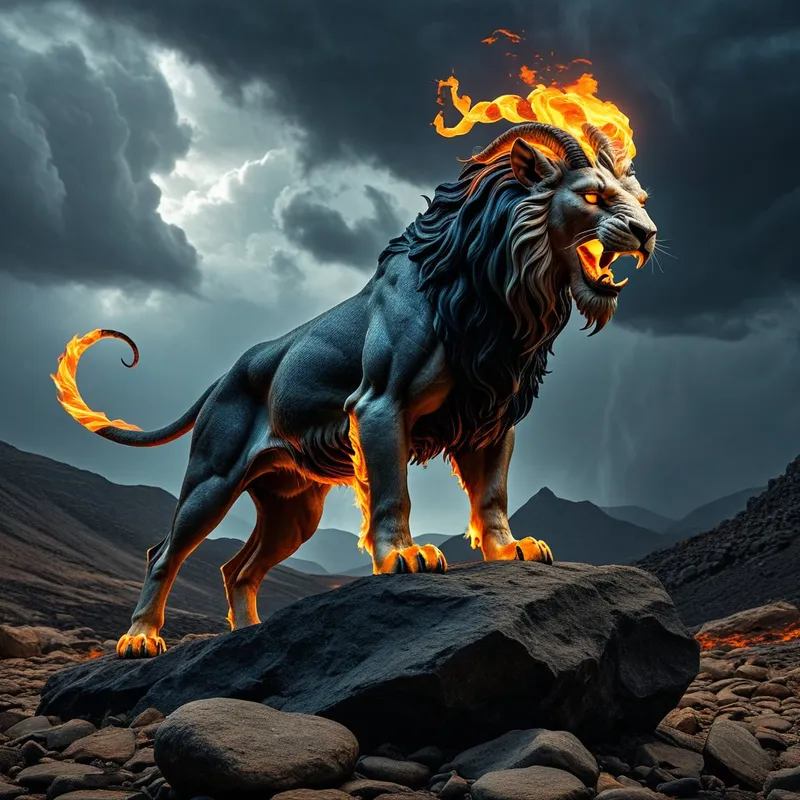
Its form was a nightmare given substance. The powerful, tawny body of a lion, king of the plains, moved with a predator’s grace. But from the center of its back, a second head erupted—the bearded, stubborn head of a wild goat, its eyes blank and chewing on phantom cud. And where a tail should lash, there instead writhed a living serpent, scales glistening, its hiss a promise of venom. But its true horror was its breath. From the lion’s mighty jaws, it did not roar air, but a torrent of searing, black-tinged flame that scorched the earth and set the very rocks to weeping slag. It was a creature of impossible hunger, devouring flocks and men alike, a walking holocaust that made the land barren.
The king of Lycia, Iobates, despaired. Into his court came a hero, Bellerophon, bearing a sealed tablet that secretly demanded his death. Seeing his chance, Iobates set the youth an impossible task: slay the Chimera. A mortal man, however brave, was but kindling for such a beast.
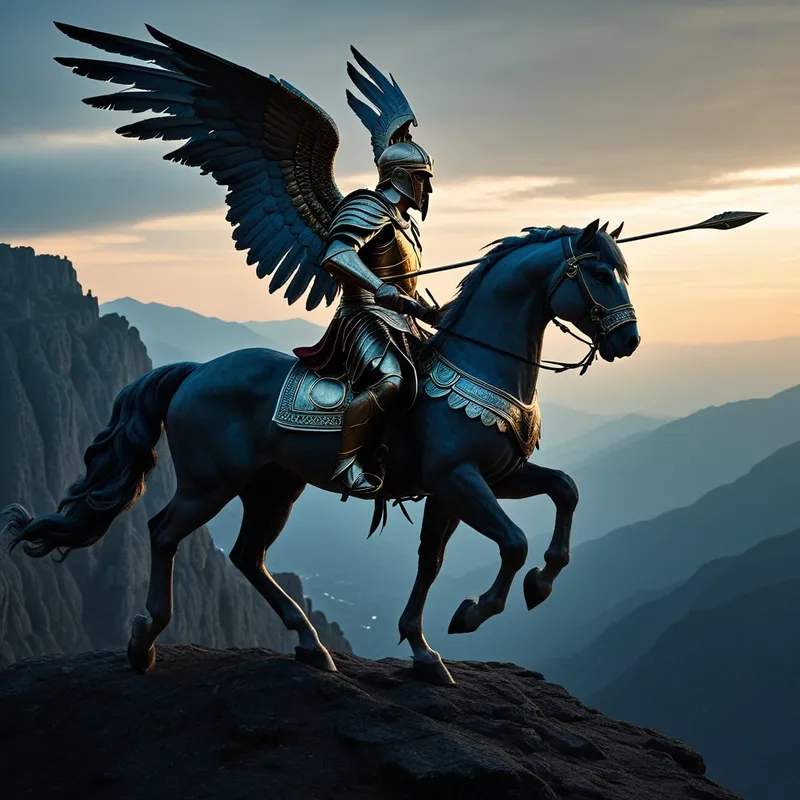
But Bellerophon was favored. With the aid of the seer Polyeidus, he captured and tamed the divine, winged horse Pegasus, sprung from the blood of the Gorgon. From the back of this celestial steed, Bellerophon took to the skies, a speck against the sun. He soared above the Chimera’s fiery blasts, the heat of its breath warming the air beneath him. The monster raged below, a composite of earthly fury, unable to reach the heaven-touched hero.
Then came the cunning. Upon the advice of Athena, who whispers to those who listen, Bellerophon fixed a lump of lead to the tip of his spear. He dove, a falcon striking, and drove the spear deep into the Chimera’s flaming throat. The beast roared, and in its rage, its own hellish breath turned upon it. The lead melted, flowing down its throat, searing and choking the life from the impossible creature. The lion’s roar guttered, the goat’s head fell silent, the serpent tail went limp. The fire died, leaving only smoke and the strange, cooling carcass of a forgotten dream of terror. The land of Lycia breathed again, and Bellerophon’s name was sung as the rider who conquered the sky to kill the earth-bound monster.
Cultural Origins & Context
The Chimera is not merely a monster from a fireside tale; it is a foundational piece of the Greek mythological imagination, given canonical form in Hesiod’s Theogony and immortalized in Homer’s Iliad. Hesiod names it among the fearsome offspring of the primordial monsters Echidna and Typhon, placing it within a genealogy of chaos that the Olympian order had to subdue. Homer references it as a "portent" for men, a byword for something fantastically impossible and terrifying.
This myth functioned on multiple levels in the ancient Greek psyche. On one hand, it was an etiological tale, explaining the name of the volcanic landscape near Cragus, where methane vents could spontaneously ignite, seen as the "breath" of the beast. On a deeper level, it served a crucial societal function: it visualized the "other," the chaotic, untamed, and hybrid forces that existed beyond the boundaries of the civilized polis. The Chimera represented the wild, unconquered frontier—geographic, psychological, and spiritual. The hero’s victory, especially achieved through divine aid (Pegasus, Athena) and intelligence (the lead-tipped spear), reinforced the cultural ideal of civilized order triumphing over bestial chaos through a combination of piety, courage, and cunning.
Symbolic Architecture
The Chimera’s power as a symbol lies in its impossible anatomy. It is not a blend, but a forced assemblage. Each part speaks to a primal aspect of the untamed psyche.
The Lion represents raw, predatory instinct; the seat of rage, pride, and the unbridled will to power. It is the foundational animal thymos (spiritedness). The Goat, rising from the spine, embodies stubborn lust, base appetite, and a clinging, consuming nature. It is the chaotic life-force, often associated with the god Dionysus, but here untethered and grotesque. The Serpent tail signifies cunning, poison (resentment, hidden malice), and a chthonic, earth-bound wisdom turned treacherous. Together, they form a trinity of dis-integration.
The Chimera is the psyche in a state of civil war, where instincts are not harmonized but are monstrously conjoined, each head pulling in a different direction, the whole creature breathing the destructive fire of internal conflict.
Bellerophon, then, is the conscious ego attempting to bring order to this internal chaos. His flight on Pegasus symbolizes the necessary elevation of perspective—one cannot fight the monster on its own terms, in the mud of pure instinct. The lead-tipped spear is the crucial alchemical detail. Lead, the base metal, is placed into the fire (the monster’s essence) and, through the monster’s own agency, becomes the instrument of its transformation. The hero does not overpower the beast with superior force alone; he introduces a transformative element that turns the beast’s nature against itself.
The Dreamer's Resonance
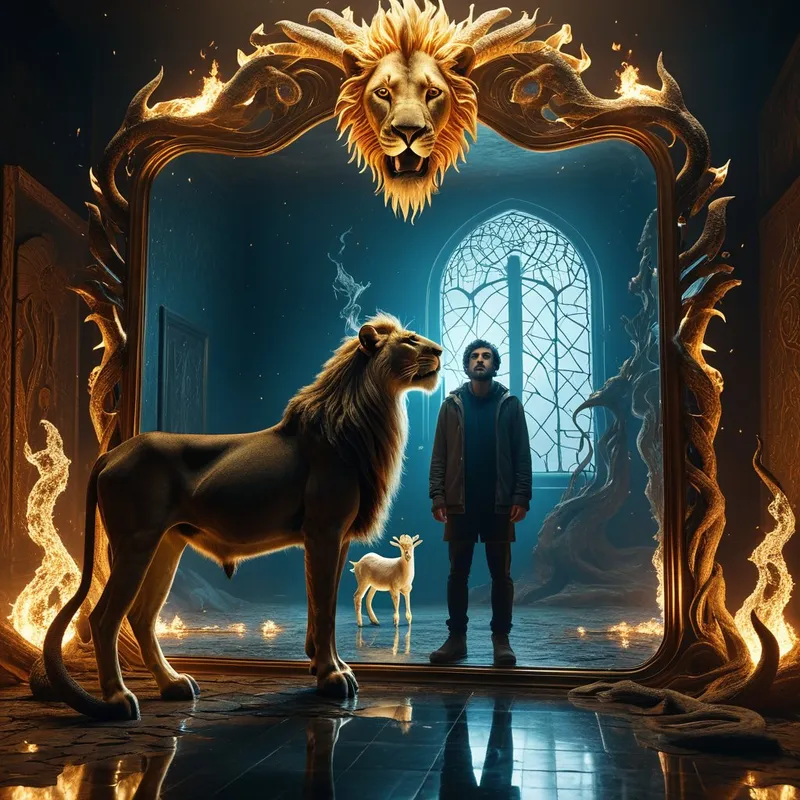
When the Chimera pattern emerges in modern dreams, it rarely appears as a literal lion-goat-serpent. Instead, one may dream of a frightening composite animal, a shapeshifting attacker, or, most commonly, a situation or relationship that feels "monstrously" complicated, with multiple conflicting, "fire-breathing" elements that seem impossible to reconcile.
Somatically, this can manifest as a feeling of being "torn apart" or "pulled in three directions," often accompanied by heat (anxiety, anger) or a choking sensation (the lead in the throat). Psychologically, this is the dreamer confronting a complex in its raw, unintegrated state. Perhaps it is a fusion of rage (lion), addictive craving (goat), and deceitful self-talk (serpent) around a particular life issue—a career, a family dynamic, a personal vice. The dream Chimera is the shadow made composite, showing the dreamer that the problem is not a single flaw but a tangled knot of interrelated psychic forces. The dream is an invitation to stop trying to fight each head separately and to seek the elevated perspective (Pegasus) and the transformative tool (the spear) that can address the root of the fiery conflict.
Alchemical Translation
The myth of the Chimera is a precise map for the alchemical process of individuation—the journey toward psychic wholeness. The monster is the prima materia, the base, confused, and chaotic state of the unconscious self at the beginning of the work.
The first step is recognition and naming. One must see the composite nature of one’s inner conflicts, to stop blaming external forces and recognize the monstrous, fire-breathing complex within. The second is ascent (Pegasus). This is the development of a transcendent function, often through reflection, therapy, art, or meditation—a way to rise above the identification with the conflict to observe it. The third is the introduction of the transformative agent (the lead). This is the conscious, often humble, intervention. In therapy, it might be a painful insight. In life, it might be a difficult but honest conversation, a boundary set, or a sacrifice made. This agent is "swallowed" by the complex (the fiery breath), and through the complex’s own energy, transmutes it.
The slaying of the Chimera is not an act of eradication, but of alchemical transmutation. The beast is not banished; its chaotic, fiery energy is neutralized and its components potentially reclaimed. The lion’s strength, the goat’s vitality, the serpent’s wisdom—all can be integrated into the personality once their monstrous, antagonistic fusion is dissolved.
The hero Bellerophon does not emerge unscathed; his later myth involves a fall for his hubris. This warns that integration is a lifelong process. To conquer one Chimera is not to be free of all inner monsters, but to learn the sacred art of the spear and the wing—the art of confronting our own impossible natures with courage, divine inspiration, and transformative cunning.
Associated Symbols
Explore related symbols from the CaleaDream lexicon: