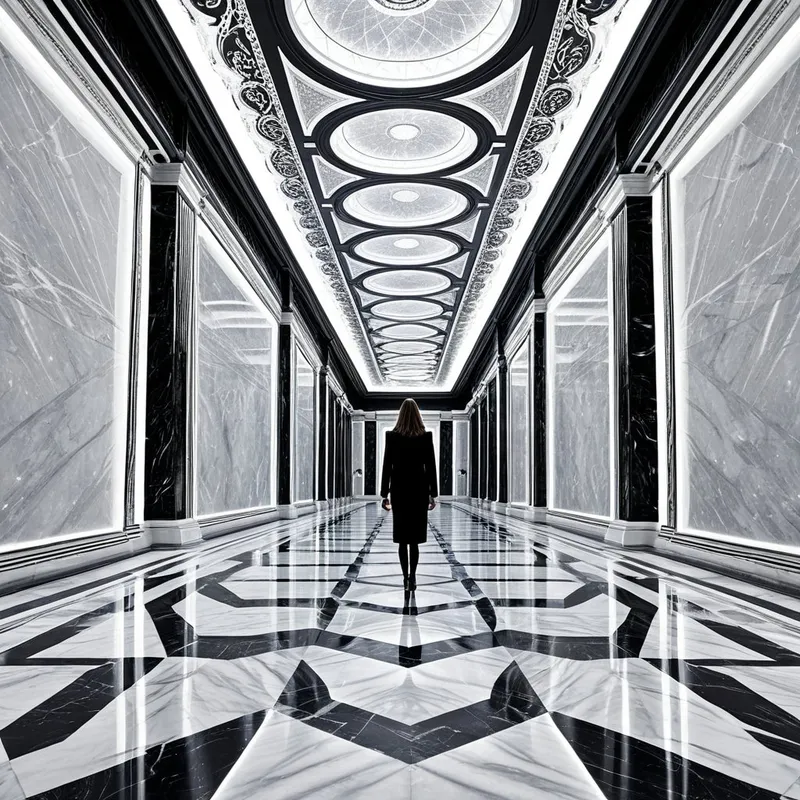
Checkerboard Floor Myth Meaning & Symbolism
A cosmic artisan sacrifices their form to become the Checkerboard Floor, the foundational pattern of reality where opposites dance and unite.
The Tale of Checkerboard Floor
In the time before time, when the Prima Materia swirled in a silent, formless sea, there existed a being known only as the Artifex Mundi. This entity was not a god of thunder or love, but of pure, unmanifest potential. It dwelled in the Vas Hermeticum, the great womb of space, and its sole desire was to bring forth a stage upon which the drama of existence could unfold.
Yet, every pattern it conceived dissolved back into the swirling mist. Light bled into dark, high merged with low, order collapsed into chaos. The Artifex Mundi saw that for a world to be born, a foundation was needed—a law, a grid, a principle of separation that would allow things to be. But this principle could not be imposed from without; it had to be woven from the very substance of the artisan.
With a resolve that shook the foundations of non-being, the Artifex began a terrible and beautiful work. It reached into its own luminous core and began to divide itself. From its right side, it drew forth all that was radiant, active, and ascending—the principle of Sulphur. This it compressed and cooled into squares of dazzling, solar white. From its left side, it drew forth all that was receptive, deep, and descending—the principle of Mercury. This it condensed into squares of abyssal, stellar black.
One by one, with agonizing slowness, the Artifex laid these tiles upon the void. Each placement was a sacrifice, a permanent limitation of its own infinite nature. As it worked, its form grew dimmer, more translucent. The cosmic hall echoed with the final, resonant click of each tile finding its ordained place. The artisan was not building a floor; it was becoming one.
Finally, as the last black tile was set adjacent to the last white, the Artifex Mundi exhaled its final breath of unbound spirit. Its form dissolved entirely, its consciousness diffusing into the perfect, endless grid it had created. In that moment, the Checkerboard Floor was born. It was not dead matter, but a living, sacred membrane. Upon its stark, alternating pattern, the dance of opposites could now begin—day and night, male and female, spirit and matter, the great game of existence made possible by a primordial act of self-sacrifice.
Cultural Origins & Context
The myth of the Checkerboard Floor is a cornerstone of the esoteric tradition known as Alchemical culture. It was never a populist fable for the masses, but a mythologem guarded and transmitted within the lodges, scriptoria, and laboratories of adepts. It was passed down through illuminated manuscripts, oral instruction, and as a pattern literally inlaid into the floors of hidden chambers where the Magnum Opus was pursued.
Its tellers were the Philosophi, who understood it not as a history of the physical world, but as a map of the opus contra naturam—the work against one's own fallen, confused nature. The myth served a critical societal function for this hidden culture: it established the first principle of all their work. Before one could seek the Philosopher's Stone, one had to acknowledge and honor the foundational law of duality. The Floor was the mandatory first step in the journey, representing the necessary stage of separatio that must precede any true coniunctio (union).
Symbolic Architecture
The Checkerboard Floor is the ultimate symbol of the differentiated world, the stage of consciousness upon which the ego is built. The Artifex Mundi represents the undifferentiated Self, the totality of the psyche before it enters the realm of opposites.
The sacrifice of the Artifex is the primordial act of consciousness: to know itself, it must first divide itself from itself.
The black and white tiles are not mere opposites in conflict; they are complementary principles in a sacred, static dance. White symbolizes Sulphur: spirit, activity, light, the masculine, and conscious awareness. Black symbolizes Mercury: soul, passivity, darkness, the feminine, and the unconscious. The Floor itself is the emergent third thing, the Salt—the stable, enduring reality that arises from their juxtaposition.
Psychologically, the myth maps the birth of the ego. The infinite potential of the unconscious (the Artifex) must sacrifice its wholeness to create the structure of the conscious mind (the Floor). This is a necessary, sacred violence. We all stand upon a personal checkerboard, the field of our own judgments, categories, and dualities (good/bad, self/other, thought/feeling) that make coherent experience possible.
The Dreamer's Resonance
When the Checkerboard Floor appears in modern dreams, it signals a profound encounter with the foundational structures of the dreamer's psyche. It is not a dream of action, but of stage.
To dream of standing on a vast, stable Checkerboard Floor suggests the dreamer is in a phase of consolidating their identity, establishing clear boundaries and principles. The psyche is affirming the necessary "floor" of the ego. Conversely, to dream of a cracking, shifting, or dissolving Floor indicates a de-structuring event—a divorce, career loss, or spiritual crisis—where the foundational assumptions of one's life are being called into question.
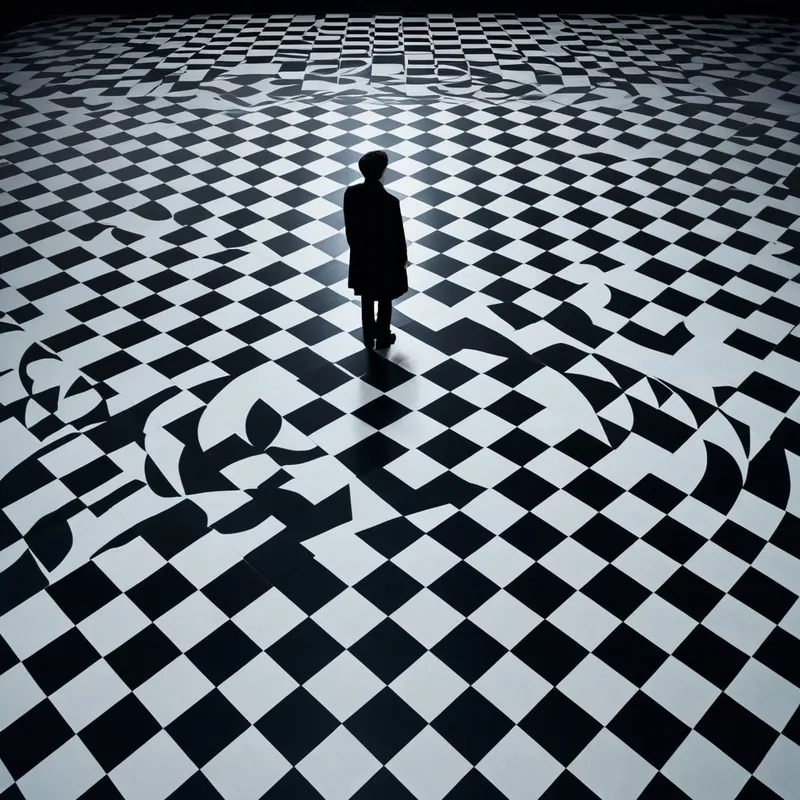
More commonly, the dream presents the Floor as a path or a puzzle. The dreamer must walk across it, often with a sense of trepidation, fearing a misstep. This somatic experience mirrors the psychological process of navigating life's dualities and making conscious choices. Each step from black to white is a movement between the unconscious and the conscious, the instinctual and the rational. The dream is an immersion in the basic algorithm of existence, asking the dreamer to become aware of the ground upon which they stand.
Alchemical Translation
For the modern individual seeking wholeness, the myth of the Checkerboard Floor models the first and most critical phase of individuation: confronting and accepting the reality of the opposites within.
The alchemical journey does not begin by transcending duality, but by fully acknowledging it. The aspiring "artifex" of their own soul must first perform the inner sacrifice of the myth. This means consciously differentiating the contents of their own psyche—mapping out their inner black and white squares. What is my light (my virtues, my conscious goals) and what is my shadow (my repressed desires, my weaknesses)? This is the labor of separatio.
The goal is not to live on only the white squares of virtue or to fall into the black squares of shadow, but to become the living Floor that holds both in a creative tension.
This process is the creation of the Vas, the sealed container of the work. By consciously mapping our inner checkerboard, we create a bounded psychological space where transformation can safely occur. We stop identifying exclusively with one side of our nature and begin to see ourselves as the field that contains the interplay. From this grounded, conscious position—standing firmly on the recognition of our own complexity—the later, more volatile stages of the work (Nigredo, Albedo) can be endured. The Floor is the stable foundation that prevents the alchemist from being utterly dissolved in the chaos of their own unconscious.
In the end, the myth teaches that our very limitations—the black and white squares of our character, our history, our binaries—are not obstacles to enlightenment, but its sacred and necessary foundation. We are, each of us, both the sacrificing Artifex and the resulting Floor, eternally creating the stage upon which the mystery of our own being unfolds.
Associated Symbols
Explore related symbols from the CaleaDream lexicon: